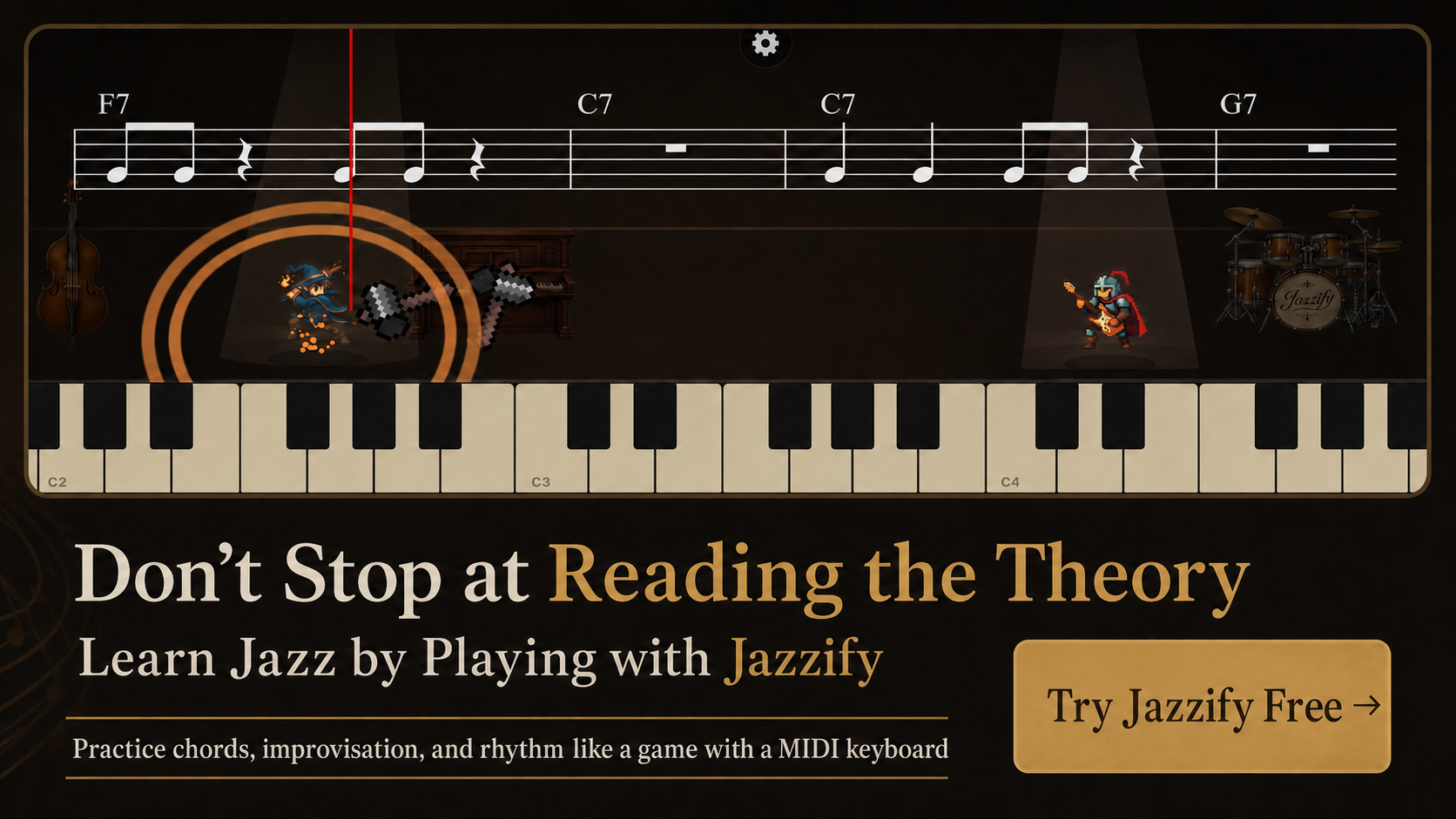
Jazz piano backing tracks — bass and drums without piano — let you practice comping, soloing, and form at realistic tempos without coordinating a live rhythm section. Used well, play-alongs build time feel and repertoire stamina; used poorly, they become background noise while you repeat the same safe voicings.
This guide covers track types, tempo selection, structured practice routines, and integration with MIDI-based learning tools.
Types of Backing Tracks
Style-based vamps
Modal vamps (Dm7 for 8 bars), blues in F, ii–V–I loops in C — no full form, ideal for voicing and solo drills.
Full-form standards
32-bar AABA or 12-bar blues with intro and ending cues — tests form memory and bridge navigation.
Rhythm-section only recordings
Classic play-along series (Jamey Aebersold-style) with written chord charts — gold standard for jazz education.
App-generated accompaniment
Browser tools generate bass and drums from chord symbols you enter or select — instant custom keys and tempos.
Choosing Tempo and Key
Start 15–20 BPM below your target performance tempo. If you want to comp "Take the A Train" at 140, first clean run at 120 with correct voicings every change.
Key selection:
- Learn in original lead-sheet key first (often B-flat or F for brass-friendly tunes)
- Transpose to C for initial harmonic study if unfamiliar with flats
- Practice singer keys (G, C, D) once form is solid
Standard-specific harmony: Take the A Train comping, Fly Me to the Moon chords.
Equipment Setup
Connect MIDI keyboard to laptop or tablet; route backing track audio to speakers or headphones separate from metronome if both used. Avoid Bluetooth audio for play-along if latency causes your comp to sit behind the beat — wired headphones preferred.
MIDI setup: Windows, browser MIDI support, latency reduction.
Structured Comping Practice (20 Minutes)
- 5 min — Listen: One chorus without playing; count form aloud; note bridge entry bar.
- 5 min — Roots only: Left hand roots on beat 1; confirm every change.
- 5 min — Shell voicings: Add third and seventh; Charleston or half notes.
- 5 min — Rootless comp: Full voicings; vary rhythm on beats 2 and 4.
Do not solo until comping survives full form without wrong roots.
Solo Practice with Backing Tracks
Restrict pitch material to force creativity:
- Chorus 1: D minor pentatonic only on ii–V–I in C
- Chorus 2: G dominant bebop on V bars; pentatonic elsewhere
- Chorus 3: Mix guide tones (3rds and 7ths) with enclosures
Pentatonics: pentatonic scales guide. Bebop: bebop scales guide.
Trading Fours and Eights
Many tracks include silent breaks for call-and-response. Use them to:
- Answer drummer's figure with short chord hit or single-line motif
- Practice ending phrases on beat 4 of bar 4 with clear resolution on bar 1
- Imitate recorded bass line rhythm in left hand during your four bars
If track has no breaks, mute playback every four bars manually — crude but effective.
Common Play-Along Mistakes
- Ignoring form: Getting lost at bridge — fix by counting bars, not guessing
- Same voicing grip every chord: Physical comfort over voice leading
- Playing through clams: Stop, rewind four bars, restart clean
- Tempo too fast: Ego over accuracy — plateau result
- Passive listening: Track on while checking phone — no motor learning
Blues and Modal Backing Tracks
Blues in F: F7–Bb7–C7 changes — comp with shell F7 (F–A–Eb), Bb7 (Bb–D–Ab), add 13ths when comfortable. Walking bass optional in left hand.
Modal D Dorian: 8- or 16-bar Dm7 vamp — quartal comp; pentatonic solo. See So What modal comping.
Building a Personal Track Library
Organize by function:
- Folder A: ii–V–I loops — all keys, 80–140 BPM
- Folder B: Active standards — full form, two tempos each
- Folder C: Ballads — slow tempos for voicing study
- Folder D: Blues — F, Bb, C, G
Label files with key and BPM in filename — saves session setup time.
Integrating with Weekly Schedule
Use backing tracks on integration day (e.g., Friday in a five-day plan):
- Monday–Thursday: silent metronome work
- Friday: full chorus play-along; record one take
Schedule template: practice schedule for busy adults.
When to Stop Using Tracks
Graduate to live jam or internal time when:
- Three consecutive recordings show clean form at target tempo
- You anticipate bridge without counting
- Comping rhythm varies beyond Charleston autopilot
Tracks remain useful for maintenance even after — professional pianists use play-alongs for warmup.
Customizing Tracks With Chord Charts
If a backing track's harmony differs from your Real Book chart, trust the chart you are studying and mute the track during conflicting bars — or annotate differences on paper before playing. Many play-along editions use simplified bridge changes. Pianists who comp blindly against mismatched harmony train wrong reflexes that surface at jam sessions.
For original compositions in browser apps, enter chord symbols exactly as you notated them so generated bass lines match your voicing drills from silent practice.
Counting Form During Solos
During solo choruses, maintain form awareness by whispering bar numbers at section boundaries (8, 16, 24) or tapping foot on beat 1 each bar. Getting lost at bar 17 of a 32-bar form ruins the return to the head. Practice one chorus comp plus one chorus solo plus one chorus comp — full three-chorus simulation before jam sessions.
Volume Balance and Room Acoustics
Backing track volume should sit below your piano in headphones so you lead time feel — not follow a loud drum mix that masks voicing errors. In untreated rooms, low-frequency buildup from laptop speakers exaggerates bass on tracks; use headphones or EQ that reduces mud below 100 Hz when practicing comping clarity.
Tempo Maps for Active Tunes
Keep a tempo map card for each active standard: start tempo, target tempo, and date last recorded clean. Example: "Fly Me to the Moon — start 80, target 120, last clean 100 on 2026-08-01." Backing tracks make tempo increases measurable — bump 5 BPM only after two clean play-along choruses at the current ceiling.
Summary
- Backing tracks provide bass and drums for comping and solo practice.
- Start below target tempo; learn form before soloing.
- Progress roots → shells → rootless over 20-minute structured session.
- Restrict solo pitch material by chorus to build vocabulary.
- Organize track library by function; use on weekly integration day.
- Fix mistakes by rewinding — do not play through errors repeatedly.
Play the Jazzify demo right now
Connect a MIDI keyboard and play this interactive demo in your browser.
On iPhone and iPad, browsers cannot use a MIDI keyboard. Please use the Jazzify app instead.