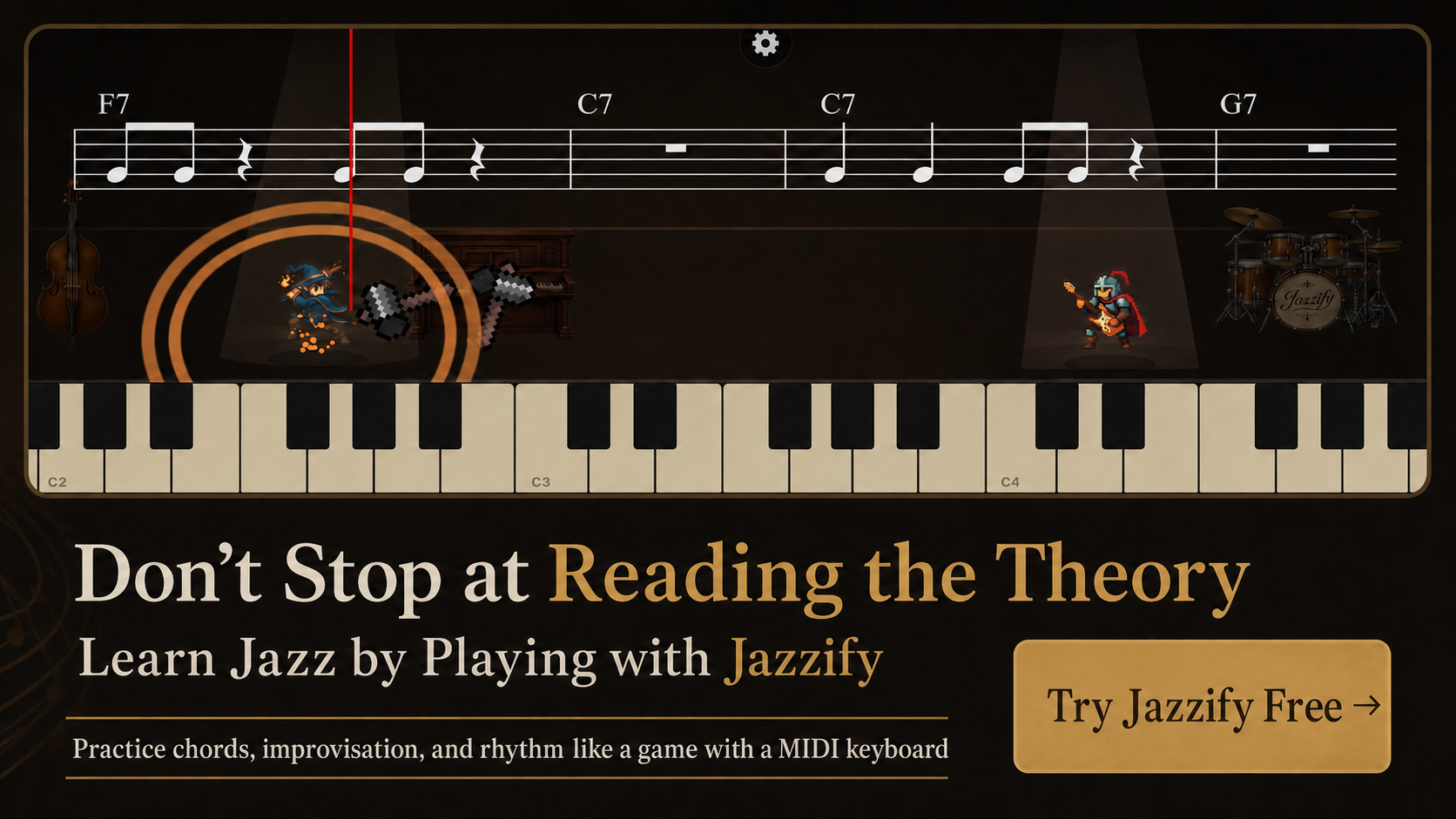
Your first jazz jam session does not require perfect technique or a huge repertoire. It requires a few prepared tunes, a basic understanding of form, honest communication, and enough listening to stay connected with the other musicians.
This guide explains how to choose the right session, what to practice, which details to confirm on stage, how pianists can comp supportively, and what to do when something goes wrong.
Choose a Beginner-Friendly Jazz Jam
Look for an event described as a beginner jam, workshop, slow session, or student session. Contact the host before attending and ask:
- Are first-time players welcome?
- Is there a house song list or preferred lead-sheet book?
- Do participants sign up in advance or after arriving?
- Is a piano or keyboard provided?
- Are there minimum purchase, cover-charge, or participation rules?
- May you attend once as a listener?
Each venue has its own system. Asking removes uncertainty and shows respect for the host. If possible, observe the session before playing. Note how tunes are called, how long solos last, and how the host communicates endings.
Prepare Two or Three Tunes, Not Twenty
Ask the host which tunes appear regularly. Common beginner starting points include:
- a 12-bar blues such as Now’s the Time or Blue Monk;
- Autumn Leaves for major and minor ii-V-I movement;
- Blue Bossa for a clear form and contrasting Latin feel;
- Satin Doll for repeated ii-V patterns;
- There Will Never Be Another You when the group expects a standard 32-bar tune.
Lists vary by country, venue, and skill level, so local information matters more than any universal “must-know” ranking.
What You Should Know for Each Tune
Prepare more than the chord symbols. For every tune, know:
- Title and key: be able to state both clearly.
- Melody: play or sing it well enough to recognize your place.
- Form: know whether it is 12-bar blues, AABA, ABAC, or another structure.
- Harmony: play the chords through the entire form without stopping.
- Style and tempo: choose a comfortable swing, ballad, bossa, or other feel.
- Comping: support the melody and solos with simple, well-timed voicings.
- Solo plan: improvise one chorus using chord tones and simple rhythms.
- Ending: know whether you want the last phrase, a repeat, or a standard cue.
If you cannot provide an introduction, say so. Ask for a count-in or request that another player begin. Clear communication is better than pretending.
A Minimal Piano Preparation Plan
Practice the form without stopping
Set a slow tempo and play through the entire tune. If a difficult chord appears, simplify it to the root, 3rd, and 7th rather than losing the pulse.
Comp with space
Use short rhythmic figures and leave room for the melody or soloist. The piano does not need to fill every beat. Practice listening to the recording while adding only one or two chord attacks per bar.
Solo with chord tones
Begin with roots, 3rds, and 7ths. Create two-bar phrases and rests. A clear rhythmic idea that follows the form is more convincing than running a scale continuously.
Simulate the whole performance
Practice the sequence: count-in, melody, solo choruses, accompaniment, return to the melody, and ending. Do not restart after mistakes. This prepares you to recover in real time.
What to Bring
- the lead-sheet source requested by the host;
- a short written list of your prepared tunes and keys;
- a pencil and small notebook;
- any required cables or adapters if a keyboard is not provided;
- a payment method for the venue charge, food, or drink;
- ear protection if the room may be loud.
A pianist normally uses the venue’s instrument, so arrive early enough to check the bench, volume, pedal, and keyboard sound without delaying the session.
What Happens When You Arrive
- Tell the staff or host that you are participating in the jam.
- Sign in with your name and instrument if there is a list.
- Tell the host that this is your first session.
- Ask how players are called and whether tune requests are written down.
- Listen until your name is called.
Do not assume that every session follows the same procedure. Some hosts assemble groups, while others invite players to approach the stage.
Communication Before the Tune Starts
Confirm these details with the band:
- tune title and key;
- feel and approximate tempo;
- who plays the melody;
- solo order and whether trading fours is expected;
- how the tune will begin;
- how the final melody and ending will be cued.
Count off a tempo you can actually maintain. Silently hear two bars before giving the count. If another musician starts the tune, watch and listen for the pulse.
Jazz Jam Session Etiquette for Pianists
- Introduce yourself and acknowledge the other players.
- Keep your volume low enough to hear the bass and drums.
- Do not double the soloist’s melody or fill every silence.
- Watch the host and musicians for visual cues.
- Keep solos to the expected length; one clear chorus is enough.
- Do not change the keyboard setup drastically without permission.
- Ask before recording or posting anyone’s performance.
- Thank the musicians and host after the tune.
How to Recover from Common Mistakes
You lose the form
Stop adding dense harmony. Listen to the bass line, melody, and drummer’s phrase. Look for the next recognizable section and re-enter with simple guide tones.
You play a wrong chord
Keep the pulse. Move to the next chord rather than trying to repair the previous beat. One wrong voicing is less disruptive than stopping the form.
You do not know how to solo
Decline the solo, or play one short chorus using chord tones and space. There is no requirement to accept every solo cue at a beginner session.
The tempo feels too fast
Simplify. Use shells, fewer chord attacks, and shorter melodic phrases. After the tune, note the tempo as a specific practice target.
Use the Session as a Feedback Loop
After the jam, write three observations:
- What worked under real performance pressure?
- Where did time, form, harmony, or communication become unclear?
- What is the smallest exercise that addresses the biggest problem?
Then prepare, return, and test the improvement. Jazzify can support the practice phase by helping you repeat chords, improvisation, and rhythm before the next session. The jam supplies real-world feedback that an isolated exercise cannot.
First-Jam Checklist
- I chose a beginner-friendly session and checked the venue rules.
- I can name two or three tunes and their keys.
- I know the melody, form, chords, feel, and ending plan.
- I can comp simply without stopping.
- I can solo one chorus or politely decline.
- I know how to ask for a count-in instead of an introduction.
- I will listen, communicate, and keep going after mistakes.
Play the Jazzify demo right now
Connect a MIDI keyboard and play this interactive demo in your browser.
On iPhone and iPad, browsers cannot use a MIDI keyboard. Please use the Jazzify app instead.