If you are wondering how to learn jazz piano by yourself, the first step is not choosing a scale or buying another method book. It is defining what “playing jazz piano” means for you. A roadmap for joining jam sessions will look different from one for arranging favorite songs at home.
This beginner plan helps you choose a realistic goal, assess your starting point, build the essential skills in the right order, and create a weekly practice loop that turns information into music.
Define the Kind of Jazz Pianist You Want to Become
“I want to play jazz” is too broad to produce a useful practice plan. Choose one primary outcome for the next three months:
- Jam-session player: read lead sheets, comp, improvise, and follow a rhythm section.
- Solo pianist: combine melody, harmony, bass movement, and form without other musicians.
- Jazz arranger: reharmonize pop songs or standards and create polished solo arrangements.
- Improviser: develop melodic vocabulary and navigate common progressions in time.
- Recreational learner: understand jazz harmony and play favorite tunes at a comfortable pace.
These goals overlap, but they do not require the same priorities. A future jam-session pianist needs time, form, comping, and interaction early. A solo player must also learn melody-and-bass coordination. An arranger needs more harmonic analysis and voice leading.
Assess Your Starting Point
A “jazz beginner” may be completely new to the piano, classically trained, experienced in another instrument, or already fluent in harmony. Use four questions to locate your real starting point:
- Can you name the notes on the keyboard without counting from C?
- Can you play major scales and basic seventh chords in several keys?
- Can you keep a steady pulse with a metronome or recording?
- Can you learn a short melody by ear and identify where the form repeats?
If the keyboard itself is unfamiliar, build basic piano coordination alongside jazz study. If you already have classical technique, spend less time on finger mechanics and more on rhythm, chord symbols, lead sheets, ear training, and improvisation.
The Six Skills Every Self-Taught Jazz Pianist Needs
1. Keyboard geography and intervals
Know note names, major scales, and intervals well enough to build rather than memorize. Intervals let you transfer a chord, voicing, or phrase into another key.
2. Seventh chords and common progressions
Learn major seventh, dominant seventh, minor seventh, and half-diminished chords. Then apply them to major ii-V-I progressions and the blues. Do not collect isolated shapes without understanding their roots, 3rds, and 7ths.
3. Rhythm and time
Jazz is not created by harmony alone. Practice quarter notes, offbeats, rests, syncopation, and swing feel. Record yourself with a metronome and check whether the pulse remains stable when the notes become difficult.
4. Ear training and transcription
Sing roots, guide tones, and short phrases before playing them. Transcribe material small enough to understand: one rhythmic idea, one voicing, or two bars of a solo. Ear work should connect sound, notation, and the keyboard.
5. Repertoire and form
Learn complete tunes, not only exercises. For each standard, know the melody, chord progression, form, key centers, and one playable ending. A small repertoire of deeply learned songs is more useful than dozens you cannot perform from beginning to end.
6. Improvisation and interaction
Begin with chord tones and simple rhythms. Create short phrases, leave space, and respond to the harmony. If your goal includes playing with others, use backing tracks and eventually rehearse with real musicians.
A 12-Week Beginner Roadmap
| Weeks | Main focus | Practical result |
|---|---|---|
| 1-2 | Note names, intervals, major scales, steady pulse | Navigate the keyboard and count basic intervals |
| 3-4 | Four seventh-chord qualities | Build chords from formulas in several keys |
| 5-6 | Major ii-V-I and guide tones | Hear and play functional resolution |
| 7-8 | One blues and one standard | Play melody, chords, and form from start to finish |
| 9-10 | Chord-tone improvisation and transcription | Create short phrases and learn ideas by ear |
| 11-12 | Performance simulation | Play complete takes without stopping |
Keep the repertoire simple enough that you can hear progress. The purpose of the schedule is not to “finish jazz” in twelve weeks. It is to establish a repeatable learning cycle.
A 45-Minute Jazz Piano Practice Plan
- 5 minutes: pulse, clapping, and one rhythmic pattern.
- 10 minutes: scales, intervals, and seventh chords in the current key.
- 10 minutes: ii-V-I voicings with smooth voice leading.
- 10 minutes: melody, harmony, and form of one tune.
- 5 minutes: ear training or a tiny transcription.
- 5 minutes: one recorded performance without stopping.
If you have only twenty minutes, keep rhythm, one harmonic skill, and one piece of repertoire. Consistent focused practice is more valuable than an occasional long session filled with unrelated material.
How to Learn Jazz Piano Online Without Getting Lost
Online lessons make self-study flexible, but unlimited information can become a problem. Use one structured curriculum as the spine of your work. Add videos, articles, and recordings only when they answer a specific question in that curriculum.
For every lesson, complete this loop:
- Understand the concept.
- Play it slowly and accurately.
- Hear and sing the important notes.
- Apply it to a tune.
- Record the result.
- Review it on another day and in another key.
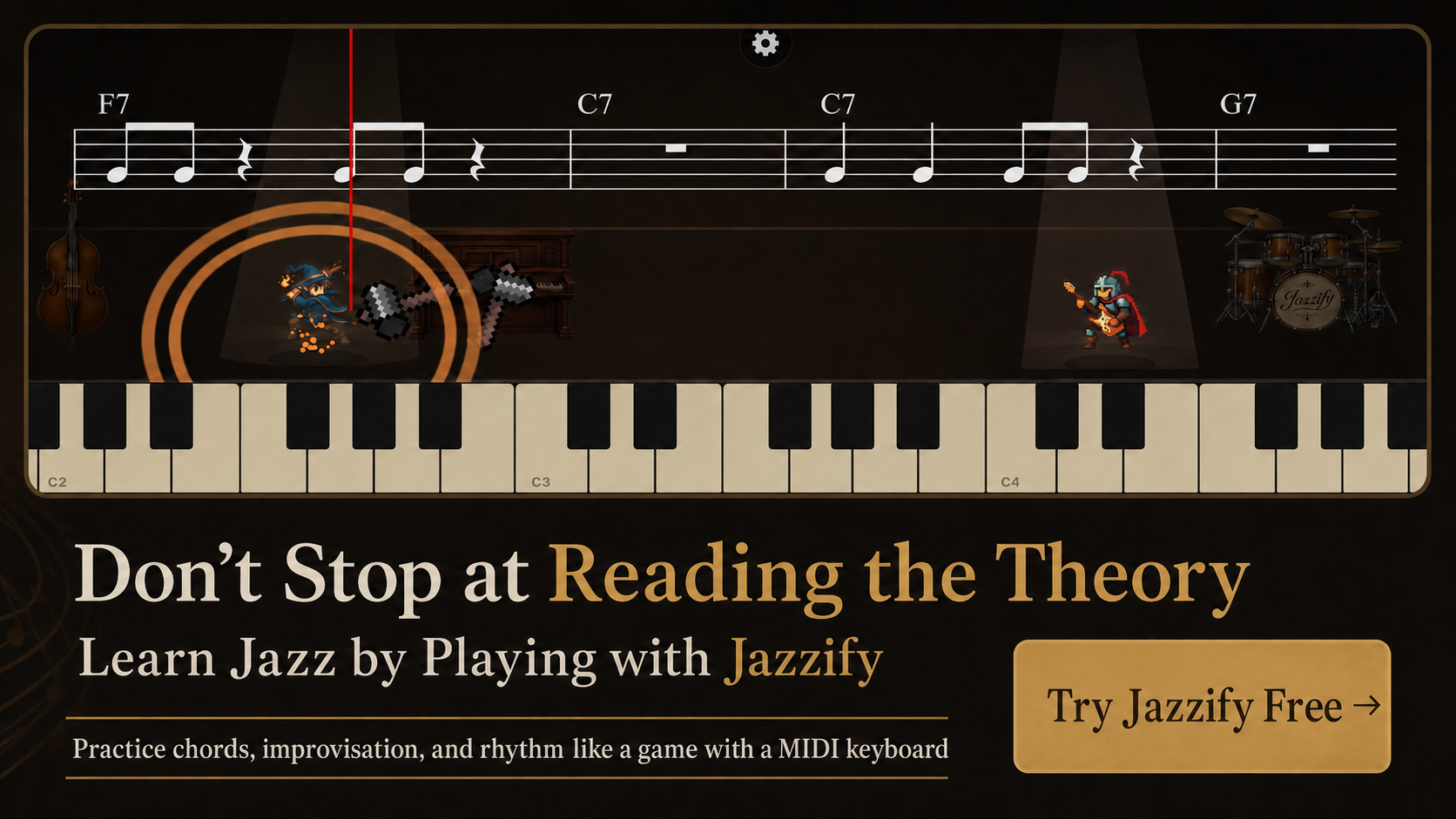
Jazzify can support that application stage by connecting chords, improvisation, and rhythm in playable practice. Use it to repeat a concept after you understand the theory, then return to real repertoire to confirm that the skill transfers.
Common Self-Study Mistakes
- Studying theory without sound: sing, play, and apply every concept.
- Practicing shapes without function: identify roots, guide tones, and resolutions.
- Changing resources constantly: follow one sequence long enough to measure progress.
- Ignoring rhythm: include time practice from the first week.
- Waiting to feel ready for tunes: use easy repertoire as the place where skills meet.
- Never seeking feedback: compare recordings, ask a teacher occasionally, or play for other musicians.
When a Teacher Can Help
Learning independently does not mean refusing all guidance. A teacher can diagnose inefficient movement, unclear rhythm, or a misunderstanding that you may not hear yourself. Even an occasional lesson can keep a self-directed plan aligned with your goal.
Seek help when the same problem survives several focused practice sessions, when pain or tension appears, or when you cannot tell what to practice next. The aim is not dependence; it is faster, safer feedback.
Summary
- Define the kind of jazz piano you want to play before choosing a method.
- Adjust the roadmap to your existing piano, theory, rhythm, and ear skills.
- Study keyboard knowledge, chords, rhythm, ear training, repertoire, and improvisation together.
- Use one structured course and apply each lesson to a complete tune.
- Record yourself and build a regular feedback loop.
- A small, consistent practice plan can take a self-taught pianist much further than scattered information.
Play the Jazzify demo right now
Connect a MIDI keyboard and play this interactive demo in your browser.
On iPhone and iPad, browsers cannot use a MIDI keyboard. Please use the Jazzify app instead.