Jazz piano rhythm practice is often neglected because harmony is easier to measure. You can see whether you hit a B-flat on a C7 chord. Swing is harder to grade—it lives in placement, articulation, and silence. Yet weak time feel exposes a beginner faster than wrong extensions.
This guide breaks swing into workable parts: eighth-note placement, accent on beats 2 and 4, anticipation across bar lines, and deliberate use of space in comping and soloing.
Swing Is Not a Notation Marking
Writing “swing eighths” on a page does not produce swing. Swing is a ratio between the long and short parts of each beat division—often described as triplet feel (long-short within a triplet) but executed with personal nuance. Listen to Wynton Kelly comping behind Miles Davis: the rhythm breathes.
Your first job is to align with 2 and 4. Jazz walk and ride patterns emphasize those beats. When your internal pulse matches the hi-hat, harmonic mistakes sound less fatal.
Exercise 1: Metronome on 2 and 4 Only
Set a metronome to half the tempo you want—if the tune is quarter note = 120, set 60 and treat each click as beat 2 or 4 of consecutive bars. Clap on 2 and 4. Then play left-hand shells on every beat while the metronome marks 2 and 4.
On Fmaj7, play F-A-C-E as quarter notes in the left hand. Keep the right hand silent. If you drift, the metronome exposes it. This is foundational for metronome practice on beats two and four.
Exercise 2: Swing Eighths on a Single Note
Play repeated swing eighths on middle C with one finger. Record at tempo 80. Listen for:
- Even spacing—not rushing the offbeats;
- Short release on the short part of the swing;
- Consistent dynamic without accenting every note equally.
Then move to a scale fragment: C-D-E-G on Cmaj7, same rhythm. The harmony is trivial; the rhythm is the lesson.
Exercise 3: Charleston and Offbeat Placement
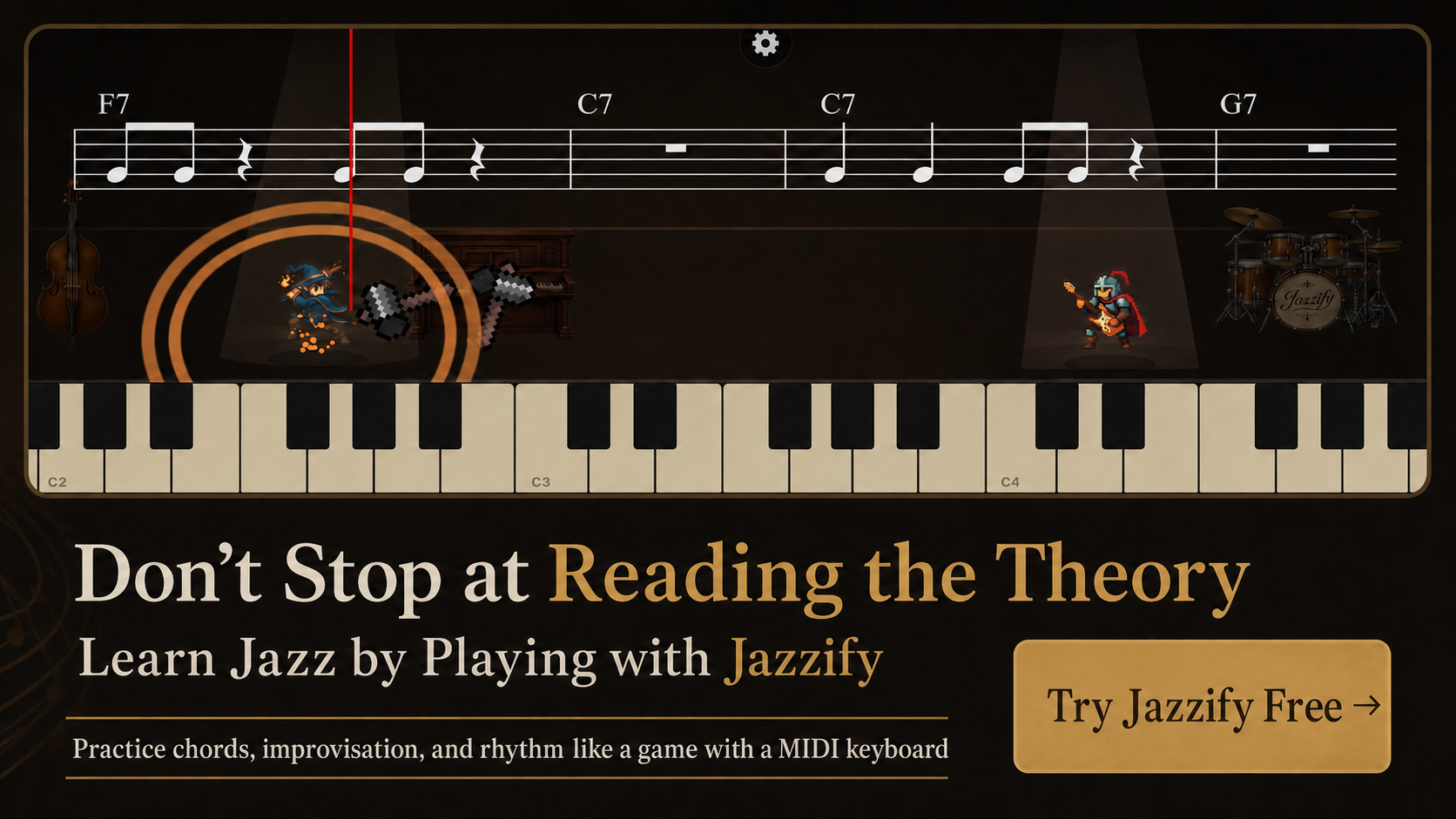
Play the Charleston rhythm on one chord: F7 on beat 1, F7 staccato on the and-of-2, rest on 3–4. Repeat for two minutes without speeding up.
Next, shift the second hit to the and-of-2 slightly late— “laid back.” Compare early ( pushing) versus late ( laying back ) placement by recording both. Soloists and compers adjust micro-timing constantly.
Exercise 4: Anticipation Into the Next Chord
Anticipation means playing a chord or note before the downbeat where it theoretically belongs. On a ii-V-I in C, play G7 on the and-of-4 of the Dm7 bar, landing early into the dominant before beat 1 of the G7 measure.
Guide tones help: move F and C on Dm7 to F and B on G7 one eighth note early. The ear accepts the early dominant if the bass still resolves on beat 1. Pianists anticipate more often than beginners expect.
Exercise 5: Space in Comping
Play four bars of Dm7-G7-Cmaj7. Rule: maximum three chord attacks per bar. Force yourself to leave at least one beat empty each measure. The silence defines the groove as much as the attacks.
Then solo with the same rule—only three notes per bar on a blues in F. You will choose stronger notes and hear the rhythm section’s role more clearly. Comping patterns from our jazz piano comping patterns article pair well with this restriction.
Exercise 6: Rhythmic Displacement of a Motif
Take a four-note motif—G, B, D, F on C7. Play it starting on beat 1. Repeat starting on the and-of-1, then beat 2, then the and-of-2. Keep the swing ratio identical; only the placement changes.
This builds flexibility for soloing and for aligning with drummers who shift accent patterns. Harmony stays fixed; rhythm carries the study.
Connecting Rhythm to Harmony
Rhythm practice should not live in isolation. After single-note drills, apply swing eighths to chord-tone lines on ii-V-I:
Dm7: F-A-C-A (8th notes); G7: B-D-F-E; Cmaj7: E-G-B-G. Resolve E on Cmaj7 on beat 1 of the new bar. Tie rhythm to the guide tones you already know.
Common Rhythm Problems and Fixes
- Rushing the tempo when chords change: Slow down five clicks; keep voicing changes on beat 1 only until stable.
- Equal-length eighths: Sing “du-da” with a longer first syllable; match the keyboard.
- Filling every beat when soloing: Use the three-notes-per-bar limit for one chorus daily.
- Ignoring 2 and 4: All metronome work should include a 2-and-4 phase weekly.
Articulation: Short Versus Legato Comp Hits
Charleston and offbeat comping use short, detached articulation—release the chord quickly so resonance does not blur the next attack. Ballad shells can be legato for warmth. Practice the same Dm7-G7-Cmaj7 progression twice: staccato at tempo 90, then legato at tempo 70. Record both; the swing ratio stays similar but the groove character changes.
Polyrhythm Preview: Three Against Four
Advanced but useful later: play Charleston in the right hand while the left hand plays roots on beats 1 and 3 only. The hands disagree rhythmically while agreeing on harmony—classic independence training. Start at tempo 60 for one minute per day; do not let the right hand rush when the left hand simplifies.
Playing With Recordings
After metronome drills, comp along with a medium-up swing recording. Match the drummer’s hi-hat on 2 and 4 rather than the ride’s subtle skip. If you consistently ahead of the ride, return to half-time metronome work for three days before recording again.
Latin and Bossa Versus Swing
Bossa and samba emphasize different subdivisions—straight eighths, not triplet swing. When practicing Blue Bossa or Song for My Father, turn off swing mental model and align with the bass pattern on 1 and and-of-2. Mixing swing comping into bossa is a common genre mistake heard immediately by listeners even when chords are correct.
Long-Form Time Stability
Play twelve choruses of blues comp with metronome 2/4 without stopping. Fatigue shows in bar 9 of later choruses—tempo creeps up. Mark the chorus where drift begins; that is your current endurance limit. Extend by one chorus per week rather than raising BPM prematurely.
Summary
- Swing lives in placement and articulation, not only in notation.
- Practice with metronome on 2 and 4; clap before you comp.
- Use Charleston, anticipation, and space exercises on ii-V-I and blues.
- Displace motifs to build rhythmic flexibility without new harmony.
- Connect every rhythm drill eventually to guide-tone lines and comping.
Play the Jazzify demo right now
Connect a MIDI keyboard and play this interactive demo in your browser.
On iPhone and iPad, browsers cannot use a MIDI keyboard. Please use the Jazzify app instead.