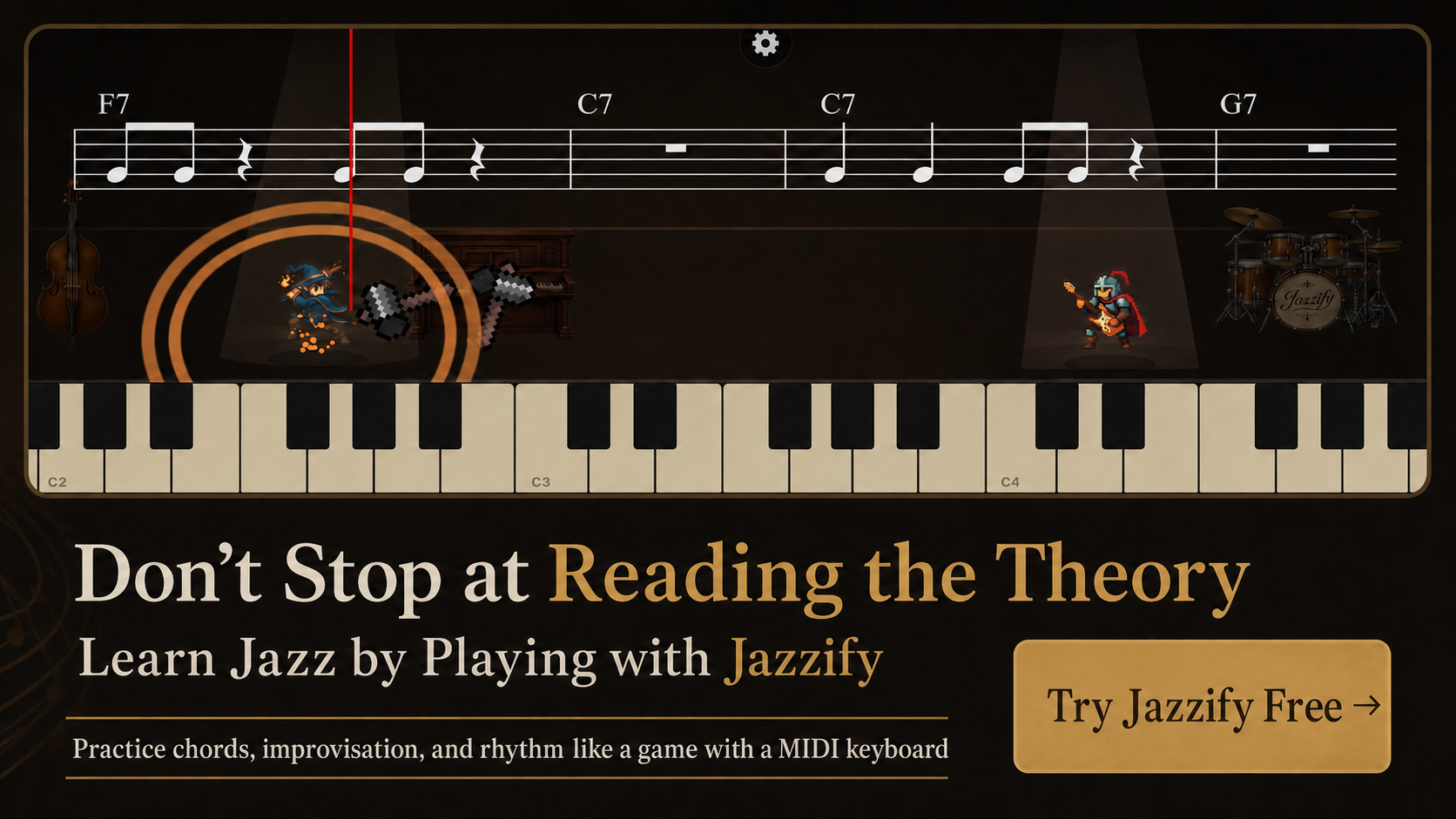
Jazz piano comping patterns are repeatable rhythmic frameworks that let you accompany a soloist or play along with a recording without reinventing your hands on every measure. Comping is not about filling every beat. It is about choosing when to speak and when to leave space.
This guide introduces four beginner-friendly patterns, shows how to apply them over a ii-V-I and a blues, and explains how to connect comping rhythm with clear voice leading in your voicings.

What Comping Means on Piano
Comping is short for “accompanying.” On piano you typically play chord voicings in the middle register while a bass player covers roots or while your left hand handles roots separately. Your job is to outline the harmony, reinforce the form, and respond to the soloist’s phrasing.
Beginners often comp too densely. Professionals comp with restraint. Start by playing less than you think you need.
Pattern 1: Freddie Green–Style Quarter Notes
Named after the Count Basie guitarist, this pattern uses steady quarter-note chords—often shells or guide-tone voicings—on every beat or every other beat in medium swing.
Over Dm7-G7-Cmaj7 in C major, play:
- Beat 1 of bar 1: Dm7 shell (D and C, the 7th, in the left hand; F and C, the 3rd and 7th, in the right);
- Beat 2: repeat or move to a nearby inversion;
- Continue through G7 (G-F in the left, B-F in the right) into Cmaj7 (C-B in the left, E-B in the right).
Keep dynamics even and articulation short. This pattern builds time feel and forces you to know voicings in every inversion.
Pattern 2: The Charleston Rhythm
The Charleston places a chord on beat 1 and a shorter hit on the “and” of beat 2, leaving beats 3 and 4 open in many contexts:
1 — (rest) — and-of-2 — (rest) —
On a blues in F, try F7 on beat 1 and a staccato F7 on the and-of-2, then Bb7 the same way in bar 2. The rests are part of the groove. Practice with a metronome clicking on 2 and 4 to internalize swing.
This pattern appears in countless small-group recordings. It sounds simple and feels sophisticated when your voicings move smoothly.
Pattern 3: Syncopated Offbeat Hits
Offbeat comping emphasizes beats 2 and 4—or the “and” of 1 and the “and” of 3—creating forward motion without constant quarter notes.
On Gm7-C7-Fmaj7 (ii-V-I in F), hit Gm7 on the and-of-1, C7 on beat 4, Fmaj7 on the and-of-2 of the next bar. Experiment with two-note guide-tone voicings: Bb and F on Gm7, E and Bb on C7, A and E on Fmaj7.
Offbeat patterns teach anticipation. You are often placing the next chord slightly before the bar line where a beginner expects it.
Pattern 4: Call-and-Response With Space
Play a short two-beat figure, rest for two beats, then answer with a related voicing or a upper-structure color. On C7, play a shell on beats 1–2, rest on 3–4, then play C7 with a added D (the 9th) on the next bar’s beats 1–2.
This mimics conversational comping behind a horn player. The silence is as important as the chord.
Voice Leading While You Comp
Rhythm without voice leading sounds blocky. When moving from Dm7 to G7, keep common tones and move inner voices by step. Dm7 might be F-C in the right hand; G7 becomes F-B (the 7th and 3rd of G7)—F stays, C moves down to B.
Review jazz piano guide tones for the 3rd-and-7th framework that makes these moves audible. Strong comping connects chords like sentences, not like a slideshow of unrelated grips.
Applying Patterns to a Blues Form
A basic F blues uses F7-Bb7-F7-F7, Bb7-Bb7-F7-F7, C7-Bb7-F7-C7 (with many variations in the last four bars). Choose one comping pattern and stay with it for the entire chorus before switching.
Example: Charleston on F7 (beat 1 and and-of-2), same on Bb7, then shorten hits to half notes in bar 11 when the turnaround intensifies. For left-hand root options while you comp with the right, see jazz piano left-hand voicings.
Practice Method: One Pattern, One Form, One Key
- Pick one pattern from this article.
- Apply it to a ii-V-I in C, F, and B-flat at quarter note = 80.
- Apply the same pattern to a blues in F at the same tempo.
- Record yourself. Listen for even time, clear harmony, and unwanted gaps where you lost the form.
- Only then add a second pattern for contrast on the repeat of the form.
Speed is irrelevant until the pattern feels automatic. Most beginners should stay under tempo 100 for several weeks.
Comping With a Backing Track or App
Practice comping against a steady bass line or drum groove so you learn to stay in the pocket. If you play alone, use a metronome on 2 and 4 rather than all four beats—closer to how swing feels on the bandstand.
Interactive tools that score your chord timing help you notice when you rush the and-of-2 or clip the Charleston short. The goal is repeatable groove, not flashy voicings.
Mixing Patterns Within a Form
Once each pattern is stable alone, assign roles by section: Freddie Green quarters on the head, Charleston behind the first solo chorus, sparse offbeat hits when the drummer drops to brushes. On a 32-bar AABA tune, many pianists comp denser on the bridge and lighter on the last A to avoid covering the final melody statement.
On Dm7-G7-Cmaj7, try quarters through Dm7 and G7, then half-note shells on Cmaj7 to mark arrival. The rhythmic contrast reinforces harmonic resolution without louder dynamics.
Ballad Comping: Even Simpler Patterns
At slow tempos (quarter note = 60–72), whole-note guide-tone voicings or half-note shells often suffice. On Cmaj7-Fmaj7-Dm7-G7, hold E and B on Cmaj7 for two beats, move to A and E on Fmaj7, F and C on Dm7, B and F on G7—one change every two beats. Avoid Charleston on ballads until the melody is secure; space is the default texture.
Summary
- Comping is rhythmic accompaniment with harmonic clarity and space.
- Start with Freddie Green quarters, Charleston, offbeat hits, or call-and-response.
- Connect voicings with guide-tone voice leading on ii-V-I and blues forms.
- Practice one pattern through a full form before mixing patterns.
- Use recording or feedback to fix time feel before raising tempo.
Play the Jazzify demo right now
Connect a MIDI keyboard and play this interactive demo in your browser.
On iPhone and iPad, browsers cannot use a MIDI keyboard. Please use the Jazzify app instead.