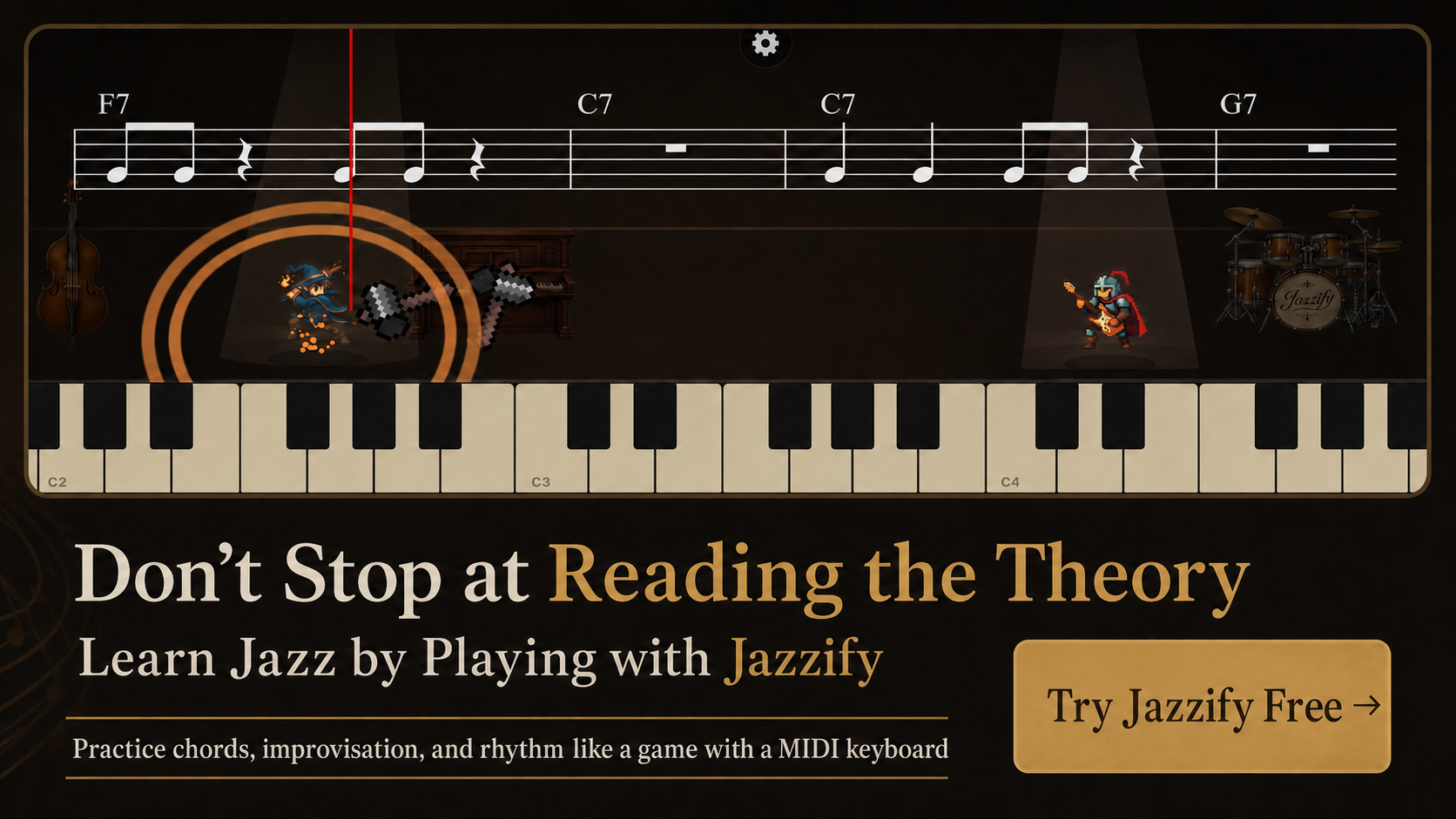
Consistent MIDI keyboard practice beats occasional marathon sessions. Jazz skills—voicing muscle memory, swing subdivision, chord-symbol fluency—compound in short daily blocks. Twenty minutes is enough to touch technique, harmony, rhythm, and repertoire when each segment has a defined goal and measurable tempo.
This routine assumes a 61-key controller connected via USB to a browser or app with Web MIDI support. Adjust keys and tempos to your level, but keep the segment order: warm-up before harmony, harmony before rhythm, rhythm before creative application.
Why 20 Minutes Works for Jazz MIDI Practice
Research on skill acquisition consistently favors distributed practice over cramming. For MIDI specifically, short sessions also reduce setup friction: cable in, browser open, metronome on—done in under a minute once the habit forms.
Twenty minutes prevents the fatigue that causes sloppy voice leading. When your left hand starts landing G7 shells with a muddy fifth, you are past the productive window. Stop, log tempo, and return tomorrow.
Before You Start: One-Minute Setup
- USB cable connected; Bluetooth off unless you accept added latency.
- Headphones on; metronome set to click on beats 2 and 4.
- Browser tab open; MIDI permission granted.
- Sustain pedal tested (CC 64 toggles 0 → 127).
- Today's key written on a sticky note: e.g., "B♭ major ii–V–I."
If notes fail to register, run through MIDI keyboard not detected in browser before blaming your playing.
Segment 1 (3 Minutes): Finger and Velocity Warm-Up
Play C major ascending and descending, hands separately, quarter note = 72 bpm. Focus on even velocity between fingers 2, 3, and 4—watch the MIDI velocity meter if your app shows one. Target velocity 70 on every note; no spike above 85.
Then play chromatic pairs: C–C♯, D–D♯, E–F, using fingers 1–2 and 2–3. Jazz voicings shift by half step constantly; this drill wakes up lateral motion.
Finish with one octave of staccato quarter notes on G major (G–A–B–C–D–E–F♯–G). Lift fingers quickly; no pedal.
Segment 2 (5 Minutes): Shell Voicing Cycle
Today's key: B♭ major. Play one bar each:
- Cm7 shell: C–E♭–B♭
- F7 shell: F–A–E♭
- B♭maj7 shell: B♭–D–A
- B♭maj7 shell: hold or walk inner voice D → C
Start at q=80. Complete four full cycles without stopping. If clean, bump to q=88 next session—not today.
Voice-leading check: E♭ (the 3rd of Cm7) should move down to D (the 7th of F7) when possible. A (3rd of F7) resolves to A (7th of B♭maj7) or G if you voice creatively. Review jazz piano shell voicings if the moves feel random.
Segment 3 (4 Minutes): Guide-Tone Line
In the same B♭ progression, play only the 3rd and 7th of each chord with the right hand while left hand rests:
- Cm7: E♭ and B♭
- F7: A and E♭
- B♭maj7: D and A
Play quarter notes, one chord per beat, connecting smoothly. This isolates the notes improvisers target. Our guide-tone article explains why horn players and pianists converge on these tones.
Segment 4 (5 Minutes): Comping on a Blues
Switch to F blues for variety. Left hand only, shell voicings:
| Bar | Chord | Shell notes |
|---|---|---|
| 1 | F7 | F–A–E♭ |
| 2 | B♭7 | B♭–D–A♭ |
| 3 | F7 | F–A–E♭ |
| 4 | F7 | same |
| 5 | B♭7 | B♭–D–A♭ |
| 6 | B♭7 | same |
| 7 | F7 | F–A–E♭ |
| 8 | D7 | D–F♯–C |
| 9 | G7 | G–B–F |
| 10 | C7 | C–E–B♭ |
| 11 | F7 | F–A–E♭ |
| 12 | C7 | C–E–B♭ → turnaround |
Rhythm: Charleston pattern—quarter on beat 1, dotted quarter on & of 2, quarter on beat 3, rest on 4. Metronome q=96. Loop twice (24 bars total).
Segment 5 (3 Minutes): App or Repertoire Slice
Option A — Open a guided module in your practice app and complete one exercise at full accuracy. Option B — Play the first eight bars of a standard melody you are memorizing, hands together, no pedal.
Do not start a new tune here. Apply the routine's harmony to material already in progress.
Weekly Rotation: Change One Variable
Repeat the same 20-minute block daily, but rotate focus to avoid plateaus:
| Day | Shell key | Blues tempo | Segment 5 focus |
|---|---|---|---|
| Mon | B♭ | q=96 | App voicing drill |
| Tue | C | q=96 | Standard melody |
| Wed | E♭ | q=104 | App rhythm module |
| Thu | F | q=96 | Standard melody |
| Fri | G | q=104 | Free improv on guide tones |
| Sat | Extended 30 min: add rootless voicings | — | — |
| Sun | Rest or passive listening only | — | — |
Tracking Progress With MIDI Data
Log three numbers after each session in a spreadsheet or notes app:
- Shell cycle tempo (bpm) where errors appeared.
- Blues comping tempo completed cleanly.
- App module score or percent correct.
When shell cycles stay clean at q=104 for three consecutive days in a key, move that key to "maintenance" once per week and promote a weaker key to daily rotation.
Scaling Up When 20 Minutes Feels Easy
Add time only after all segments stay clean:
- +5 min: Rootless Type A voicings on the same ii–V–I (Dm7(9) → G7(13) → Cmaj7(9)).
- +5 min: Transpose blues to B♭ or C with same shell shapes.
- +10 min: Full standard form with iReal Pro backing track, shells in left hand.
Do not exceed 45 minutes on MIDI without a break; tension injuries accumulate silently.
Alternate 20-Minute Block: Rootless Focus Day
Once shells stay clean at q=104 in three keys, swap Segment 2 for rootless Type A voicings one day per week:
- Dm7(9): F–C–E–A (from bottom)
- G7(13): B–F–E–A
- Cmaj7(9): E–B–D–G
Keep the same 4-bar cycle and metronome placement. Rootless shapes demand wider stretches—if fingers 4 and 5 fatigue, drop tempo to q=76 and restore shells the next day. The goal is voice-leading clarity: the 7th of Dm7 (C) moves down to B (3rd of G7), then B resolves to A or G depending on your maj7 voicing.
FAQ: MIDI Practice Without a Teacher
Can I split the 20 minutes into two 10-minute sessions? Yes, but complete Segment 1 (warm-up) before each block. Never comp cold—the first Charleston pattern sets timing for the whole session.
Should I use a sustain pedal during shells? Not during Segment 2. Pedal masks incomplete finger release. Add pedal only during Segment 5 ballad melody work.
What if my 49-key board runs out of range? Transpose the exercise down one whole step for that session, or shift octave on the controller. Long term, a 61-key board reduces friction—see our keyboard size comparison articles.
Month-Long Tempo Ladder Example
Track one metric—shell ii–V–I in F (Gm7–C7–Fmaj7)—across four weeks:
| Week | Target tempo | Success criterion |
|---|---|---|
| 1 | q=76 | 8 cycles, zero wrong chord qualities |
| 2 | q=84 | 8 cycles, guide tones connect smoothly |
| 3 | q=92 | 8 cycles, Charleston comp added in Segment 4 same day |
| 4 | q=100 | 8 cycles, app rhythm score above 85% |
Only raise tempo when the prior week’s criterion holds for three consecutive practice days. This ladder prevents the common trap of playing fast with wrong 7ths.
On rest days (Sunday in the sample rotation), listen actively to one recording—Wynton Kelly comping on "So What," for example—and tap beats 2 and 4 on your knee. Passive listening counts as part of jazz training even when the keyboard stays closed.
Common Routine Breakdowns
- Skipping warm-up: Leads to uneven velocity and rushed comping.
- Raising tempo mid-session: Log tomorrow's target instead.
- Practicing only in C and F: Rotate keys weekly.
- Ignoring latency: If swing feels mushy, switch USB and read reduce MIDI latency for piano.
Summary
- Twenty minutes daily beats irregular long sessions for jazz voicing and rhythm.
- Order: warm-up → shell ii–V–I → guide tones → blues comping → app or melody slice.
- Rotate keys and tempos weekly; log bpm and accuracy.
- Extend duration only when every segment stays clean at target tempo.
- Fix MIDI connection issues before adjusting musical goals.
Play the Jazzify demo right now
Connect a MIDI keyboard and play this interactive demo in your browser.
On iPhone and iPad, browsers cannot use a MIDI keyboard. Please use the Jazzify app instead.