Jazz chord tensions are notes added above the basic seventh chord to create color, movement, and a closer connection between harmony and melody. The main tension families are the 9th, 11th, and 13th.
This guide explains where those numbers come from, how they relate to scale degrees 2, 4, and 6, how natural tensions differ from altered tensions, and why some extensions work better than others on a given chord.

What Are Chord Tensions?
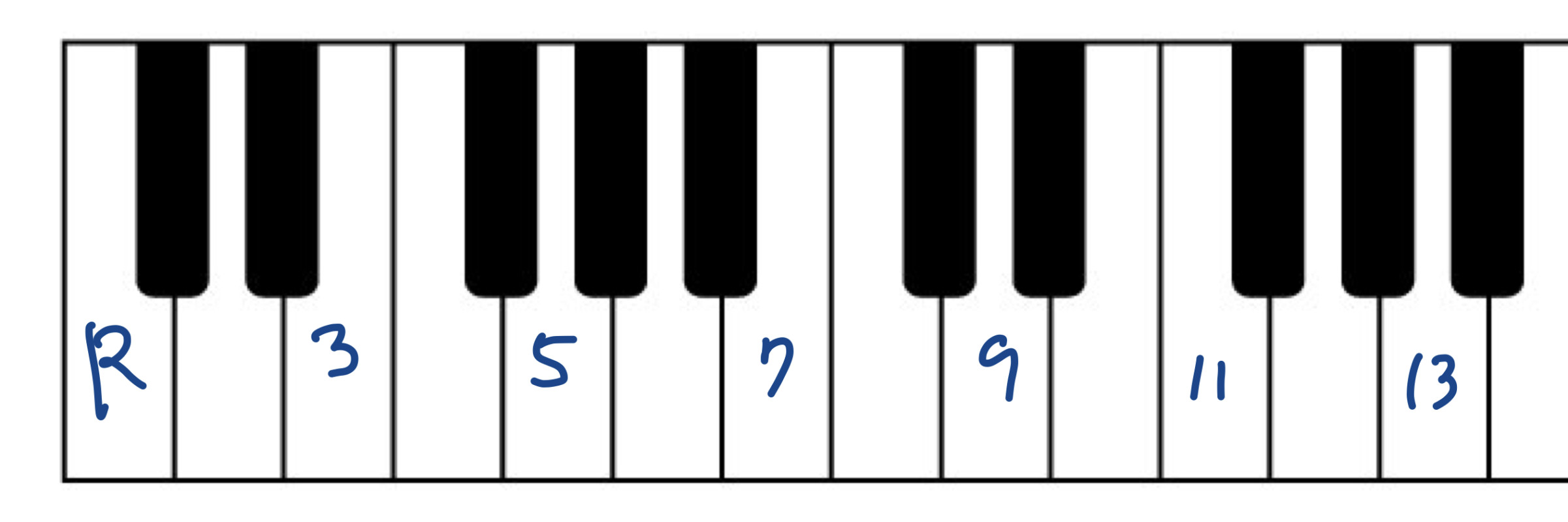
Seventh chords are built by stacking thirds: root, 3rd, 5th, and 7th. If you continue the same stack above the 7th, you reach the 9th, 11th, and 13th:
1-3-5-7-9-11-13
The notes above the 7th are often called extensions or tensions. They enrich the sound without necessarily changing the chord’s basic function.
Why 9, 11, and 13 Equal 2, 4, and 6
Subtract seven from each compound interval:
- 9 - 7 = 2
- 11 - 7 = 4
- 13 - 7 = 6
That means a 9th has the same pitch class as a 2nd, an 11th as a 4th, and a 13th as a 6th. The higher number communicates that the note is functioning as a chord extension rather than as a close-position scale tone.
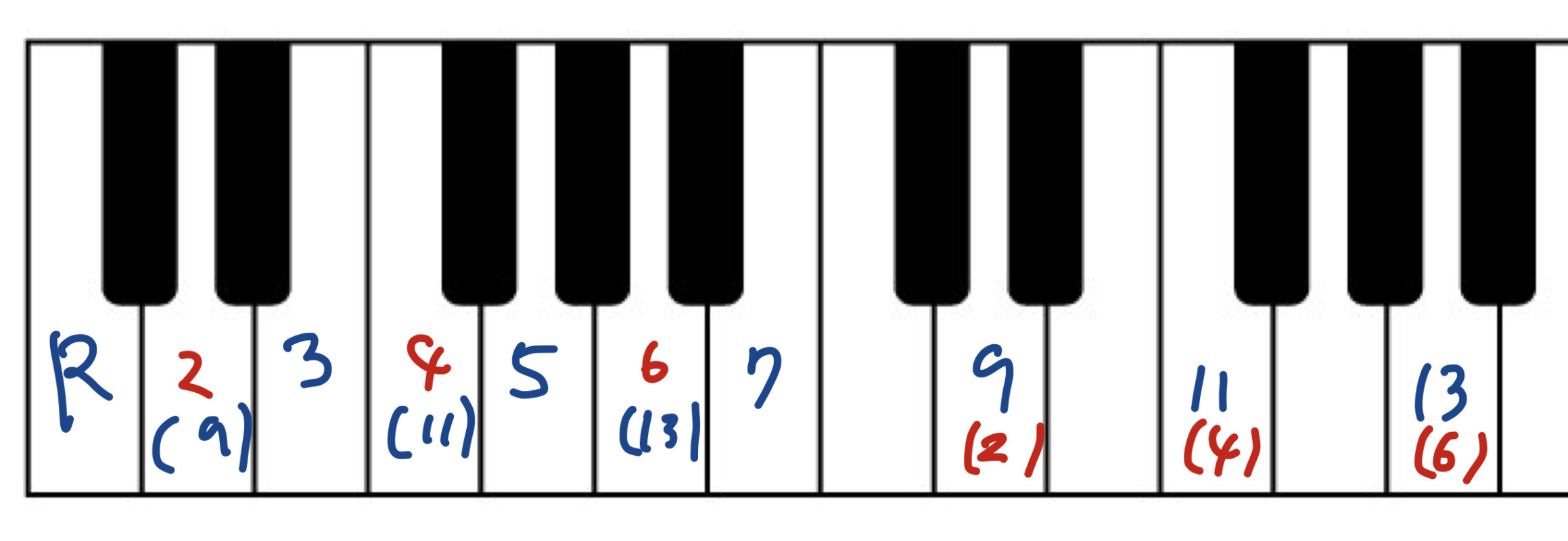
This relationship also connects chord tones to scales. The chord tones 1, 3, 5, and 7 plus the extension tones 2, 4, and 6 form a complete seven-note scale.
The 9th Family
The three common 9th colors are:
- b9: a minor ninth above the root, equivalent to b2.
- 9: a major ninth above the root, equivalent to 2.
- #9: an augmented ninth above the root. On dominant chords, it is enharmonically the same pitch as a minor third but spelled as a raised ninth to preserve the major third in the chord.
For example, the natural 9th of C is D, the b9 is D-flat, and the #9 is D-sharp. A C7#9 chord can contain both E, the major third, and D-sharp, the raised ninth. Those two spellings describe different harmonic roles even though D-sharp sounds like E-flat on the piano.
The 11th Family
The common 11th colors are:
- 11: a perfect eleventh above the root, equivalent to 4.
- #11: an augmented eleventh above the root, equivalent to #4.
The natural 11th is especially common on minor seventh and suspended dominant chords. The #11 is a characteristic color on Lydian major chords and Lydian dominant chords.
The 13th Family
The common 13th colors are:
- 13: a major thirteenth above the root, equivalent to 6.
- b13: a minor thirteenth above the root, equivalent to b6.
A natural 13th is common on dominant seventh chords and many minor seventh chords. A b13 is an altered dominant color that creates extra tension before resolution.
Natural and Altered Tensions
The unaltered extensions 9, 11, and 13 are called natural tensions. The most common altered tensions are b9, #9, #11, and b13.
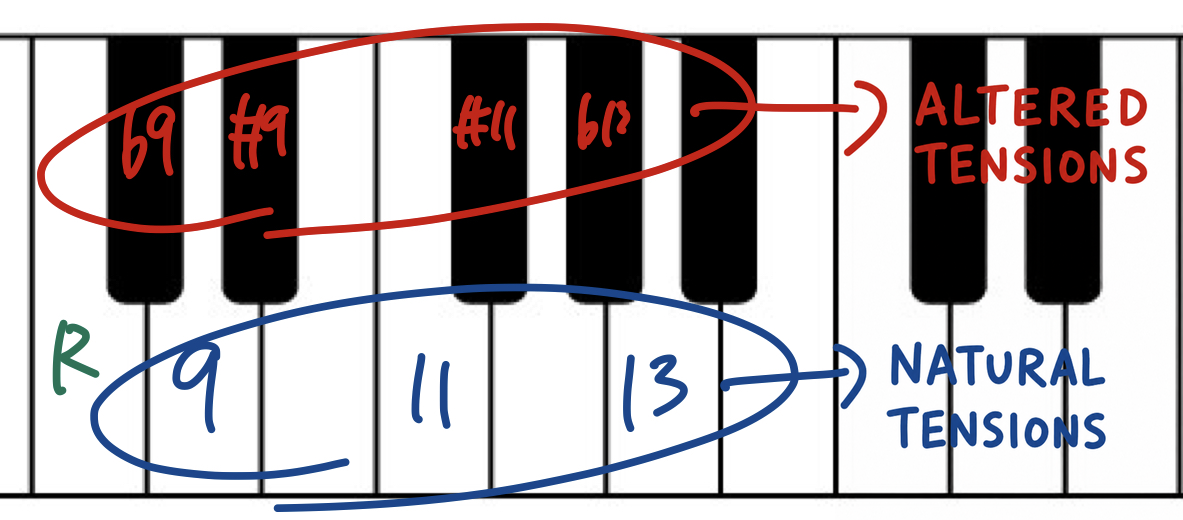
A quick way to find the natural tensions above a root is to take degrees 2, 4, and 6 of the major scale that begins on that root. Above F, the natural 9th, 11th, and 13th are G, B-flat, and D.
Available Tensions and Avoid Notes
Not every extension is equally suitable on every chord. An available tension supports the chord’s quality and harmonic function. An avoid note is a scale tone that can create an especially harsh minor-ninth rub with an essential chord tone or blur the chord’s function when sustained.
For example, on Cmaj7, D is a natural 9th and A is a natural 13th. F natural forms a minor ninth above the chord’s major third, E, so it is often treated cautiously in a sustained voicing. F-sharp, the #11, provides a cleaner Lydian color.
On a functional G7 chord, A and E work as the 9th and 13th. C natural can rub against B, the major third, so it is often avoided as a long-held extension unless the chord is intentionally treated as G7sus. Altered notes such as A-flat, B-flat, and E-flat create b9, #9, and b13 colors that intensify the resolution to C.
Chord Tension Practice Questions
What is the 9th of F?
Show the answer
G.
What is the #9 of G?
Show the answer
A-sharp, often played as the same piano key as B-flat.
What is the #11 of A-flat?
Show the answer
D.
What is the b13 of G-flat?
Show the answer
E-double-flat, enharmonically D on the piano.
What is the 11th of D?
Show the answer
G.
What is the b9 of G?
Show the answer
A-flat.
What is the 13th of F-sharp?
Show the answer
D-sharp.
How to Hear Chord Extensions at the Piano
- Play a seventh chord and hold it.
- Add one extension in a higher register.
- Remove and replace the extension while keeping the basic chord steady.
- Compare natural 9 with b9 and #9, natural 11 with #11, and natural 13 with b13.
- Listen for how each color changes the pull toward the next chord.
Jazzify can help you repeat those comparisons in chord progressions, so the tension becomes a sound you recognize rather than only a number you calculate.
Summary
- Chord tones are 1, 3, 5, and 7; extensions continue the stack to 9, 11, and 13.
- The 9th, 11th, and 13th correspond to scale degrees 2, 4, and 6.
- Natural tensions are 9, 11, and 13.
- Common altered tensions are b9, #9, #11, and b13.
- Available tensions depend on chord quality, chord-scale choice, voicing, and harmonic function.
- An avoid note can still be used as a passing tone or intentional dissonance.
Play the Jazzify demo right now
Connect a MIDI keyboard and play this interactive demo in your browser.
On iPhone and iPad, browsers cannot use a MIDI keyboard. Please use the Jazzify app instead.