The ii V I progression is one of the most common harmonic patterns in jazz standards. Once you can build it in every key and recognize it on a lead sheet, many seemingly complicated chord progressions become easier to understand.
This guide explains the function of the three chords, how to find them in a major key, how the dominant resolves, and how to spot ii-V-I movement that briefly points to a key other than the song’s home key.

What Is a ii-V-I Progression?
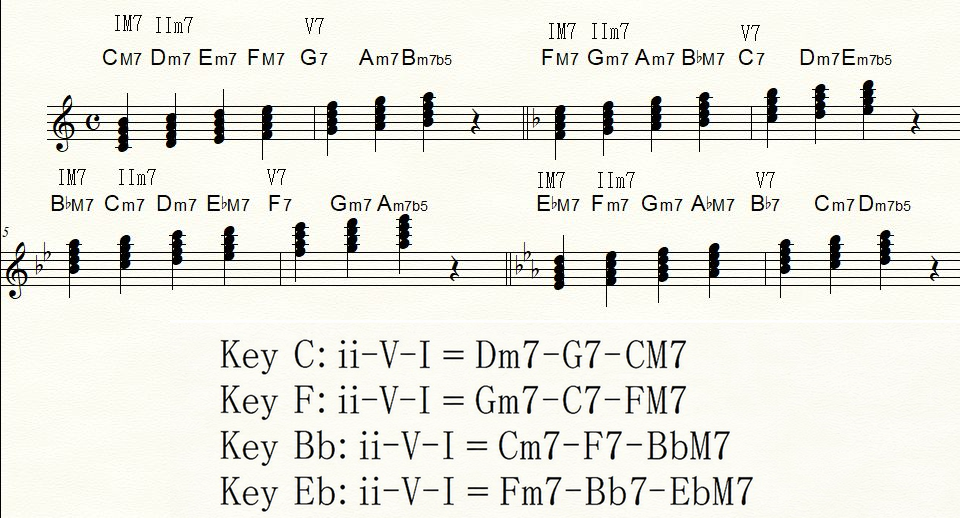
In a major key, the ii-V-I progression uses the seventh chords built on the second, fifth, and first degrees of the major scale:
iim7-V7-Imaj7
In C major, those chords are:
Dm7-G7-Cmaj7
You may see the progression written as ii-V-I, II-V-I, 2-5-1, or simply ii-V when the tonic chord is omitted or delayed. Lowercase Roman numerals are often used for minor-quality chords, so ii immediately tells you that the second chord is minor.
Why the ii-V-I Sounds Resolved
Each chord has a clear harmonic role:
- ii has a predominant function. It prepares the dominant.
- V7 has a dominant function. It creates tension that points toward the tonic.
- Imaj7 has a tonic function. It provides the point of arrival.
The root movement contributes to the strong sense of direction. D moves up a perfect fourth to G, and G moves up a perfect fourth to C. You can also hear this as descending fifths.
The dominant chord contains another powerful resolution. In G7, B is the third and F is the seventh. B tends to rise to C, while F tends to fall to E. These two half-step resolutions lead directly into the third and root of Cmaj7.
You do not need advanced voicings to hear the function. Start with simple seventh chords and listen for preparation, tension, and release.
How to Build a ii-V-I in Any Major Key
Use this three-step process:
- Write the major scale of the target key.
- Find scale degrees 2, 5, and 1.
- Build a minor seventh chord on 2, a dominant seventh chord on 5, and a major seventh chord on 1.
For example, the F major scale is F-G-A-B-flat-C-D-E. Its second, fifth, and first degrees are G, C, and F, so the progression is:
Gm7-C7-Fmaj7
The G major scale is G-A-B-C-D-E-F-sharp. Its ii-V-I is:
Am7-D7-Gmaj7
Quick check
What is the ii-V-I progression in B-flat major?
Show the answer
Cm7-F7-Bbmaj7.
What is the ii-V-I progression in E-flat major?
Show the answer
Fm7-Bb7-Ebmaj7.
How to Recognize ii-V-I Progressions in Jazz Standards
A jazz standard may be in C major while briefly using a ii-V-I progression from another key. For example, you might find Gm7-C7-Fmaj7 inside a tune whose home key is C. Those three chords point temporarily to F major.
This does not always mean the entire song has permanently changed key. It may be a short tonicization: the progression makes F sound like a local tonic before the harmony returns to C.
To find these patterns quickly, look for either of these clues:
- A dominant seventh chord preceded by a minor seventh chord whose root is a perfect fourth below it.
- A minor seventh chord followed by a dominant seventh chord whose root is a perfect fourth above it.
Then ask where the dominant chord wants to resolve. A C7 usually points to some kind of F chord. If the complete pattern is Gm7-C7-Fmaj7, you can label it ii-V-I in F.
Recognition exercises
If Gm7 is the ii chord, what are the V and I chords?
Show the answer
Gm7 is ii in F major, so the complete progression is Gm7-C7-Fmaj7.
If D7 is the V chord, what is the ii chord?
Show the answer
D7 is V in G, so the ii chord is Am7.
Is Bm7-Eb7 a diatonic ii-V pair?
Show the answer
No. The root of a diatonic V chord should be a perfect fourth above the root of ii; B up to E-flat is not a perfect fourth.
A Practical ii-V-I Piano Routine
- Choose one major key and say the scale degrees aloud: “two, five, one.”
- Name the three chord roots before playing them.
- Play the seventh chords slowly and listen for the dominant resolving to the tonic.
- Repeat the pattern around the circle of fourths until you have covered all twelve keys.
- Open a lead sheet and circle every minor-seventh-to-dominant-seventh pair.
- Label the temporary tonic that each dominant chord targets.
At first, prioritize recognition over speed. The aim is to see Dm7-G7 and immediately understand its function, not merely to remember the chord names. Once that recognition is automatic, you can apply different voicings and improvisation ideas to the same harmonic unit.
Practice the Progression as Music
The ii-V-I is more than a theory label. It is a reusable musical phrase. Practice it with a steady pulse, transpose it, and listen to how each chord changes the sense of tension.
Jazzify can help you repeat chord and improvisation exercises in a playable context, making it easier to connect Roman-numeral analysis with what your hands and ears experience.
Summary
- A major ii-V-I uses iim7, V7, and Imaj7.
- In C major, the progression is Dm7-G7-Cmaj7.
- The chords move through predominant, dominant, and tonic functions.
- The third and seventh of V7 resolve by half step into the tonic chord.
- Jazz standards often contain ii-V-I patterns that briefly point to another key.
- Practice recognizing and playing the progression in all twelve keys.
Play the Jazzify demo right now
Connect a MIDI keyboard and play this interactive demo in your browser.
On iPhone and iPad, browsers cannot use a MIDI keyboard. Please use the Jazzify app instead.