The seven jazz modes for piano come from treating each note of a major scale as a new tonal center. The notes may stay the same, but the interval pattern, home note, chord connection, and overall sound change.
This practical guide covers Ionian, Dorian, Phrygian, Lydian, Mixolydian, Aeolian, and Locrian. You will learn each interval formula, find its parent major scale, connect it to a seventh chord, and practice hearing it as a distinct sound.

What Are the Seven Modes of the Major Scale?
Play the notes of C major from each successive scale degree and you get seven modes:
- C to C: C Ionian
- D to D: D Dorian
- E to E: E Phrygian
- F to F: F Lydian
- G to G: G Mixolydian
- A to A: A Aeolian
- B to B: B Locrian
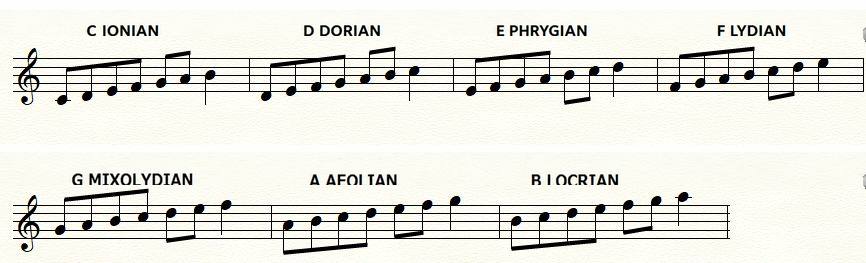
Simply starting and ending on a different note is not enough to create a convincing modal sound. You need to hear that note as home, support it with the appropriate chord, and emphasize the interval that distinguishes the mode.
Interval Formulas and Chord Connections
| Mode | Formula | Common chord connection | Characteristic color |
|---|---|---|---|
| Ionian | 1 2 3 4 5 6 7 | maj7 | natural 4 and major 7 |
| Dorian | 1 2 b3 4 5 6 b7 | m7 | natural 6 |
| Phrygian | 1 b2 b3 4 5 b6 b7 | m7 or sus b9 colors | b2 |
| Lydian | 1 2 3 #4 5 6 7 | maj7#11 | #4 |
| Mixolydian | 1 2 3 4 5 6 b7 | 7 | b7 |
| Aeolian | 1 2 b3 4 5 b6 b7 | m7 | b6 |
| Locrian | 1 b2 b3 4 b5 b6 b7 | m7b5 | b2 and b5 |
The formulas are measured from the modal root. For example, D Dorian uses D-E-F-G-A-B-C. Its b3 and b7 make it minor, while its natural 6 distinguishes it from D Aeolian.
Ionian: The Major-Scale Sound
Ionian is the ordinary major scale. C Ionian is C-D-E-F-G-A-B. Its natural 3 and major 7 establish the bright major quality.
Over a sustained Cmaj7 chord, emphasize B resolving to C. F, the natural 4, can create a minor-ninth rub above E when sustained in a voicing, so pianists often treat it as a melodic passing tone in a plain Ionian context.
Dorian: Minor with a Natural 6
D Dorian uses the notes of C major but centers them on D: D-E-F-G-A-B-C. The natural 6, B, is the defining color. Compare it with D natural minor, which contains B-flat.
Dorian is one of the most important modes in jazz. It is commonly associated with minor seventh chords, including the ii chord in a major-key ii-V-I progression and many modal minor passages.
Phrygian: Minor with a Flat 2
E Phrygian is E-F-G-A-B-C-D. Its b2, F, creates an immediately recognizable dark tension against the root E.
Because the b2 is so strong, sustain an E bass note while alternating between E and F in the right hand. This makes the mode sound different from Aeolian or Dorian even though all three have a minor 3rd and minor 7th.
Lydian: Major with a Sharp 4
F Lydian is F-G-A-B-C-D-E. The note B is #4 relative to F. That raised fourth avoids the natural-4 clash found between B-flat and A in F Ionian, creating the spacious maj7#11 color used frequently in jazz.
Practice an Fmaj7 chord in the left hand and play B prominently in the right. The #11 should sound like a defining color, not an accidental note outside the chord.
Mixolydian: Major with a Flat 7
G Mixolydian is G-A-B-C-D-E-F. Its major 3 and b7 outline a dominant seventh chord. That makes Mixolydian the basic mode associated with an unaltered dominant chord.
Play G7 in the left hand and improvise with the white keys while treating G as home. Listen to how F, the b7, gives the mode a different pull from G Ionian, which would contain F-sharp.
Aeolian: The Natural Minor Scale
A Aeolian is A-B-C-D-E-F-G, the natural minor scale. Its b6, F, distinguishes it from A Dorian, which contains F-sharp.
Aeolian works for a natural-minor sound, but functional minor harmony often changes scale degrees to create a dominant chord. That is why harmonic and melodic minor become important beyond this first modal overview.
Locrian: Minor with a Flat 5
B Locrian is B-C-D-E-F-G-A. Its b3, b5, and b7 outline Bm7b5, while the b2 adds further instability.
In tonal jazz, Locrian is most often connected to a half-diminished chord rather than used as a long static tonic sound. Practice it over Bm7b5 and listen for the distinctive tritone from B to F.
How to Find the Parent Major Scale
Every major-scale mode uses the notes of a parent major scale. To build a mode on any root, ask which degree of the parent scale that root represents.
- Ionian: the modal root is degree 1, so the parent major scale has the same root.
- Dorian: the modal root is degree 2, so the parent major root is a whole step below.
- Phrygian: the modal root is degree 3, so the parent major root is a major third below.
- Lydian: the modal root is degree 4, so the parent major root is a perfect fourth below.
- Mixolydian: the modal root is degree 5, so the parent major root is a perfect fifth below.
- Aeolian: the modal root is degree 6, so the parent major root is a major sixth below, or a minor third above.
- Locrian: the modal root is degree 7, so the parent major root is a major seventh below, or a minor second above.
Example: E Dorian
Dorian is the second mode. If E is degree 2, the parent major scale begins one whole step below on D. Play D major from E to E:
E-F#-G-A-B-C#-D
Example: C Phrygian
Phrygian is the third mode. If C is degree 3, the parent major scale begins a major third below on A-flat. Play A-flat major from C to C:
C-Db-Eb-F-G-Ab-Bb
A Practical Modal Piano Routine
- Choose one modal root and hold it as a low drone.
- Build the mode using its interval formula.
- Play the associated seventh chord in the left hand.
- Improvise a short right-hand phrase that emphasizes the characteristic note.
- Compare the mode with another mode of the same root.
- Transpose the exercise to a new root.
For example, compare C Ionian, C Lydian, and C Mixolydian over suitable C chords. The root stays fixed while scale degrees 4 and 7 change. Hearing those differences is more useful than only reciting the parent-scale names.
Jazzify can help you turn interval formulas into sound by practicing scales, chords, and improvisation together. Use the mode over a matching harmony and listen for its characteristic note in a musical phrase.
Summary
- The seven major-scale modes are Ionian, Dorian, Phrygian, Lydian, Mixolydian, Aeolian, and Locrian.
- Each mode has a distinct interval formula measured from its own root.
- A mode becomes audible when its root functions as the tonal center.
- Dorian highlights natural 6, Phrygian b2, Lydian #4, Mixolydian b7, Aeolian b6, and Locrian b2/b5.
- Use the parent major scale to find the notes, then practice the mode over its associated chord.
- A drone and characteristic-note exercise helps turn theory into a recognizable sound.
Play the Jazzify demo right now
Connect a MIDI keyboard and play this interactive demo in your browser.
On iPhone and iPad, browsers cannot use a MIDI keyboard. Please use the Jazzify app instead.