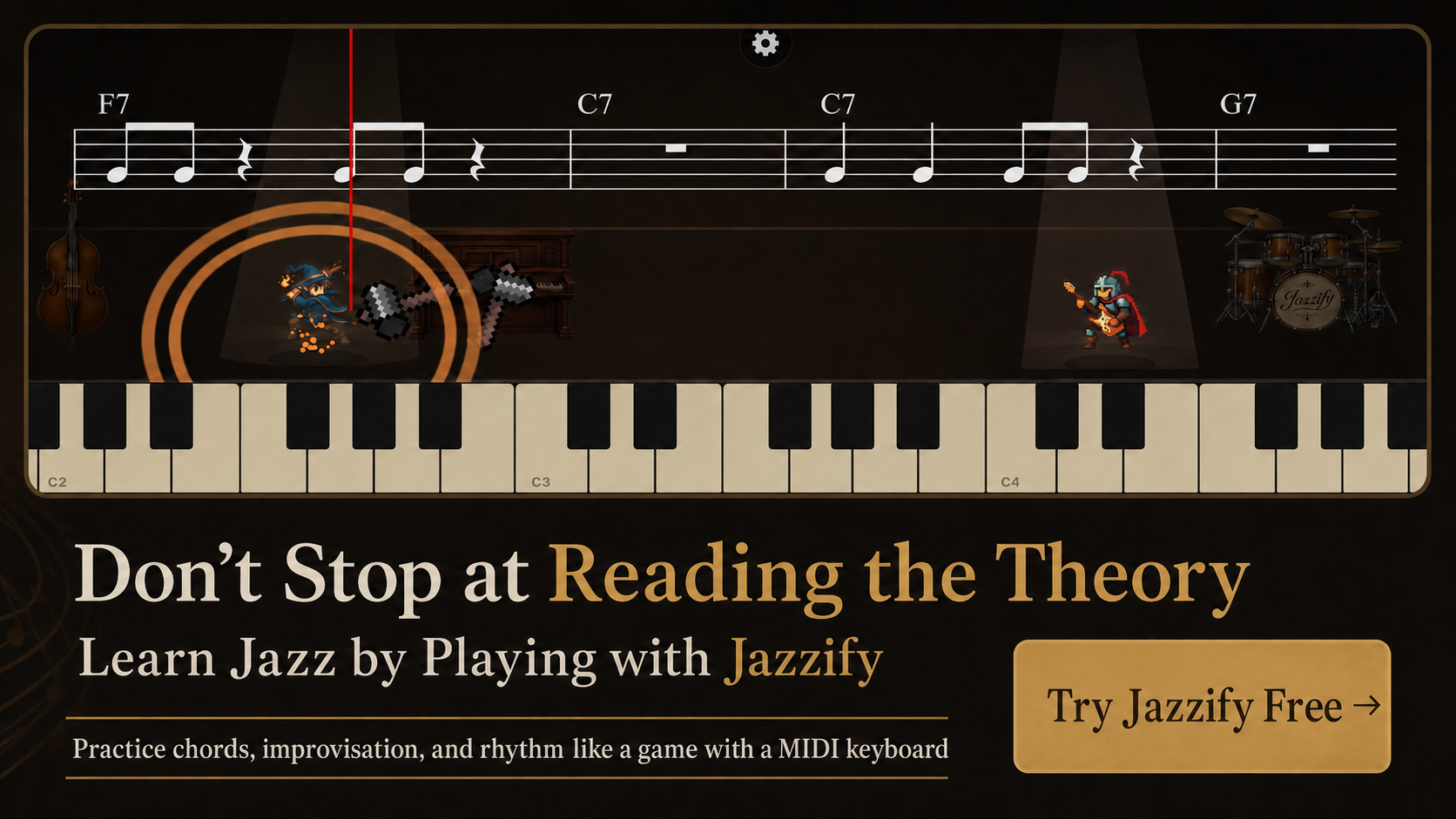
Beginners often start jazz piano improvisation with a full scale and wonder why lines sound lost. Chord tones—roots, 3rds, 5ths, and 7ths—mark the strong beats where harmony is clearest. Build your first solos from those four notes per chord, then add passing tones only after the skeleton sounds intentional.
This guide gives chord-tone rules, ii-V-I line templates, blues exercises, and a path toward enclosures and tensions without skipping the foundation.
Why Chord Tones First
Scales contain seven or more notes; only four are chord tones. On G7 in a ii-V-I, B (3rd) and F (7th) define the dominant pull toward Cmaj7. Landing E and B on Cmaj7 completes the resolution. Scale players who skip chord tones often miss those arrivals.
Chord-tone soloing teaches your ear where harmony lives. It pairs directly with guide-tone hearing.
The Four Notes on Each Quality
From C:
- Cmaj7: C, E, G, B
- C7: C, E, G, Bb
- Cm7: C, Eb, G, Bb
- Cm7b5: C, Eb, Gb, Bb
Practice ascending and descending arpeggios in quarter notes, one chord per bar, metronome on 2 and 4. Then randomize order: E-G-C-B on Cmaj7 without always starting on C.
Strong Beats Rule
On beats 1 and 3, play a chord tone of the current chord. On beats 2 and 4, you may use passing tones from the scale—but resolve to a chord tone on the next strong beat.
On Dm7-G7-Cmaj7: F (Dm7 3rd) on beat 1, passing A on beat 2, B (G7 3rd) on beat 3 of the G7 bar, E (Cmaj7 3rd) on beat 1 of Cmaj7. This single rule improves more solos than a new scale.
ii-V-I Line Templates
Template A (top voice): C → B → B on guide tones of Dm7-G7-Cmaj7 (7th-7th-common 7th).
Template B (3rd voice): F → F → E (3rd of Dm7, 7th of G7 voiced as F, 3rd of Cmaj7).
Template C (mixed): A (5th of Dm7) → B → D (5th of G7) → E. Play in swing eighths at tempo 80.
Transpose to F and B-flat. Connect theory from the ii-V-I article to these templates until they are muscle memory.
Blues in F: Chord Tones on Dominants
F7: F, A, C, Eb. Bb7: Bb, D, F, Ab. C7: C, E, G, Bb. Solo one chorus using only these notes on beats 1 and 3. Add blues scale passing tones on 2 and 4 in chorus two—see jazz piano blues progression.
Enclosures (Preview)
Once chord-tone lines work, approach a target note from above and below: to land E on Cmaj7, play F-D-E or G-Eb-E around beat 1. Enclosures use non-chord tones on weak beats surrounding a chord tone on a strong beat—still organized, not random scale running.
When to Add Scales
Add C dorian on Dm7, G mixolydian on G7, C ionian on Cmaj7—one mode per chord—only after one chorus of pure chord tones sounds good. Modes are in our jazz modes for piano guide. Modes without chord-tone targets become finger exercises.
Practice Routine
- Five minutes: arpeggios random start note;
- Five minutes: Template A on ii-V-I in three keys;
- Ten minutes: one blues chorus chord tones only, record and check strong beats;
- Five minutes: sing your line before playing it.
Common Mistakes
- Starting every phrase on the root;
- Using scale note 1 on every downbeat regardless of chord;
- Ignoring rest—space makes chord tones audible;
- Adding altered scale on G7 before plain G7 chord tones work.
Connecting Chord Tones Across Bars
Think in lines, not bar-by-bar arpeggios. From Dm7 to G7, keep F (3rd of Dm7) as a common tone while the bass moves D to G—then resolve F to E on Cmaj7 in the next bar. A three-bar line with one common tone sounds more musical than three restarted arpeggios.
Rhythm on Chord-Tone Solos
Use mostly quarter notes and half notes in chorus one. Introduce swing eighths in chorus two, still landing E on Cmaj7 beat 1 and B on G7 beat 3. Syncopation before strong beat placement produces lines that sound busy but not jazzy.
Recording and Self-Critique
Record one chorus daily. Mark with a pencil where downbeats missed chord tones—circle beat 1 of bar 5 if you played A on F7 when the chord was Bb7. One circled note per day is enough homework; fix it tomorrow before adding new keys.
Chord Tones on Half-Diminished ii
On Dm7b5 in a minor ii-V, chord tones are D, F, Ab, C—not the major-third shapes from major-key ii. Soloists who play F on Dm7b5 (the 3rd) and B on G7 (the 3rd) mirror voice leading pianists use in comping. Apply the same on Am7b5-D7-Gm7 in Autumn Leaves.
From Chord Tones to Motifs
Once four-note arpeggios work, repeat a three-note shape: E-G-B on Cmaj7 becomes F-A-C on Dm7 with one note changed—motivic development without new scales. Motifs keep solos coherent when tempo increases at jams.
Double-Time Preview (Later)
When chord-tone quarters at tempo 100 are clean, play two eighth notes per bar still landing chord tones on beat 1—E and G on Cmaj7, then rest. Do not double-time entire scales until every downbeat hits a chord tone for one chorus at single time.
Solo Order on a Blues Jam
Pianists often solo after horns. Comp two choruses minimally, then take one chorus chord-tone solo, then comp again—etiquette that preserves energy. Practice the transition: Charleston comp bar 12 into solo starting on F or A on beat 1 of bar 1 without rushing.
Long Tones as Chord-Tone Practice
Hold E on Cmaj7 for two beats, rest two beats, repeat on each chord of ii-V-I. Long tones expose whether you truly hear the note against the harmony—faster than running eighth-note arpeggios without listening.
ii-V-I in All Keys Over Time
Spend one week per key on chord-tone solo only: C, then F, then B-flat, then E-flat. Do not add a new key until one chorus at tempo 84 sounds intentional. Twelve keys in twelve weeks is a realistic adult pace alongside other practice blocks.
Summary
- Build first solos from 1-3-5-7 of each chord.
- Place chord tones on beats 1 and 3; pass on 2 and 4.
- Use ii-V-I templates in C, F, and B-flat.
- Apply to blues before modes and alterations.
- Sing lines to connect ear and fingers.
Play the Jazzify demo right now
Connect a MIDI keyboard and play this interactive demo in your browser.
On iPhone and iPad, browsers cannot use a MIDI keyboard. Please use the Jazzify app instead.