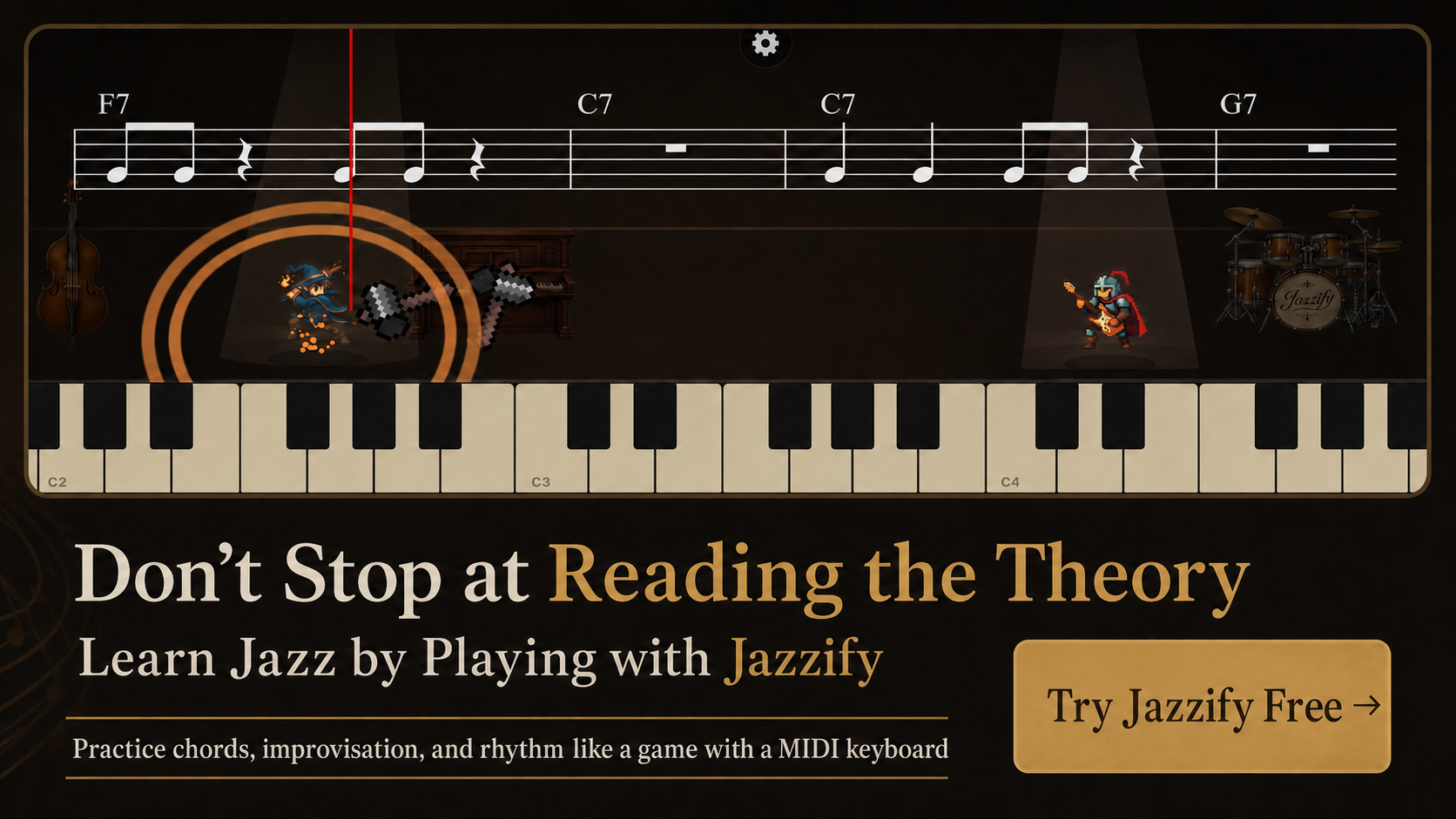
Many adults assume it is too late to learn jazz piano as an adult. That is not true. What changes is not your potential but your schedule, your expectations, and the way you practice. Adults often progress faster in theory and ear training than children do, because they can connect new information to music they already know.
This guide offers a realistic starting path: one clear goal, a small harmonic vocabulary, a daily routine you can sustain, and a way to measure progress without comparing yourself to conservatory students.
Why Adults Have Real Advantages
Adult learners bring listening history. You may already recognize a ii-V-I cadence in a Bill Evans recording even if you cannot yet play it. That background shortens the gap between theory and sound. Adults also tend to practice with intention. Twenty focused minutes beats two hours of unfocused repetition.
The main obstacles are time and self-criticism. Jazz rewards consistency over marathon sessions. Protect a small daily block—before work, after dinner, or on a lunch break—and treat it as non-negotiable as brushing your teeth.
Define a First Goal That Fits Your Life
“Become a jazz pianist” is too vague. Choose one outcome for the next eight weeks:
- Comp through one standard with left-hand roots and right-hand shells;
- Play a simple solo using chord tones on a blues in F;
- Transcribe four bars of a pianist’s left-hand voicing;
- Play Dm7-G7-Cmaj7 smoothly in five keys.
One goal keeps practice from scattering. When you finish it, pick the next. Adults who succeed treat jazz as a long project with visible milestones, not a race.
What to Learn First: Chords Before Flash
Start with the four seventh-chord qualities you will see on every lead sheet: maj7, 7, m7, and m7b5. In C, those are Cmaj7 (C-E-G-B), C7 (C-E-G-Bb), Cm7 (C-Eb-G-Bb), and Cm7b5 (C-Eb-Gb-Bb). Build each from its interval formula rather than memorizing isolated fingerings.
Our guide to jazz piano chords for beginners walks through this order in detail. Once you can construct these chords from any root, add the ii-V-I progression in C (Dm7-G7-Cmaj7), then transpose to F (Gm7-C7-Fmaj7) and B-flat (Cm7-F7-Bbmaj7).
Ear Training Is Not Optional for Adults
Jazz is an aural tradition. Even ten minutes of singing guide tones—playing the 3rd and 7th of each chord in a ii-V-I—will sharpen your hearing faster than reading alone. Sing D and C on Dm7, then B and F on G7, then E and B on Cmaj7. When those half-step resolutions become obvious, chord symbols start to sound like directions rather than puzzles.
Adults sometimes skip ear work because it feels slow. Do the opposite. Slow ear training prevents years of playing shapes you do not hear.
Build a Sustainable Daily Routine
A workable week for a busy adult might look like this:
- Monday: chord formulas in two keys, five minutes each;
- Tuesday: ii-V-I with metronome on beats 2 and 4;
- Wednesday: learn one new standard’s chord chart—no melody required yet;
- Thursday: shell voicings in the left hand, melody or scale in the right;
- Friday: transcribe two measures from a recording;
- Weekend: play through everything at a comfortable tempo.
Adjust the split, but keep the total near twenty to thirty minutes on weekdays. Consistency compounds.
Choose Tools That Match How You Learn
Some adults thrive with a teacher for accountability. Others need an interactive app that scores timing and voicing accuracy. A lead-sheet book plus a backing track can be enough if you already know how to structure practice. The wrong tool is whichever one you never open.
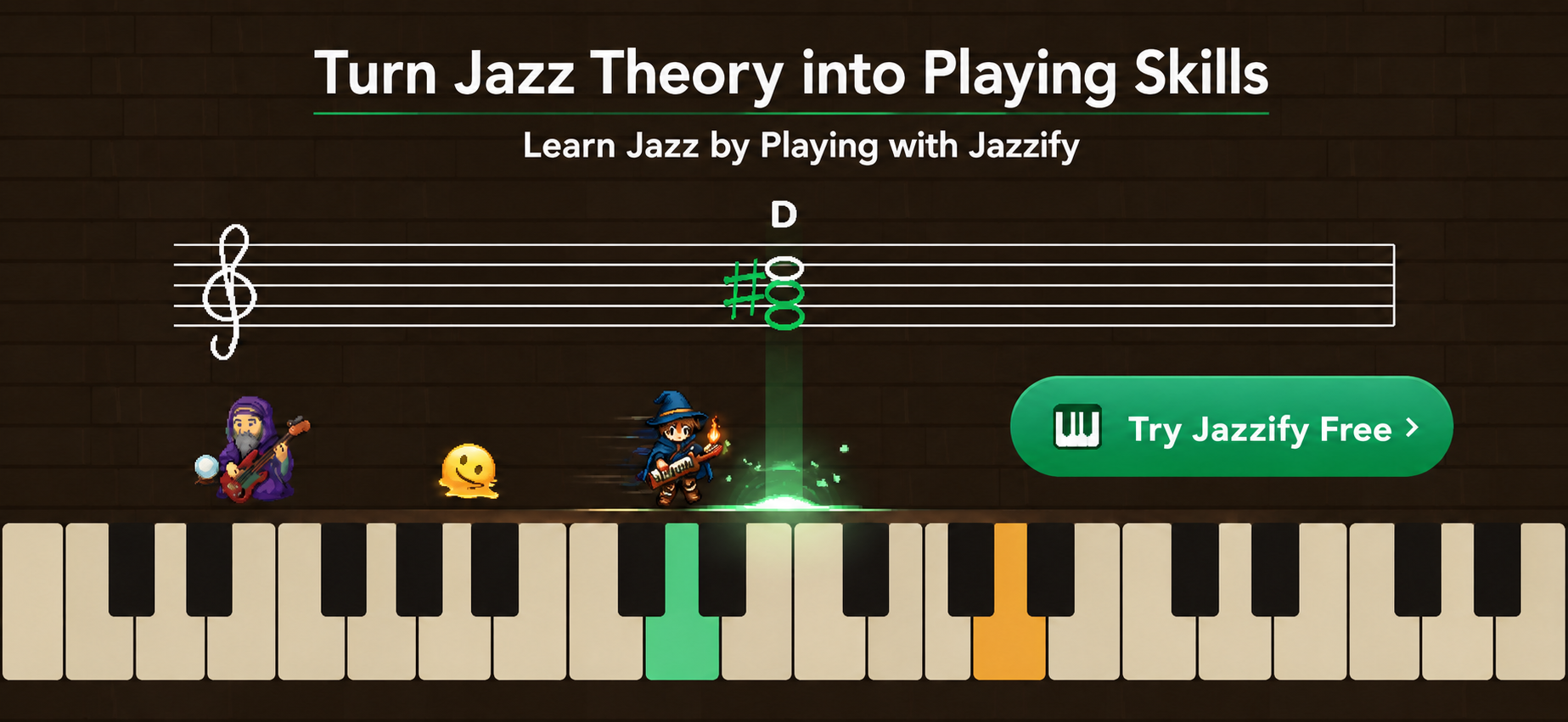
If you use an app, pick one that connects theory to playing—hearing a V7 resolve, not just labeling it. Jazzify is designed for that loop: short exercises, immediate feedback, and repertoire hooks so theory becomes muscle memory.
Manage Expectations and Avoid Common Traps
Three traps slow adult beginners:
- Collecting resources instead of practicing one tune. One standard learned deeply teaches more than ten skimmed.
- Chasing advanced voicings too early. Rootless A/B voicings matter later. Shells and guide tones come first.
- Ignoring time feel. Jazz is rhythm first. A simple voicing with good swing beats a complex grip played stiffly.
Compare yourself to yesterday, not to a professional on a live stream.
Accountability and Community
Adults stick with jazz longer when practice is visible to someone else—a teacher every two weeks, a weekly jam, or a practice partner who expects your Dm7-G7-Cmaj7 at tempo 80. Share a thirty-second recording monthly; external ears catch time problems you no longer notice.
When to Add Improvisation and Repertoire
After you can comp a basic ii-V-I in three keys, begin improvising on chord tones only: on Cmaj7 use C, E, G, and B; on G7 use G, B, D, and F. No scales required yet—just chord tones on strong beats.
Add one standard per month. Learn its form (AABA or ABAC), its key centers, and its turnaround. For harmonic detail on voicings, see how to build jazz piano voicings. Melody comes from the recording; harmony comes from the chart.
Physical Setup and Injury Prevention
Adults often return to piano after years away. Before speed or voicing depth, reset posture: bench height so forearms are level, wrists relaxed, feet flat for pedal control. Warm up with five-finger patterns in C and G at mezzo volume before jazz voicings. Tension in the shoulders translates directly into stiff swing feel.
If you practice on a digital keyboard, use weighted keys when possible and connect via MIDI for apps that score timing. Half-weighted controllers work for theory drills but hide dynamic control that acoustic and high-end digital pianos reveal in ballad comping.
How Long Until It “Sounds Like Jazz”?
Most adults who practice twenty-five minutes daily for six months can comp a blues in F and solo with chord tones on a medium-tempo ii-V-I without losing the form. That is a realistic milestone—not playing like Bill Evans, but sounding coherent on a jam session with patient musicians.
Year one is for vocabulary and time. Year two adds repertoire depth and transcription. Adjust expectations if you skip ear training or metronome work; those gaps show up first at jams.
Summary
- Adults can learn jazz piano with consistent short sessions and clear goals.
- Master maj7, 7, m7, and m7b5 before exotic extensions.
- Practice ii-V-I in multiple keys and sing guide-tone motion.
- Avoid resource-hoarding; depth on one tune beats breadth on many.
- Add improvisation on chord tones once basic comping is stable.
Play the Jazzify demo right now
Connect a MIDI keyboard and play this interactive demo in your browser.
On iPhone and iPad, browsers cannot use a MIDI keyboard. Please use the Jazzify app instead.