If you want to know how to build jazz piano voicings, begin with the chord’s function rather than adding random notes. A clear process helps you choose chord tones, select useful tensions, avoid unwanted clashes, and arrange the result in a playable register.
This guide introduces a practical beginner formula for diatonic seventh chords in a major key. It is a starting vocabulary, not a rule that limits every voicing you will use later.

What Is a Jazz Piano Voicing?
A voicing is the way a chord’s notes are selected, ordered, spaced, and distributed between the hands. Cmaj7 does not have to appear only as C-E-G-B. You might omit the root or fifth, add D as the 9th, invert the chord, or spread its notes across different octaves.
Lead sheets usually give you a chord symbol rather than a complete arrangement. A symbol such as Cmaj7 identifies the basic harmony, but it often leaves the exact extension choices to the player. That freedom is one of the creative parts of jazz piano.
Start with the Essential Chord Tones
Before adding tensions, identify the notes that establish chord quality:
- The 3rd distinguishes major from minor.
- The 7th distinguishes major seventh, dominant seventh, and minor seventh functions.
- The root identifies the chord, but a bass player may already provide it.
- The 5th supports the chord but is often the first basic note omitted when space is limited, unless it is altered.
The 3rd and 7th are often called guide tones because they communicate so much harmonic information with only two notes. Build a reliable core with them before decorating the chord.
Choose an Available Tension
A tension should support the chord’s quality, scale, and function. Use this sequence:
- Identify the chord and its Roman-numeral function in the key.
- Write the chord tones: 1, 3, 5, and 7.
- Find possible 9ths, 11ths, and 13ths from the relevant scale.
- Check whether a candidate creates an unwanted minor-ninth clash with an essential chord tone.
- Select one or two tensions that produce the color you want.
- Remove a less essential note if the voicing has become too dense.
For example, Dm7 in C major contains D-F-A-C. The diatonic note E is its natural 9th, so Dm9 is an easy first extension. G is the 11th and can also work, while B is the natural 13th associated with the Dorian sound.
On G7 in C major, A is the 9th and E is the 13th. Those two notes add color while preserving the dominant function that resolves to C.
A Beginner Formula for Diatonic Chords
Use the following pattern as a first set of tension choices for the diatonic seventh chords of a major key:
Imaj7(9) - iim7(9) - iiim7 - IVmaj7(9) - V7(9,13) - vim7(9) - viim7b5
In C major, that becomes:
Cmaj7(9) - Dm7(9) - Em7 - Fmaj7(9) - G7(9,13) - Am7(9) - Bm7b5
A simple way to remember this template is:
- Do not add a natural 9th to iii or vii in this strictly diatonic exercise.
- Add a natural 9th to the other five scale-degree chords.
- Add a natural 13th to V7 as an additional dominant color.
Why iii and vii Omit the Natural 9th Here
In C major, the iii chord is Em7. Its natural 9th is F-sharp, which is not part of the C major scale. The diatonic note above E is F natural, a b9 that creates a close clash with the root.
The vii chord is Bm7b5. Its natural 9th is C-sharp, also outside C major. The diatonic note C is a b9 above B.
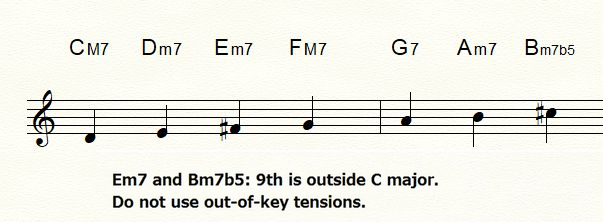
That does not mean F-sharp can never appear over Em7 or C-sharp can never appear over Bm7b5. It means those notes are not part of this first, strictly diatonic C-major template. Context determines whether an outside note is an expressive modal color or an unintended clash.
Why Add the 13th to V7?
The dominant chord supports especially clear tension choices. In G7, E is the natural 13th. It adds warmth and color without removing the chord’s essential tritone between B and F.
A practical four-note dominant voicing might retain the 3rd and 7th, add the 9th and 13th, and omit the root and 5th:
G7(9,13): B-F-A-E
If you are playing without a bass player, you may need to supply the root elsewhere. The exact arrangement depends on register, ensemble, and musical texture.
Turn the Formula into Playable Voicings
After selecting the notes, place them so the voicing is comfortable and connected to the chords around it:
- Keep the notes in a clear middle register; very low clusters can sound muddy.
- Preserve the 3rd and 7th whenever they define the chord’s function.
- Move each voice to a nearby note in the next chord when possible.
- Avoid doubling notes that are already prominent in the bass or melody unless the doubling is intentional.
- Check that the added tension does not conflict with the melody.
For a C-major ii-V-I, first choose Dm7(9), G7(9,13), and Cmaj7(9). Then arrange the selected notes so each voice travels the smallest practical distance. Smooth motion matters more than reproducing the same closed chord shape under every root.
Practice Method
Play the seven diatonic chords in one major key using the beginner tension formula. Say each scale degree and extension aloud. Then transpose the exercise to another key.
Once the note choices are secure, practice them inside ii-V-I progressions. Jazzify can help you repeat chord movements, compare voicings, and connect extension formulas with the sound and physical feel of real harmonic motion.
Summary
- A voicing is the selection, order, spacing, and distribution of chord notes.
- Begin with the 3rd and 7th, then add tensions that support the chord’s function.
- A useful beginner pattern is Imaj7(9), iim7(9), iiim7, IVmaj7(9), V7(9,13), vim7(9), and viim7b5.
- In a strictly diatonic major-key exercise, iii and vii omit the natural 9th because it falls outside the parent scale.
- V7 commonly adds both the 9th and 13th.
- After choosing the notes, use good register and minimal voice movement to make the progression playable.
Play the Jazzify demo right now
Connect a MIDI keyboard and play this interactive demo in your browser.
On iPhone and iPad, browsers cannot use a MIDI keyboard. Please use the Jazzify app instead.