The altered scale is one of the most useful sounds for creating tension over a dominant seventh chord. This guide explains how to build it, how its interval names change in a dominant context, and how to connect it to melodic minor, Mixolydian b6, and the tritone substitute.

What Is the Altered Scale?
Start with a major scale and lower every note except the tonic by a half step. The resulting formula is 1, b2, b3, b4, b5, b6, b7. This spelling is often called the Super Locrian scale.
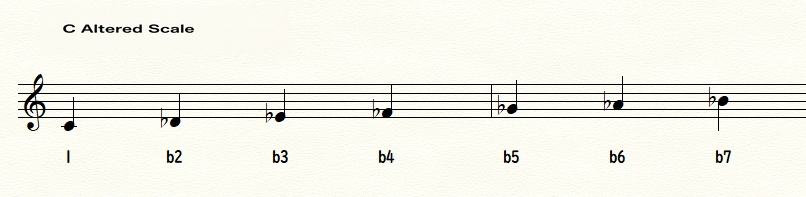
Which Chord Uses the Altered Scale?
Stacking the scale in thirds can suggest Cm7b5, but the altered scale is normally played over a dominant seventh chord with altered tensions. Over C7, the scale contains the chord tones C, E, and B-flat together with D-flat, E-flat, G-flat, and A-flat.
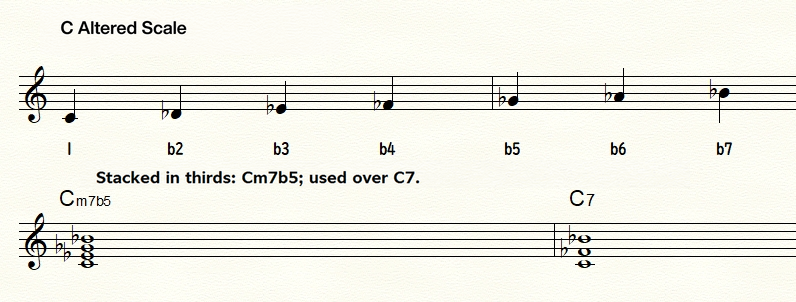
The important enharmonic change is F-flat = E. In a C7 context, that note is the major third. This is why the scale can support a dominant chord even though the Super Locrian spelling uses b4.
Altered Scale Tension Notation
Jazz musicians usually respell the altered scale to show its relationship to the dominant chord:
1, b9, #9, 3, b5 (or #11), b13, b7
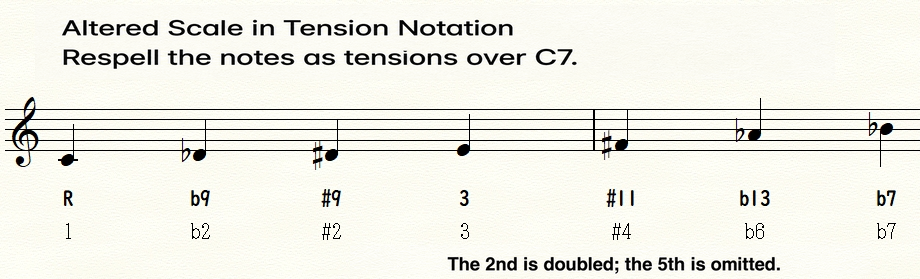
The tension spelling contains both b9 and #9 while omitting the natural fifth. That asymmetry is part of the sound: the scale concentrates unstable colors around the third and seventh, making the resolution to the tonic especially strong.
The Seventh Mode of Melodic Minor
The altered scale is the seventh mode of melodic minor. To find the parent melodic minor scale, move up a half step from the altered-scale root. For example:
- G altered uses the notes of A-flat melodic minor.
- B altered uses the notes of C melodic minor.
- D altered uses the notes of E-flat melodic minor.
- G-sharp altered uses the notes of A melodic minor.
Practice tip: Pick a dominant chord, move its root up a half step, and play melodic minor from that new note. Then return to the dominant root and hear the same pitch collection as an altered scale.
Using the Altered Scale over V7
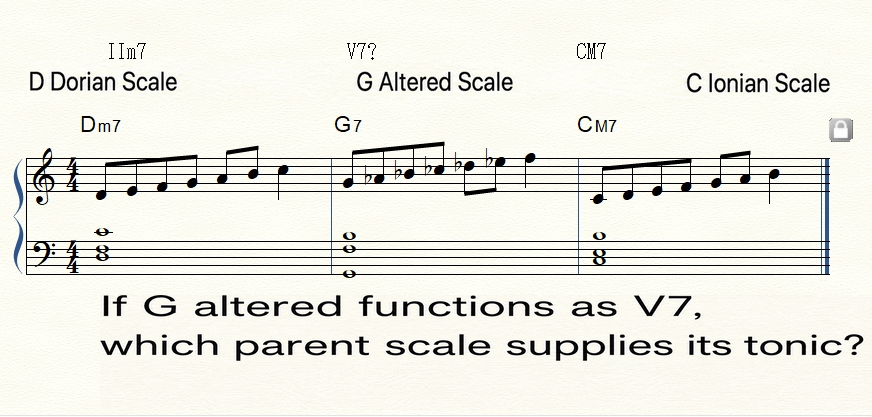
In a Dm7-G7-Cmaj7 progression, play G altered over G7. The parent collection is A-flat melodic minor, but you do not need to hear the chord as a borrowed VII7 in A-flat. Functionally it is still the V7 of C; the parent scale is simply a practical way to organize the available tensions.
Why C modal interchange does not explain G altered
G altered does not contain C, so it cannot be described as a mode with C as its tonic. A more useful comparison is to reorder the same notes from E-flat or to connect them directly to the dominant function.
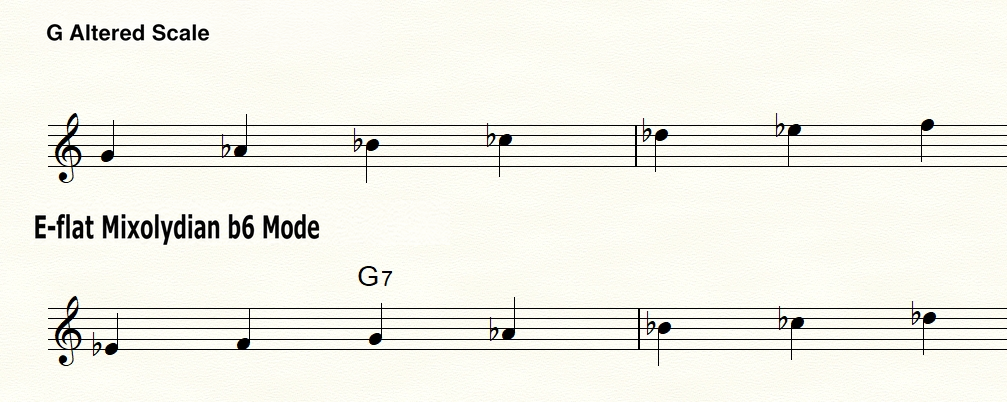
G Altered and E-flat Mixolydian b6
Reorder the notes of G altered from E-flat and you get E-flat Mixolydian b6. G is the third of that mode, so G7 can be heard as III7 within the same pitch collection.
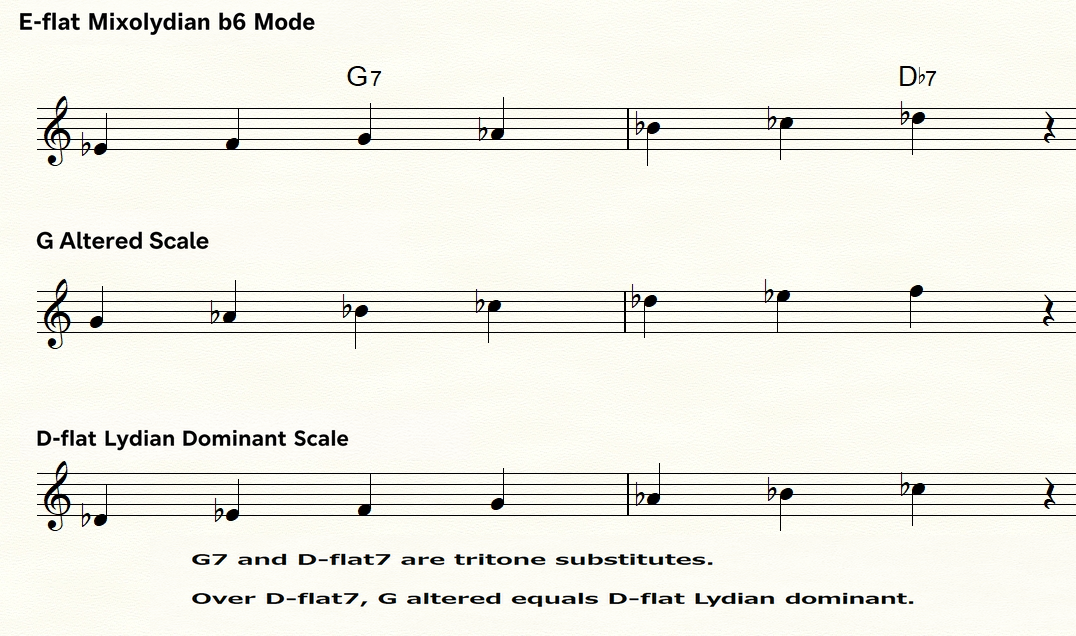
From the Altered Scale to the Tritone Substitute
G7 and D-flat7 are tritone substitutes. The notes of G altered are the same pitch collection as D-flat Lydian dominant. That means a line learned over G7 altered can also work over D-flat7 when the harmony uses the tritone substitute.
Summary
- The Super Locrian formula is 1, b2, b3, b4, b5, b6, b7.
- Over V7, respell it as 1, b9, #9, 3, b5/#11, b13, b7.
- The altered scale is the seventh mode of melodic minor.
- G altered uses the notes of A-flat melodic minor.
- G altered and D-flat Lydian dominant use the same notes, which connects the scale to the tritone substitute.
Play the Jazzify demo right now
Connect a MIDI keyboard and play this interactive demo in your browser.
On iPhone and iPad, browsers cannot use a MIDI keyboard. Please use the Jazzify app instead.