Secondary dominant chords create a brief pull toward a chord other than the home tonic. They sound like the V7 chord of a temporary target, making an ordinary diatonic chord feel momentarily like a local tonic.
This guide explains how secondary dominants work in a major key, how to label them, how to find their expected resolutions, and how to recognize them in jazz standards.

What Is a Secondary Dominant?
The dominant seventh chord built on the fifth degree of the home key is the primary dominant. In C major, that chord is G7, and it normally resolves to C.
A secondary dominant is a dominant seventh chord that targets another diatonic chord. It is “secondary” because it belongs to a temporary key area rather than serving as the main dominant of the song.
For example, Dm7 is the ii chord in C major. The dominant of D is A7, so A7 can be used before Dm7:
A7-Dm7
A7 contains C-sharp, a note outside the C major scale. That chromatic note creates a leading-tone pull into D. The progression briefly makes Dm sound like a tonic without necessarily changing the overall key.
The Five Common Secondary Dominants in a Major Key
In C major, the most common temporary targets are ii, iii, IV, V, and vi. Build the V7 of each target to find the five secondary dominants:
| Label | Chord in C major | Expected target |
|---|---|---|
| V7/ii | A7 | Dm or Dm7 |
| V7/iii | B7 | Em or Em7 |
| V7/IV | C7 | F or Fmaj7 |
| V7/V | D7 | G or G7 |
| V7/vi | E7 | Am or Am7 |
The vii chord is usually not tonicized this way because its diminished quality does not provide a stable temporary tonic. The home tonic is already served by the primary dominant, G7, so that chord is simply V7 rather than a secondary dominant.
Why minor targets still use a dominant seventh chord
When the temporary target is minor, use the dominant from the target’s harmonic minor scale. For example, the natural D minor scale would produce Am7, but harmonic minor raises C to C-sharp and produces A7. That raised leading tone is what creates the strong resolution to Dm.
How Secondary Dominants Are Labeled
A7 in C major is written V7/ii, read as “five-seven of two.” The symbol tells you that A7 is the dominant seventh chord of the ii chord.
Some materials write V7 of ii instead of using a slash. The meaning is the same:
- The symbol after the slash names the target.
- The V7 before the slash describes the chord’s function relative to that target.
To decode D7 as V7/V in C major, work from right to left. The target is V, or G. The dominant seventh chord of G is D7.
How to Find a Secondary Dominant
Use this process when you are given a target chord:
- Identify the root of the target.
- Move up a perfect fifth, or down a perfect fourth, to find its dominant root.
- Build a dominant seventh chord on that root.
- Label the result as V7 followed by a slash and the target’s Roman numeral.
To find V7/vi in C, first identify vi as A minor. A perfect fifth above A is E, so E7 is V7/vi.
You can also work backward from an unfamiliar dominant chord. If you find B7 in a passage in C major, move a perfect fourth upward from B to E. Em is iii in C, so B7 is V7/iii.
Expected Resolution and Deceptive Motion
A secondary dominant strongly suggests its target, but it does not have to resolve there. A7 usually moves to Dm in C major, yet a composer can redirect it. When the expected tonic resolution is avoided, the result may be described as a deceptive resolution.
This is why analysis should account for both chord construction and musical context. A dominant seventh quality suggests a possible target; the following chord tells you whether the expected tonicization is fulfilled.
Secondary Dominant Practice Questions
What is V7/ii in F major?
Show the answer
The ii chord is Gm. Its dominant is D7, so the answer is D7.
What is V7/vi in G major?
Show the answer
The vi chord is Em. Its dominant is B7, so the answer is B7.
In F major, is D7 a secondary dominant?
Show the answer
Yes. D7 resolves toward Gm, the ii chord, so it is V7/ii.
In B-flat major, is E7 a standard secondary dominant?
Show the answer
No. E7 would target A, but A is not one of the usual diatonic tonicization targets in B-flat major.
Finding Secondary Dominants in a Jazz Standard
When analyzing a lead sheet, first mark every dominant seventh chord. Then ask whether each one is the primary V7 or a dominant of another diatonic chord.
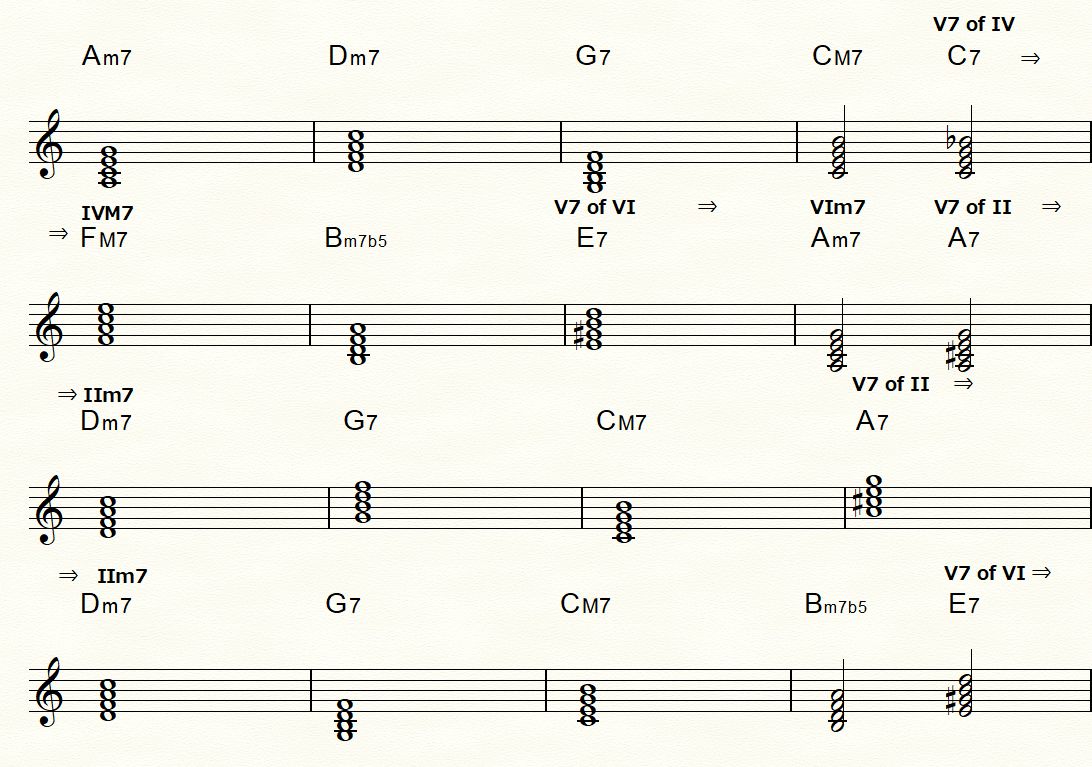
In a C-major setting, the original article uses a passage from Fly Me to the Moon to illustrate three examples:
- C7 is V7/IV and points toward F.
- E7 is V7/vi and points toward Am.
- A7 is V7/ii and points toward Dm.
Practice Secondary Dominants at the Piano
Choose a major key, play each diatonic target chord, and precede it with its own V7. Listen for the chromatic note that creates the new leading-tone pull. Then repeat the pattern in another key.
Jazzify can help turn that analysis into practical repetition. Practice hearing a dominant chord, predicting its target, and resolving it while working with playable chord progressions rather than isolated labels.
Summary
- A secondary dominant is a V7 chord that tonicizes a chord other than the home tonic.
- In a major key, the usual targets are ii, iii, IV, V, and vi.
- V7/V means “the dominant seventh chord of the dominant.”
- Move a perfect fourth above a dominant root to find its expected target.
- Minor targets use the dominant produced by harmonic minor.
- The expected target can be delayed or avoided in a deceptive resolution.
Play the Jazzify demo right now
Connect a MIDI keyboard and play this interactive demo in your browser.
On iPhone and iPad, browsers cannot use a MIDI keyboard. Please use the Jazzify app instead.