Type A and Type B rootless voicings give jazz pianists two compact ways to arrange the same chord. The best choice is usually the shape that stays in a clear register and moves the shortest distance from the previous chord.
This guide reviews the two interval formulas, introduces a practical root-name shortcut from the original lesson, and applies the shapes to major ii-V-I progressions in all twelve keys.

What Are Type A and Type B Rootless Voicings?
In this system, a Type A voicing begins with the chord’s 3rd and a Type B voicing begins with its 7th. For a seventh chord with a natural 9th:
- Type A: 3-5-7-9
- Type B: 7-9-3-5
For a dominant seventh chord with a 9th and 13th:
- Type A: 3-13-b7-9
- Type B: b7-9-3-13
The root is omitted because a bass player or the harmonic context can supply it. The 3rd and 7th define chord quality and function, while the 9th and 13th add color.
You may also encounter spread rootless layouts written as 3-7-9-5 or 7-3-5-9. They use the same essential note pool but distribute it differently. Compare the exact interval order instead of assuming every “Type A” or “Type B” label means the same shape.
Choose the Shape by Register and Voice Leading
Both inversions can describe the same chord, but they do not sit equally well in every register. If a Type A shape falls too low, its close intervals may sound muddy. If a Type B shape sits too high, it may collide with the melody or the right hand.
Use three questions:
- Does the shape remain in a clear middle register?
- Does it keep common tones from the previous chord?
- Do the other voices move by step or small interval?
This is the musical reason for alternating shapes through a progression. A new root does not require every note to jump to a new position.
A Practical Root-Name Shortcut
The original lesson gives a mnemonic for keeping these left-hand voicings in a useful range:
- Roots named C or D, including their sharps or flats, usually use Type A.
- Roots named F, G, or A, including their sharps or flats, usually use Type B.
- Roots named B or E may use either type; choose the one that completes the smoothest progression.
For example, Cmaj7(9), C7(9,13), Dm7(9), and D-flat7(9,13) use Type A in this register-based system. Fm7(9), F-sharp7(9,13), G7(9,13), and A-flatmaj7(9) use Type B.
Alternate A and B through a ii-V-I
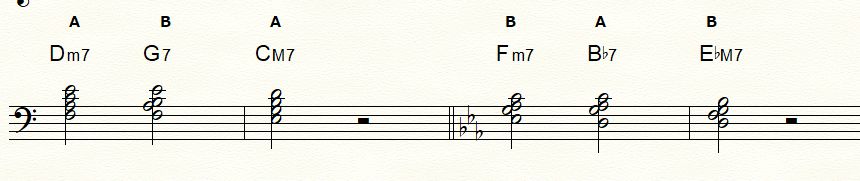
A major ii-V-I often alternates the two shapes:
Type A - Type B - Type A
or
Type B - Type A - Type B
In C major, Dm7-G7-Cmaj7 uses A-B-A in this system. In E-flat major, Fm7-Bb7-Ebmaj7 uses B-A-B.
Once the first chord is placed in a comfortable register, the alternating pattern gives you a reliable starting point for the following two chords. Always listen and check the actual notes rather than relying on the letters alone.
Type Patterns for Major ii-V-I in All Twelve Keys
| Key | Progression | Type pattern |
|---|---|---|
| C | Dm7-G7-Cmaj7 | A-B-A |
| F | Gm7-C7-Fmaj7 | B-A-B |
| B-flat | Cm7-F7-Bbmaj7 | A-B-A |
| E-flat | Fm7-Bb7-Ebmaj7 | B-A-B |
| A-flat | Bbm7-Eb7-Abmaj7 | B-A-B |
| D-flat | Ebm7-Ab7-Dbmaj7 | A-B-A |
| G-flat | Abm7-Db7-Gbmaj7 | B-A-B |
| B | C#m7-F#7-Bmaj7 | A-B-A |
| E | F#m7-B7-Emaj7 | B-A-B |
| A | Bm7-E7-Amaj7 | A-B-A |
| D | Em7-A7-Dmaj7 | B-A-B |
| G | Am7-D7-Gmaj7 | A-B-A |
Some enharmonic keys produce the same sounding progression with different spellings. Practice the notation that appears most often in your repertoire, but understand how the shapes transpose by interval.
Applying the System to Diatonic Chords
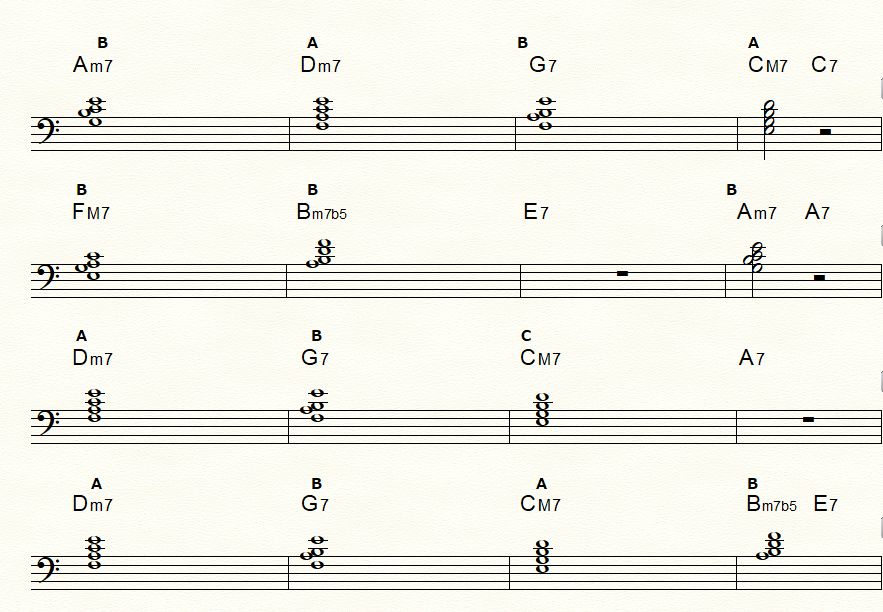
In C major, begin with the obvious root-name choices:
- Cmaj7: A
- Dm7: A
- Fmaj7: B
- G7: B
- Am7: B
The remaining Em7 and Bm7b5 depend on the progression and register. The original exercise assigns Em7 to A and Bm7b5 to B.
In F major, the root-name shortcut immediately gives Type B to Fmaj7, Gm7, and Am7, and Type A to C7 and Dm7. B-flatmaj7 and Em7b5 are then selected by context; the original exercise uses A for both.
These assignments are useful for drilling one connected layout, but real comping may change inversion to follow the melody, avoid another instrument, or create a different line.
Use the Shapes in a Jazz Standard
After marking the diatonic chords in a tune, label each one A or B and play only the left-hand voicing. Then add the melody or improvise with the right hand.
If a chord is a secondary dominant or belongs to a temporary key, identify its function before choosing tensions. The same A/B interval layouts still work, but the available notes may differ.
A Minimal-Movement Practice Routine
- Play the ii chord in the recommended register.
- Hold any notes shared with V7.
- Move the remaining voices to the closest chord tones or tensions.
- Repeat the process from V7 to Imaj7.
- Transpose the progression around the circle of fourths.
- Record yourself and listen for jumps, muddy low clusters, or melody collisions.
Jazzify can help you repeat ii-V-I movements with rhythm and improvisation, turning the A/B formulas into an automatic left-hand vocabulary.
Summary
- Type A begins with the 3rd; Type B begins with the 7th.
- Choose the inversion that stays in a clear register and minimizes voice movement.
- A practical shortcut uses Type A for C/D roots and Type B for F/G/A roots.
- B/E roots are chosen by context in this register-based system.
- Major ii-V-I progressions often alternate A-B-A or B-A-B.
- The interval formulas matter more than the nonstandardized A/B labels.
Play the Jazzify demo right now
Connect a MIDI keyboard and play this interactive demo in your browser.
On iPhone and iPad, browsers cannot use a MIDI keyboard. Please use the Jazzify app instead.