Two-handed jazz piano voicings become much easier to use when you organize them by the top note. Instead of memorizing isolated shapes, you can choose a chord family, place the melody or guide tone on top, and connect each voicing through tension and resolution.
The Basic Two-Handed Voicing Concept
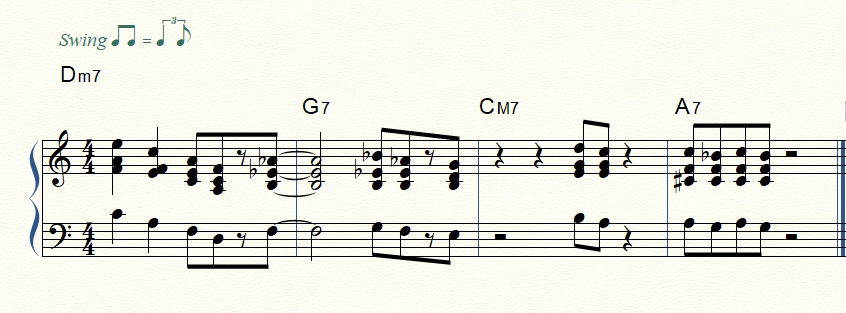
These shapes distribute chord tones and tensions across both hands. The left hand supplies the lower guide tones or shell, while the right hand completes the color above. Keep the texture clear: the lowest notes define the harmony, and the top note gives the voicing its melodic direction.
Major Seventh Voicings
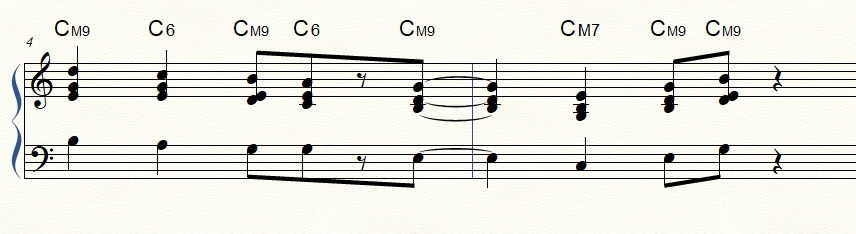
For a major seventh chord, build the vocabulary from inversions of M7, 6, and M9. Those three structures cover the most common top notes without changing the basic major sound. Choose the inversion by the note you want to hear at the top.
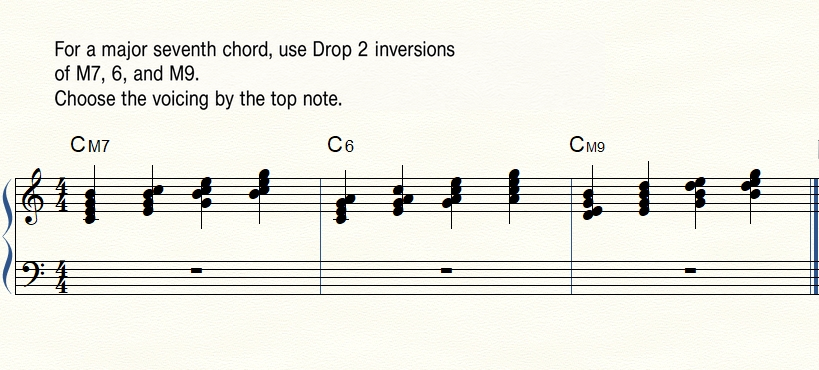
Choosing a voicing by the top note
- Root on top: use an inversion that keeps the major color below the root without crowding it.
- Ninth on top: use an M9 structure and make the ninth sing like a melody note.
- Third or fifth on top: choose the nearest M7 or 6 inversion.
- Sixth or seventh on top: treat the top note as a color tone and connect it by step to the next voicing.
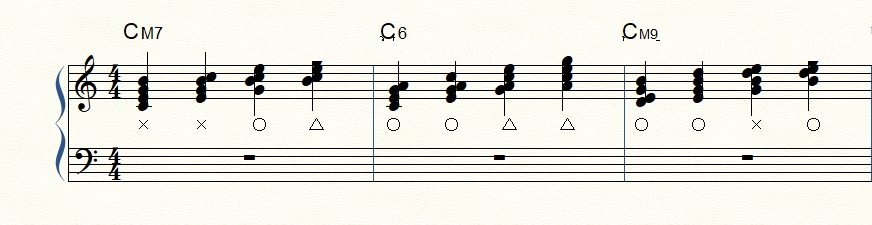
Practice tip: Hold the lower voices while singing the top note. If you cannot hear the top note independently, simplify the voicing before adding more tension.
Major-seventh practice pattern
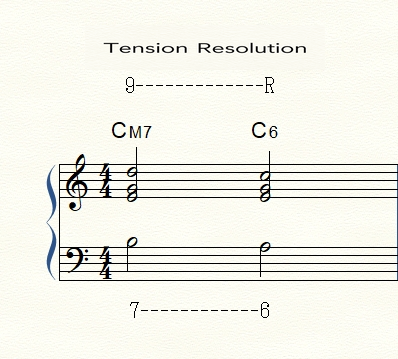
Tension and Resolution on Major Seventh Chords
A tension becomes expressive when it moves to a stable chord tone. In the example below, the ninth resolves to the root and the major seventh resolves to the sixth. Practice the upper voice first, then add the remaining notes without changing the timing.
Minor Seventh Voicings
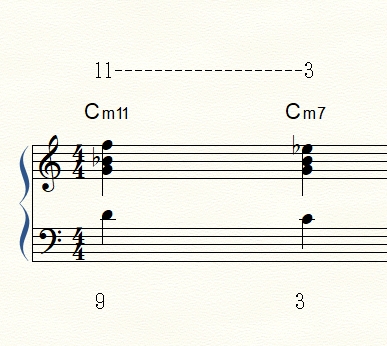
Minor seventh voicings follow the same top-note principle. Begin with the root, ninth, and minor third as lead notes. Keep the minor third and flat seventh audible somewhere in the voicing so the chord quality remains unambiguous.
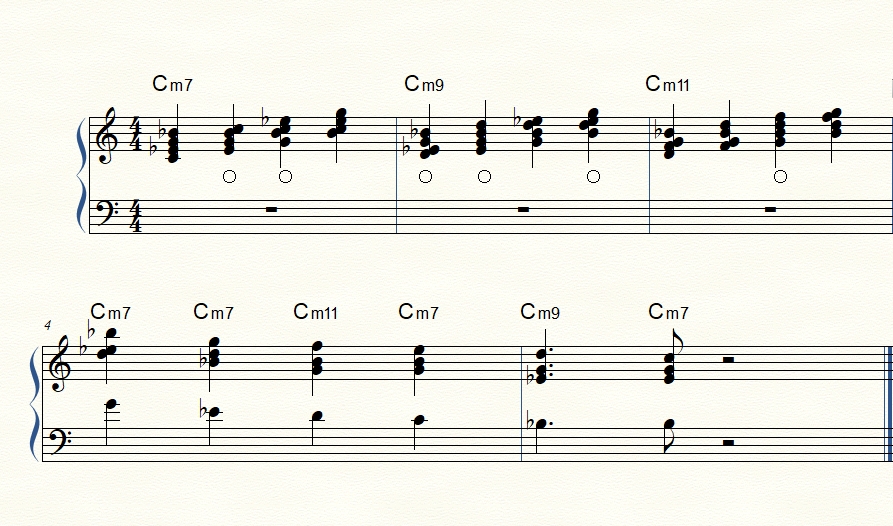
Resolve the ninth to the root or let the seventh fall to the sixth when the melody allows it. The resolution should be audible in the top or an inner voice; it does not need to happen in every part at once.
Dominant Seventh Voicings with Natural Tensions
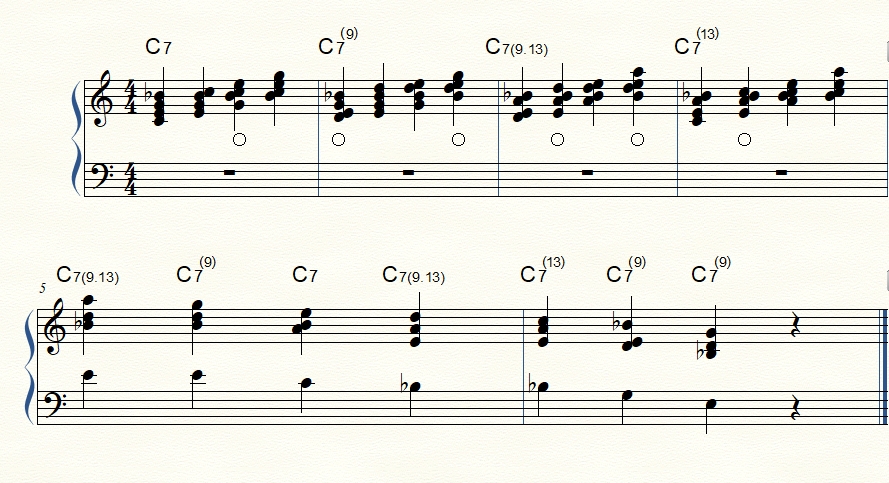
For a dominant seventh chord with natural tensions, organize the shapes around root, 9, 3, 5, 13, and b7 in the top voice. The third and b7 define the dominant function; the ninth and thirteenth add color without weakening the resolution.
Altered Dominant Voicings
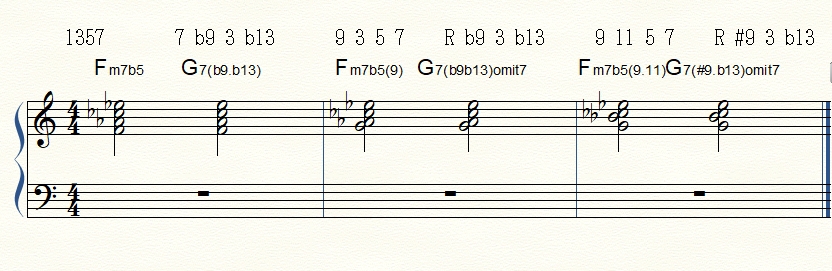
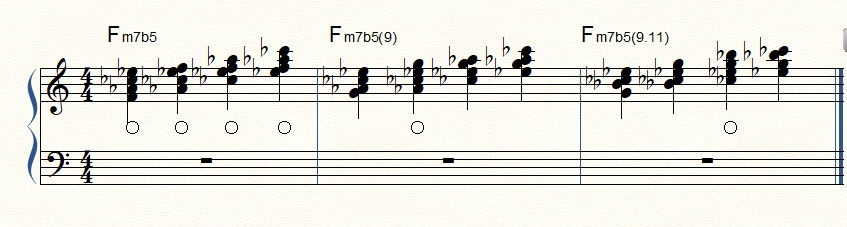
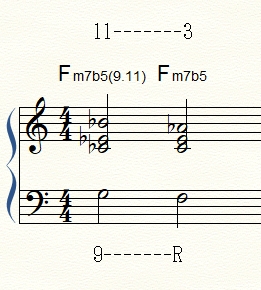
Altered dominant voicings are easier to remember as upper structures. Over G7, an Fm7b5 shape supplies b7, b9, 3, and b13. Adding the ninth of Fm7b5 brings in the G root; adding the eleventh brings in B-flat, the #9 of G7.
- Fm7b5 over G suggests G7(b9, b13).
- Fm7b5(add9) over G suggests G7(b13) with the root included.
- Fm7b5(add9, 11) over G suggests G7(#9, b13).
Arrange altered voicings by top note
Minor Seven Flat Five Voicings
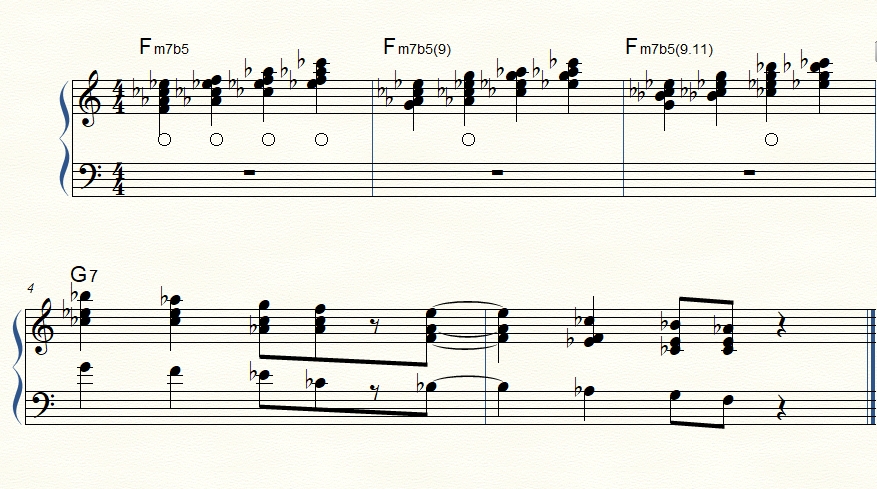
A half-diminished chord already contains a strong tension between its root and flat fifth. Use close voice leading and let added color tones resolve by step. Avoid doubling a dissonant note in a register where it overwhelms the chord quality.
Minor-Major Seventh and Minor 6
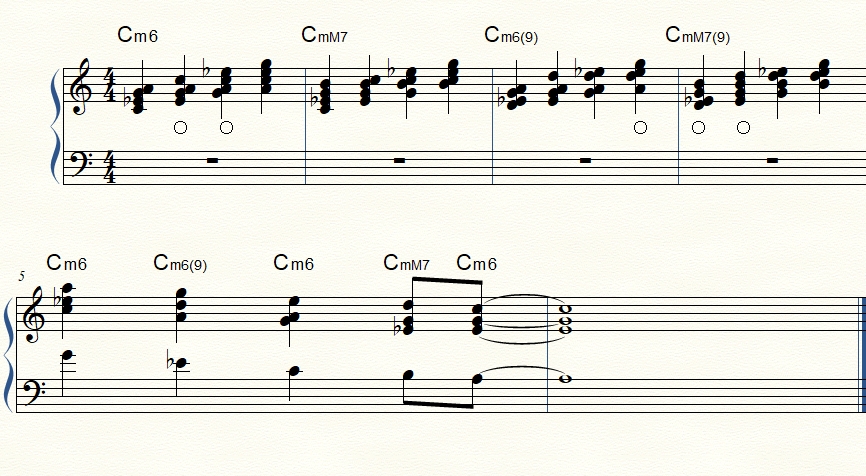
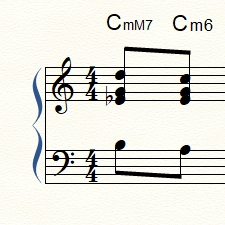
Minor-major seventh and minor 6 voicings come from melodic minor. The major seventh has a strong pull to the root, while the sixth offers a softer point of rest. Practice both colors so you can follow the melody rather than relying on a single fixed shape.
Practice the Voicings in Progressions
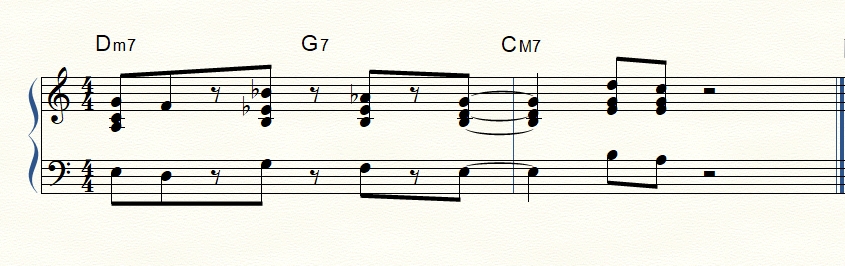
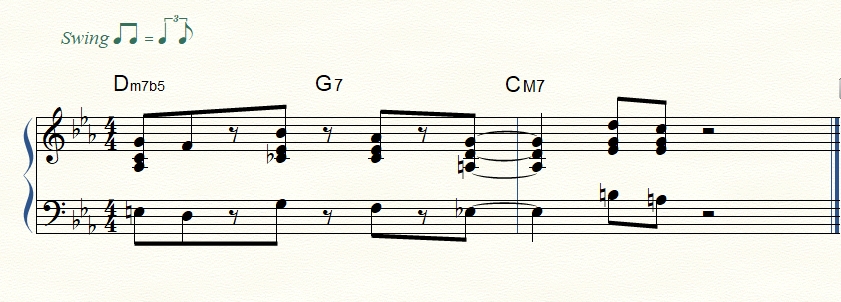
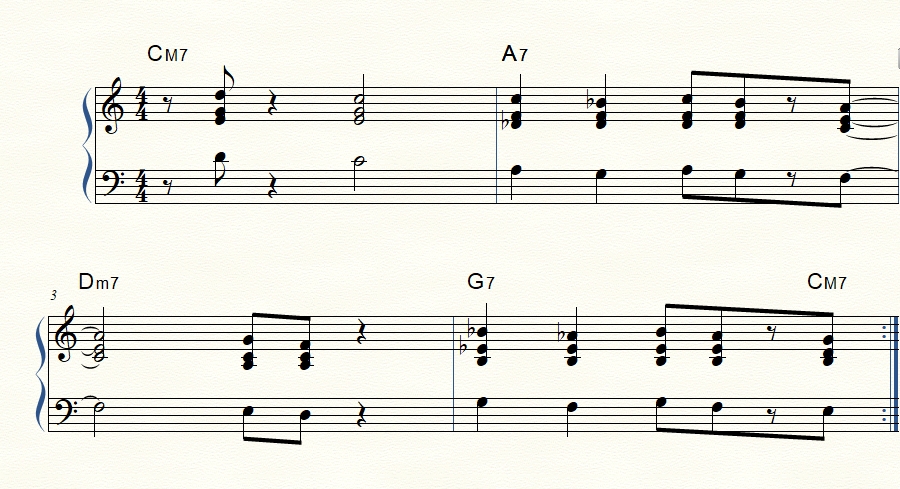
Isolated shapes become usable only when they connect through real harmony. Practice slowly enough to hear the top line, guide-tone motion, and bass movement as separate layers.
Major 2-5-1
Minor 2-5-1
1-6-2-5
Summary
- Choose two-handed voicings by the desired top note.
- Use M7, 6, and M9 inversions for major-seventh harmony.
- Resolve 9 to root and 7 to 6 to make tension audible.
- Keep 3 and b7 clear in dominant voicings.
- Use half-diminished upper structures to organize altered-dominant colors.
- Practice every shape inside ii-V-I and I-vi-ii-V progressions.
Play the Jazzify demo right now
Connect a MIDI keyboard and play this interactive demo in your browser.
On iPhone and iPad, browsers cannot use a MIDI keyboard. Please use the Jazzify app instead.