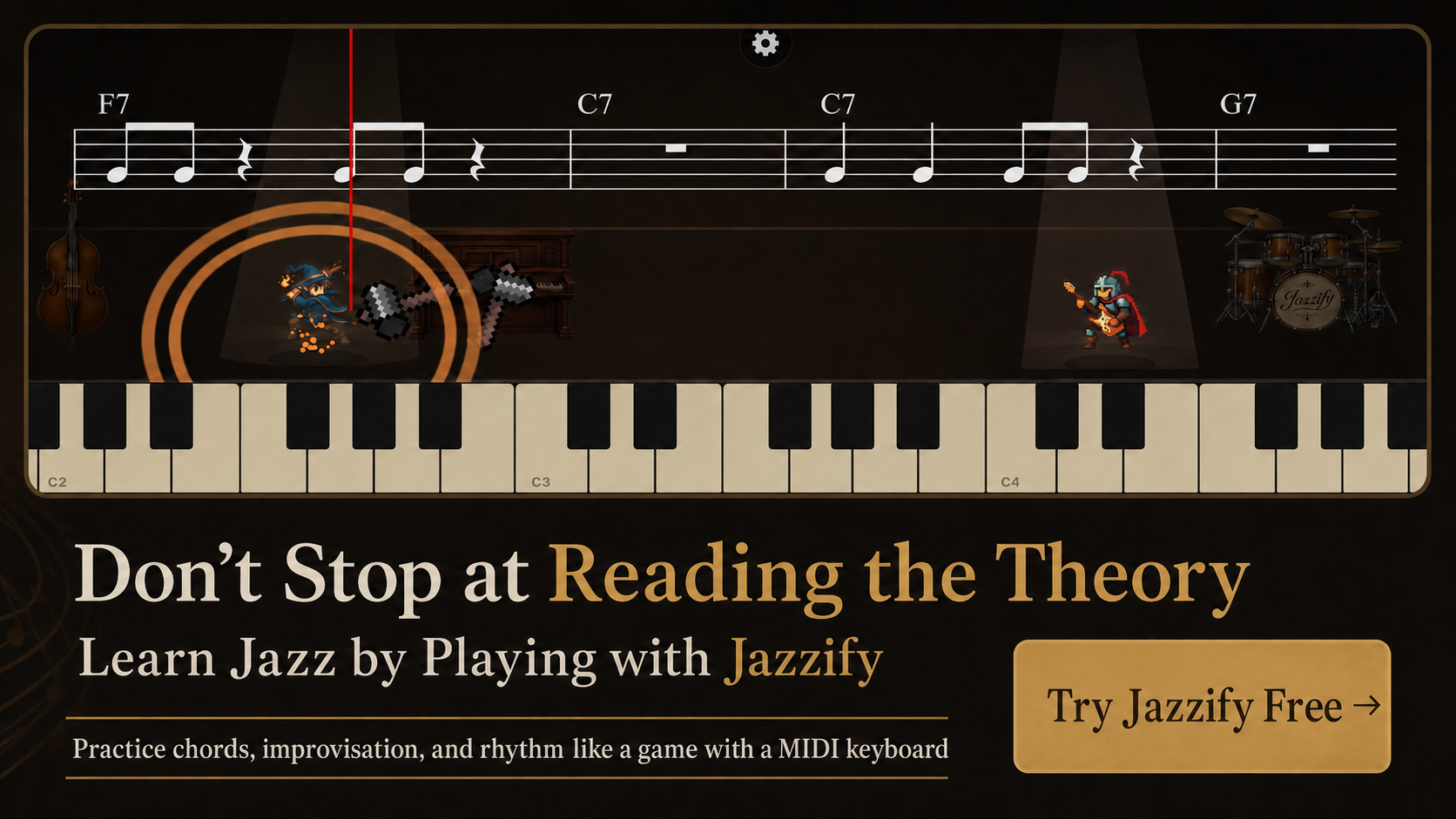
Choosing between a 49 vs 61 key MIDI keyboard for jazz is a trade-off between portability and harmonic breathing room. Forty-nine keys cover roughly four octaves; sixty-one keys cover five. That extra octave determines whether you play a Dm7 shell (D–F–C) and a simultaneous melody note above the staff without octave-shifting mid-phrase.
This comparison focuses on jazz-specific tasks—shell and rootless voicings, blues comping, standards in common keys—not classical repertoire that demands 88 keys.
Range by the Numbers
| Keyboard size | Typical range | MIDI note range (approx.) |
|---|---|---|
| 49 keys | C2 – C6 | 36 – 84 |
| 61 keys | C2 – C7 | 36 – 96 |
Middle C is MIDI note 60 (C4). Jazz left-hand shells often sit between C3 and G4; right-hand melody lines on standards frequently reach A4–D5 and occasionally higher on intros or tags.
What 49 Keys Handle Well
- Shell voicings in middle keys: Cm7–F7–B♭maj7 in F and B♭ with left hand around C3–F4.
- ii–V–I in C, F, B♭, G: Shapes stay within one hand position.
- Blues in F: F7 shell at F3–A3–E♭4 fits comfortably.
- Ear training and chord spelling: App drills that show one voicing at a time.
- Travel and hotel practice: Fits in a backpack with a laptop or iPad.
If your practice is mostly browser-based harmony modules and you comp in keys near F and B♭, 49 keys suffice for months.
Where 49 Keys Pinch
- Standards in E♭ and A♭: Left-hand roots drop lower; shells like E♭m7 (E♭–G♭–D♭) may need octave shift.
- Two-handed rootless voicings: C6/9 in left hand (C–E–G–A–D) plus right-hand guide-tone line above C5 runs out of room.
- Melody above the staff: "Autumn Leaves" peaks around E5; on 49 keys you may lose headroom when left hand sits low.
- Bass note pedagogy: Walking bass patterns from C2 require the bottom of a 61-key board; 49 starts at C2 but offers no margin below.
What 61 Keys Add for Jazz
The fifth octave (C6–C7) is the practical win—not concert grand low end. Benefits:
- Melody and voicing simultaneously in keys up to two sharps/flats without transpose button.
- Rootless Type B voicings (3rd on bottom) plus right-hand extensions (9th, 13th) in the same frame.
- Comfortable practice of "Girl from Ipanema" and bossa melodies that sit high.
- Less reliance on octave ± buttons during improvisation drills.
Connect either size via USB; setup steps match in connect MIDI keyboard to iPad.
Side-by-Side Jazz Task Comparison
| Task | 49 keys | 61 keys |
|---|---|---|
| Dm7–G7–Cmaj7 shells, key of C | Comfortable | Comfortable |
| Blues in F, left hand only | Comfortable | Comfortable |
| Blues in B♭, shells + simple riff | Tight | Comfortable |
| Rootless voicings + melody | Often requires octave shift | Usually fits |
| Standard in E♭ (e.g., "All the Things You Are") | Frequent shifts | Manageable |
| Simultaneous LH root + RH solo line | Limited | Reasonable |
Portability and Desk Footprint
Typical dimensions (varies by model):
- 49 keys: ~80 cm wide, ~2–3 kg — slides into overhead bins.
- 61 keys: ~100 cm wide, ~4–6 kg — still portable but needs wider tray table.
For daily commute practice on a 49-key board, transpose difficult standards down a whole step temporarily rather than fighting range—then revisit on 61 keys or 61 vs. 88 keys when you upgrade.
Action and Pedals Matter More Than Two Octaves
A 61-key board with synth action and no sustain jack hurts jazz more than a 49-key semi-weighted board with pedal input. Prioritize:
- Sustain pedal input (CC 64).
- Semi-weighted or better keybed.
- USB class-compliant connectivity.
- Key count third—unless you already know you play high melodies daily.
Sample Voicing Test Before You Buy
At a store or using an online spec sheet, map these shapes to the keyboard photo:
- F7 shell: F3, A3, E♭4 — both hands idle above.
- Cmaj7(9) rootless: E3, G3, B3, D4, G4 in left; melody note E5 in right.
- Gm7 → C7 → Fmaj7 cycle in F: shells with right-hand guide tone on top.
If the right-hand E5 forces octave + on 49 keys while left hand stays put, expect constant shifting in real repertoire.
Who Should Buy 49 Keys
- Frequent travelers practicing harmony and app drills only.
- Beginners in first six months focused on shells and ii–V–I in C, F, G, B♭.
- Producers who already own an 88-key studio piano and need a mobile sketchpad.
- Students with desk space under 85 cm wide.
Who Should Skip 49 and Get 61
- Primary instrument for jazz—no acoustic piano access.
- Working through standards with hands-together arrangement.
- Practicing rootless voicings and improvisation simultaneously.
- Planning to perform with iReal Pro backing tracks at original keys.
Pair a new board with structured practice: MIDI keyboard practice routine scales to either size.
Standards That Stress Each Key Count
These examples assume original concert keys and left-hand shells plus right-hand melody:
| Standard | Key | 49 keys | 61 keys |
|---|---|---|---|
| "Blue Bossa" | Cm | Comfortable | Comfortable |
| "Autumn Leaves" | Gm / Em | Manageable | Comfortable |
| "All the Things You Are" | A♭ | Frequent octave shifts | Manageable |
| "Body and Soul" | D♭ | Left hand very low | Still low but workable |
| "Giant Steps" | B | Melody peaks challenge range | Better headroom |
If your repertoire list skews toward A♭ and D♭ ballads, budget for 61 keys early. If you live in C, F, and B♭ for the first year, 49 keys remain viable.
Recommended Controller Features (Either Size)
- Octave ± buttons that respond instantly—some budget boards lag, breaking flow during shifts.
- Pitch and mod wheels matter less for jazz piano; prioritize pedal jack.
- Aftertouch optional; velocity sensitivity is not—test by playing C–E–G at velocities 40, 80, 110.
- USB bus power for iPad use without a separate power brick when possible.
Before purchase, connect the demo unit to your phone or tablet and run one voicing drill from best apps for jazz practice to confirm Web MIDI works out of the box.
Real-World Setup Scenarios
Bedroom desk (90 cm wide)
A 49-key board fits with room for a laptop beside it. Angle the keyboard slightly toward your dominant hand so shell voicings in G and D feel natural without wrist twist.
Weekly commute
49 keys in a backpack plus iPhone and Lightning adapter covers harmony review on a train. Save 61-key boards for destinations where you practice 30+ minutes seated.
Studio with existing 88-key piano
Keep a 49-key controller for DAW input and a 61-key board for travel. The home piano handles touch; the controller handles portability—key count overlap is intentional, not redundant.
Octave-Shift Workarounds on 49 Keys
When a standard forces a low root below your board’s range, use the octave-down button once and accept that your hands move up an octave visually. Document which tunes need this trick—"Body and Soul" in D♭ is a common example—so you recognize the pattern before buying 61 keys.
Used Market and Resale
61-key controllers hold resale value because they suit generalists. 49-key boards flood the market after beginners upgrade—buy used 49 keys cheap for travel, but expect to sell when harmony outgrows range.
Summary
- 49 keys cover four octaves (C2–C6); enough for shells and ii–V–I in friendly keys.
- 61 keys add a fifth octave critical for melody + voicing and keys like E♭ and A♭.
- Semi-weighted action and sustain pedal trump raw key count for jazz feel.
- Travelers and app-only harmonists can start at 49; serious jazz students should default to 61.
- Test specific voicings (F7 shell, Cmaj7(9) rootless) on the keyboard before purchase.
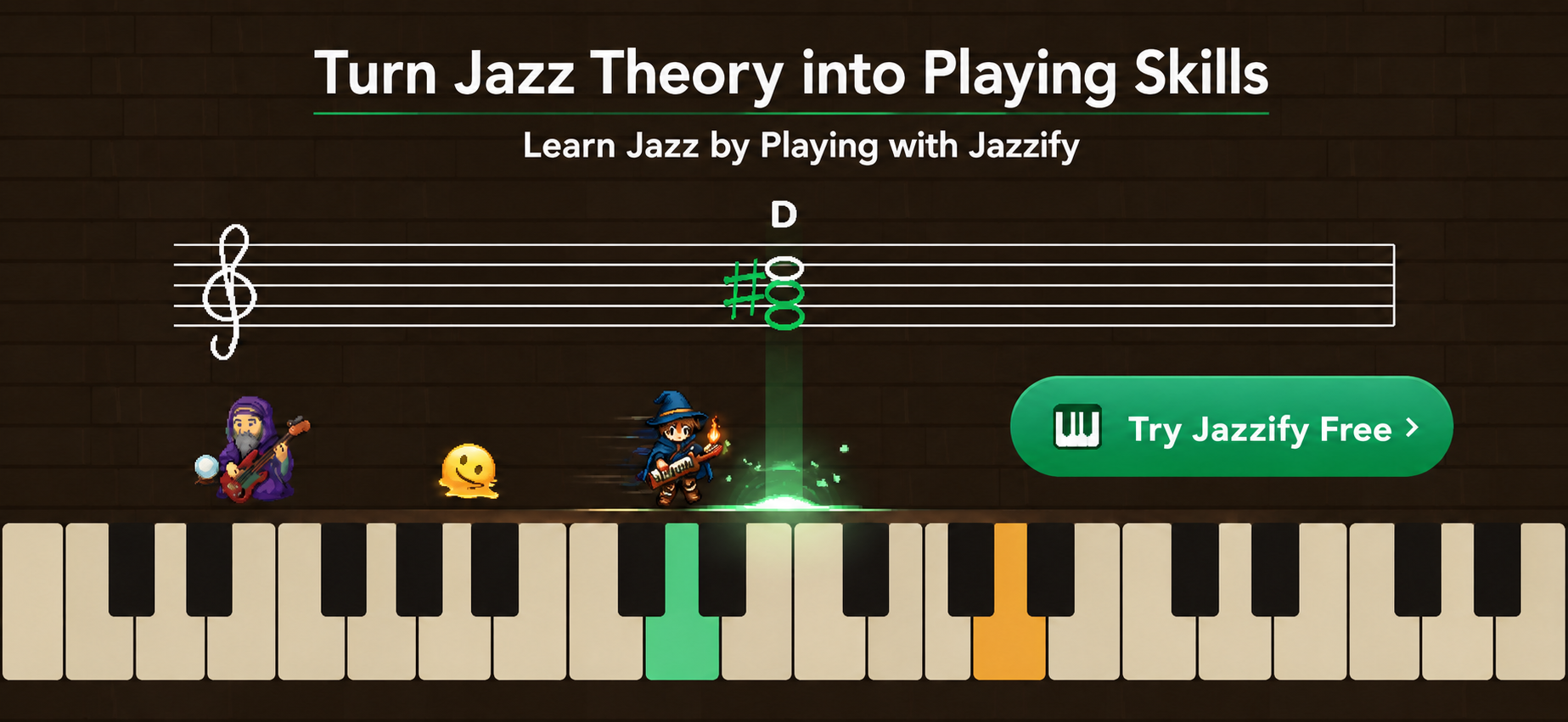
Play the Jazzify demo right now
Connect a MIDI keyboard and play this interactive demo in your browser.
On iPhone and iPad, browsers cannot use a MIDI keyboard. Please use the Jazzify app instead.