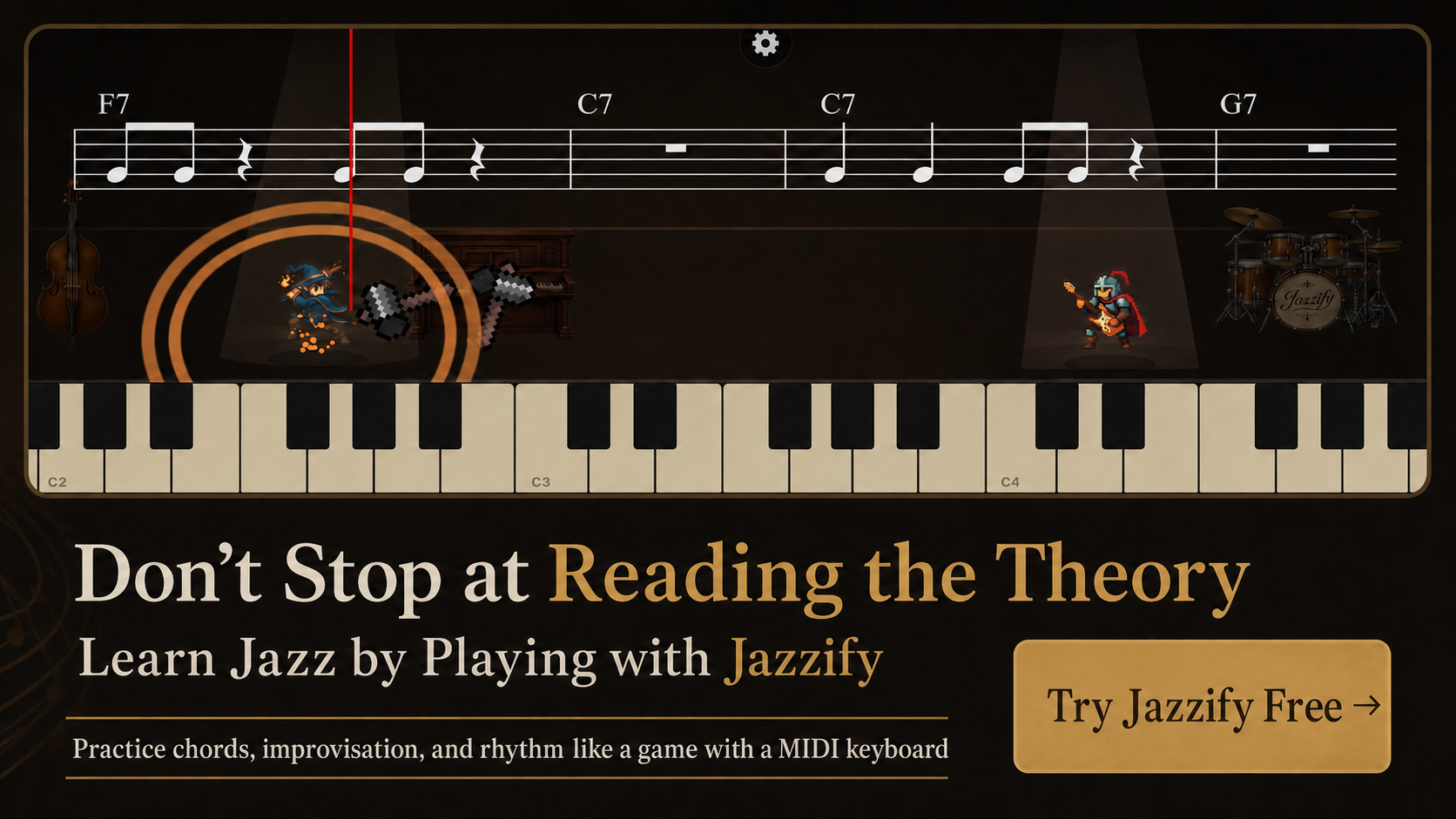
Jazz piano ear training is the skill of connecting what you hear on recordings with what your hands play on the keyboard. Without it, chord symbols stay abstract and improvisation becomes guesswork. With it, a Dm7-G7 cadence sounds like a question and answer before you read the chart.
This guide focuses on practical exercises: guide-tone singing, chord-quality recognition, short transcription loops, and interval drills tied directly to standard progressions.
Why Pianists Need Ears, Not Just Theory
Piano is a visual instrument. It is easy to learn shapes without learning sounds. Jazz, however, is learned from the bandstand and the recording. The musicians you admire did not start with a lead sheet—they started with listening.
Ear training does not replace theory. It makes theory audible. When you hear that the third of G7 resolves up to C and the seventh of G7 resolves down to B, the ii-V-I progression becomes something you recognize in real time.
Exercise 1: Sing Guide Tones on ii-V-I
Guide tones are the 3rd and 7th of each chord. On Dm7-G7-Cmaj7 in C major:
- Dm7: F (3rd) and C (7th);
- G7: B (3rd) and F (7th);
- Cmaj7: E (3rd) and B (7th).
Sing the top voice: C → B → B (common tone), or sing the line F → F → E where F on G7 moves down to E on Cmaj7. Play the roots in the left hand while you sing. Then switch: sing roots, play guide tones.
Do this in F (Gm7-C7-Fmaj7: Bb-A, E-Eb, A-G in various guide-tone lines) and B-flat (Cm7-F7-Bbmaj7) until the half-step resolutions feel inevitable.
Exercise 2: Identify Chord Qualities by Ear
Record yourself playing random maj7, 7, m7, and m7b5 chords in root position. Playback without looking at the keyboard. Name the quality before you peek.
Focus on the telltale intervals:
- maj7: natural 7th (B in Cmaj7)—bright, settled;
- 7: flat 7th (Bb in C7)—open, leaning forward;
- m7: flat 3rd and flat 7th—darker, less resolved;
- m7b5: flat 5th (Gb in Cm7b5)—unstable, often leading to V7.
Our jazz piano chords for beginners article lists formulas that match these sounds.
Exercise 3: Two-Bar Transcription Loops
Choose a recording with clear piano—Bill Evans, Wynton Kelly, or Red Garland ballads work well. Loop two bars. Identify the top note of the voicing on beat 1. Write it down. Find it on the piano. Add the next note.
Do not transcribe entire solos yet. Two bars repeated for fifteen minutes builds the same neural pathway without overwhelm. For a full workflow, see how to transcribe jazz piano.
Exercise 4: Hear Tensions Against a Drone
Hold a Cmaj7 (C-E-G-B). Play D, then F, then G above it. D is the 9th, F is the 11th (watch voice leading in real tunes), G is the 5th. Learn which tensions sound consonant on maj7 versus dominant.
On C7, compare Bb (7th), D (9th), and Ab (b9). The altered colors point toward Fm or F major resolution. The jazz chord tensions guide names these extensions in context.
Exercise 5: Short Phrase Call-and-Response
Sing a four-note phrase on a C7 chord— for example G, B, D, F (5-7-9-7). Play it on the piano. Sing a variation—G, B, Eb, D (adding the b9). Play that. This links ear, voice, and fingers.
Use a C7–Fmaj7 backing loop. End phrases on a chord tone of Fmaj7: A, C, E, or F. If you land on a note that clashes, you will hear it immediately—that is the lesson.
Exercise 6: Dictation With Roman Numerals
Have a friend—or an app—play progressions using Roman numerals. Write what you hear: iim7-V7-Imaj7, or Imaj7-viim7b5-iii7-vim7. Check against the keyboard.
Start in one key until recognition is fast, then move to concert pitch without naming the key aloud first. This bridges ear training to real lead sheets.
How Much Ear Training Per Day?
Ten to fifteen minutes daily beats a long session on weekends. Split the week:
- Monday and Wednesday: guide-tone singing;
- Tuesday: chord-quality quiz;
- Thursday: two-bar transcription;
- Friday: tension drone exercise;
- Weekend: phrase call-and-response on a blues in F.
Singing is non-negotiable even if you feel self-conscious. Internal pitch makes voicing choices faster under your fingers.
Connecting Ear Training to Performance
When you comp behind a melody—or improvise—you are reacting in real time. Ear training shrinks the delay between hearing an idea and playing it. Start every practice session with five minutes of singing guide tones on one ii-V-I before you touch technique exercises.
Apps that play chord progressions and ask you to match voicings by ear accelerate this loop. The feedback should be immediate: right sound, right timing, or try again.
Hearing Root Movement by Bass Alone
Play recordings with the bass prominent—Ray Brown with Oscar Peterson, for example. Pause after each bar and sing the bass note only. On a blues in B-flat, you should hear B-flat, E-flat, B-flat, B-flat through the first four bars before you name chord qualities. Root hearing keeps you oriented when the right hand uses substitutions.
Interval Drills That Transfer to Jazz
Practice ascending minor thirds (C to Eb, D to F) and tritones (C to F#) on piano while singing. Jazz voicings move by these intervals constantly: G7 to Cmaj7 is a fourth in the bass; tritone sub moves the bass by half step. Five minutes of interval singing daily supports transcription and reharmonization later.
Testing Yourself Without Gadgets
At the keyboard, close your eyes. Have a practice partner call out “m7” or “dominant 7.” Play any root with that quality. Then they call “ii-V in F” and you play Gm7-C7. This low-tech quiz exposes gaps faster than replaying apps you have memorized visually.
Ear Training and Transcription Together
Alternate singing and writing. After you sing a two-bar comping figure, notate only the top two voices on staff paper or in a MIDI piano roll. You do not need perfect notation—whole notes for guide tones are enough. Compare with the recording. Discrepancies teach more than playing along silently.
On a C7 chord, if you wrote Bb for the top note but the recording uses B natural as a brief approach, you discovered an enclosure—not a wrong chart. Ear training plus minimal notation builds the vocabulary improvisers use on stage.
Summary
- Ear training makes chord symbols and progressions audible.
- Sing guide tones on ii-V-I in C, F, and B-flat daily.
- Identify maj7, 7, m7, and m7b5 by quality before naming roots.
- Transcribe two bars at a time; build up slowly.
- Connect tensions and short phrases to chord tones on V7 and Imaj7.
Play the Jazzify demo right now
Connect a MIDI keyboard and play this interactive demo in your browser.
On iPhone and iPad, browsers cannot use a MIDI keyboard. Please use the Jazzify app instead.