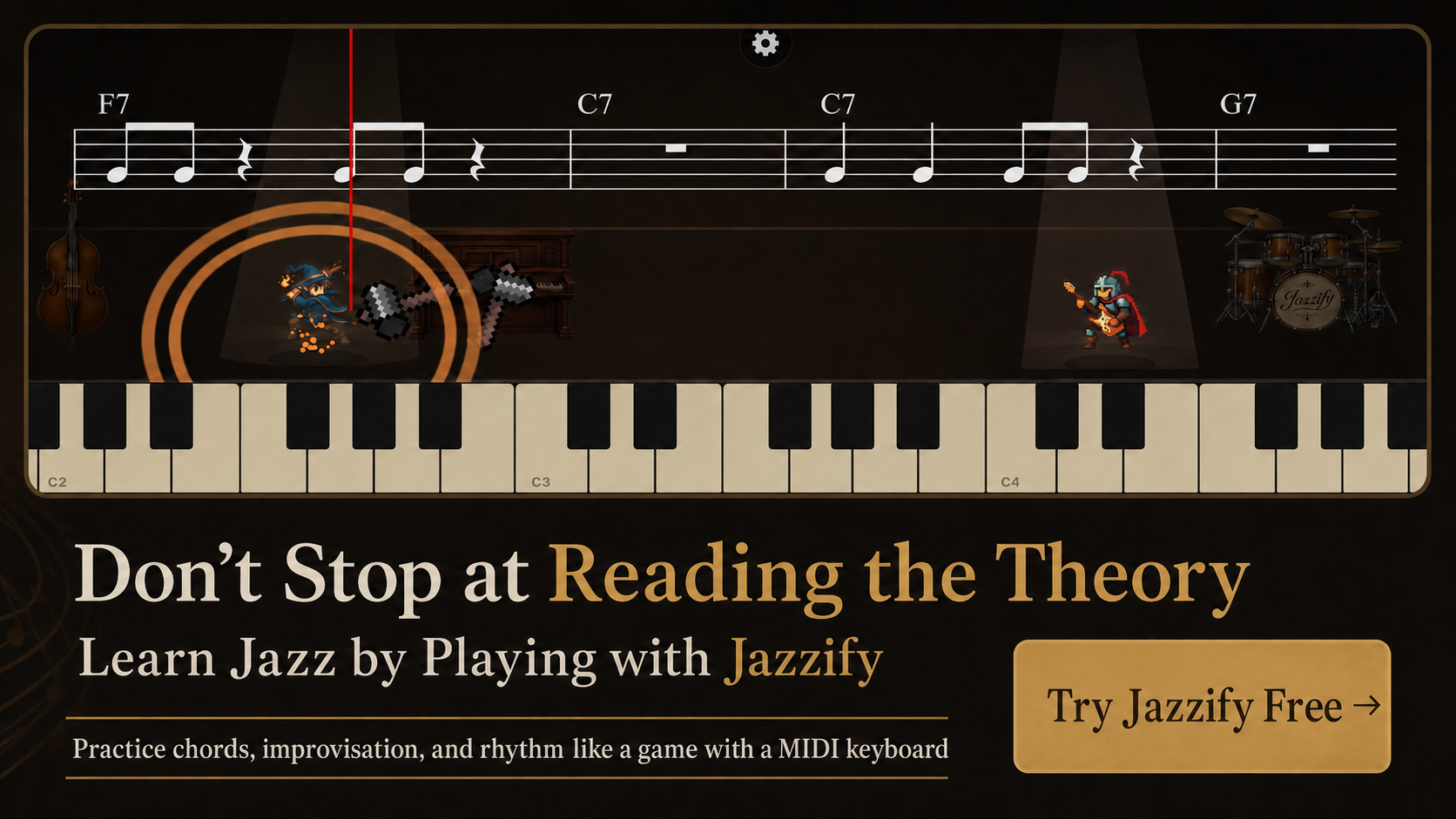
Free jazz piano lessons online can teach you voicing shapes, explain ii-V-I theory, and demonstrate how a professional comping through a standard. What they cannot do is tell you that your Dm7 voicing is missing the third or that your left hand rushes every bar — and that gap is exactly where most self-taught students stall.
This guide maps what free resources cover well, where they leave holes, and how to build a zero-cost or low-cost practice plan that still produces real progress.
Types of Free Jazz Piano Content Online
| Source | Strengths | Limitations |
|---|---|---|
| YouTube tutorials | Visual demonstrations, specific topics, diverse teachers | No curriculum order, no feedback, variable quality |
| Blog articles and guides | Reference material, chord charts, written explanations | No audio interaction, no practice tracking |
| Free app tiers | Interactive exercises, some MIDI feedback | Limited content, daily caps, ads |
| University open courses | Deep theory, academic rigor | Not performance-focused, no jazz-specific feedback |
| Community forums | Peer advice, lead sheet sharing | Unverified information, no structured path |
What Free Lessons Teach Well
Individual concepts
A 15-minute YouTube video on shell voicings or a blog post on the ii-V-I progression can explain a single topic clearly. Free content excels at isolated "aha" moments — the day you understand why a rootless voicing works, or how guide tones connect through a progression.
Demonstration and inspiration
Watching a skilled player comp through Autumn Leaves at three tempos shows you what the goal sounds like. Free performance videos and masterclass clips provide motivation and model phrasing in ways text cannot.
Reference and lookup
Need the notes of a C7alt chord? A free chord chart or blog reference answers that in seconds. Reference material is where free content permanently wins — you will always look up specific voicings and scale formulas.
Basic ear-training concepts
Free apps and websites offer interval trainers and chord-quality quizzes. These build foundational listening skills, though advanced jazz ear training (hearing ii-V-I progressions, recognizing reharmonizations) usually requires structured paid modules.
What Free Lessons Cannot Provide
Feedback on your playing
No free video watches you play and tells you what to fix. You can record yourself and compare to the instructor, but that requires discipline most beginners lack — and you may not hear the specific problem (missing chord tone, wrong inversion, timing drift).
Structured curriculum in the right order
Free content is organized by upload date and search algorithm, not by pedagogical sequence. You might learn altered dominants before you can voice a basic G7, or study solo transcription before you can comp through a blues.
Accountability and progress tracking
Free resources do not know whether you practiced yesterday. Without streaks, quests, or a teacher expecting progress, motivation fades — especially after the initial excitement of discovering jazz harmony.
Integrated ear training with keyboard input
Watching someone identify a chord by ear is not the same as doing it yourself under pressure. Free ear trainers often test recognition with multiple-choice buttons rather than requiring you to play the chord on a MIDI keyboard.
Building a Free Practice Plan That Works
If budget is zero today, structure your free resources deliberately:
Week 1–2: Foundations
- Learn triads and seventh chords from free YouTube lessons or blog guides.
- Practice chord spelling in C, F, and G using a free virtual keyboard if you lack a MIDI controller.
- Read jazz piano chords for beginners for a structured starting point.
Week 3–4: Voicings and blues
- Learn shell voicings (3-7, 7-3) from free tutorials.
- Comp through a 12-bar blues in F using shell voicings in the left hand.
- Use a free metronome app with clicks on beats 2 and 4.
Month 2: ii-V-I and first standard
- Study ii-V-I voice leading in C, F, and Bb from free content.
- Learn one standard (Blue Bossa or Autumn Leaves) from a free lead sheet and tutorial.
- Start daily listening: one recording of your standard per day.
Ongoing: Self-assessment
- Record yourself weekly on phone and compare to a reference recording.
- Follow the full roadmap in how to learn jazz piano by yourself.
When to Upgrade From Free to Paid
Consider adding a paid tool when you hit these walls:
- You practice daily but repeat the same mistakes — you need instant feedback (interactive app).
- You understand theory but cannot apply it to tunes — you need a structured curriculum (app or course).
- You have been self-studying 3+ months with minimal progress — you need a teacher for diagnosis.
- Your ear training plateaued at interval recognition — you need chord-progression and phrase-level ear work.
Jazzify offers free introductory quests with MIDI keyboard feedback — enough to experience interactive practice before deciding on a premium plan. For pricing context, see online jazz piano lessons cost.
Free vs. Paid: Honest Comparison
| Need | Free solution | Paid solution |
|---|---|---|
| Learn what a ii-V-I is | YouTube + blog | Video course (deeper) |
| Play voicings correctly | Self-recording (slow feedback) | MIDI app (instant feedback) |
| Ear training basics | Free interval trainers | Integrated ear + keyboard modules |
| Fix time feel | Metronome + self-recording | Live teacher |
| Structured daily plan | Self-created schedule | Guided quests (Jazzify) or course |
| Repertoire coaching | Free lead sheets + recordings | Teacher or advanced app curriculum |
Quality Filters for Free Content
Not all free jazz piano content is accurate or well-paced. Evaluate any free resource with these checks:
- Does the instructor play examples at the piano, not just show slides?
- Are voicings demonstrated in multiple keys, not only C major?
- Does the content reference real recordings and standards?
- Are comment sections full of students reporting progress, or only "great video" praise?
- Does the creator have verifiable performing or teaching credentials?
Avoid channels that promise "master jazz piano in 30 days" or focus exclusively on shortcut tricks without voice-leading fundamentals.
Curated Free Resource Starting Points
These types of free content are worth bookmarking:
- University jazz department lecture recordings — Berklee, Juilliard, and other programs publish free masterclass clips on harmony and improvisation.
- Lead sheet PDFs from legal sources — some publishers offer sample pages from Real Book editions.
- Jam session recordings on YouTube — watch how working musicians comp and solo on standards you are learning.
- Interactive app free tiers — Jazzify and similar platforms let you complete introductory quests before deciding on a subscription.
Save these in a dedicated browser folder rather than relying on YouTube's recommendation algorithm to surface them again.
Combining Free and Paid for Maximum Value
The most cost-effective approach for many students:
- Free — YouTube for specific topics, blogs for reference, daily listening to recordings.
- Low-cost app ($15–$25/month) — daily interactive practice with MIDI feedback.
- Occasional teacher ($60 every 2–4 weeks) — musical coaching and repertoire selection.
This combination costs less than weekly private lessons while providing both daily structure and human musical guidance. For the teacher vs. app decision, read jazz piano teacher vs. app.
Summary
- Free jazz piano lessons online excel at teaching individual concepts, demonstrating technique, and providing reference material.
- They cannot provide feedback on your playing, structured curriculum order, or accountability.
- Build a deliberate free practice plan with weekly milestones rather than browsing randomly.
- Upgrade to a paid app or teacher when you repeat mistakes, plateau, or need ear training beyond intervals.
- Combine free content with a low-cost interactive tool for the best value on a tight budget.
Play the Jazzify demo right now
Connect a MIDI keyboard and play this interactive demo in your browser.
On iPhone and iPad, browsers cannot use a MIDI keyboard. Please use the Jazzify app instead.