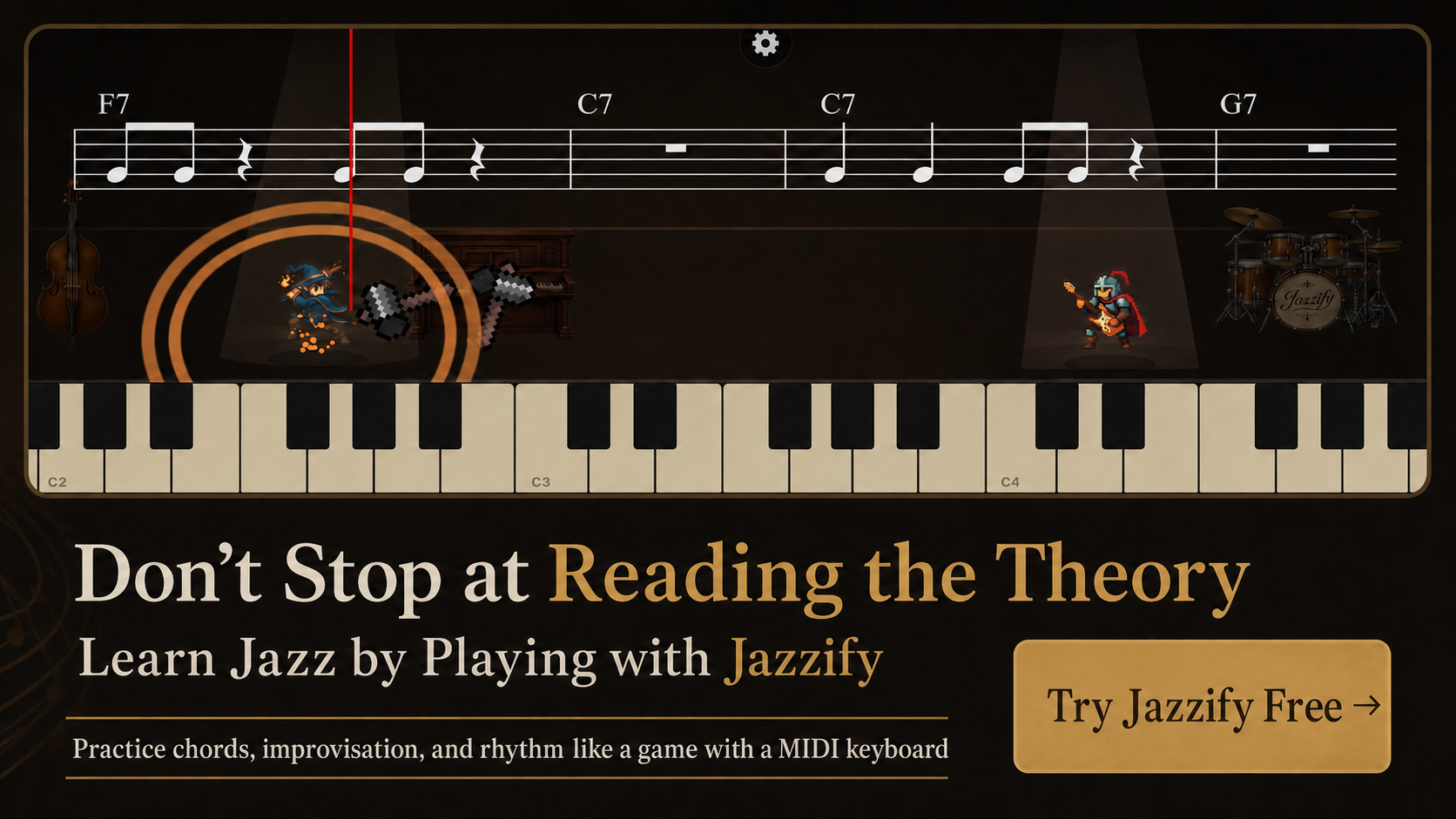
The jazz piano teacher vs. app debate is not really a choice between equals. A live teacher and an interactive app solve different problems at different price points. The students who progress fastest usually use both — a teacher for direction and musical coaching, an app for daily repetition and instant technical feedback.
This guide compares what each format does well, where each falls short, and how to decide where to invest your time and money at your current stage.
Side-by-Side Comparison
| Factor | Live teacher | Interactive app |
|---|---|---|
| Cost | $40–$120/hour | $0–$30/month |
| Feedback speed | Once a week (or less) | Instant, every attempt |
| Time feel and phrasing | Strong | Weak |
| Chord spelling and voicing | Strong | Strong (automated) |
| Ear training | Depends on teacher | Structured modules |
| Curriculum structure | Custom to you | Fixed quest path |
| Schedule flexibility | Requires booking | Anytime |
| Accountability | High (someone expects progress) | Self-driven |
What a Live Jazz Piano Teacher Does Better
Hearing your time feel
Apps can check whether you played the right notes at the right time relative to a click. They cannot tell you that your comping rushes beat 2, that your swing eighths are even instead of dotted, or that your left hand is too heavy. A teacher listens for musical feel — the element that separates competent playing from jazz playing.
Diagnosing root causes
If your ii-V-I lines sound disconnected, a teacher might discover the problem is not your scale choice but your inability to hear guide-tone voice leading. That kind of diagnosis requires human judgment and follow-up questions.
Assigning repertoire matched to your level
A good teacher picks tunes that stretch you without overwhelming you — maybe Blue Bossa this month and Autumn Leaves next, based on how you handled the current assignment. Apps follow a fixed curriculum that may not match your pace in either direction.
Modeling phrasing and articulation
Watching and hearing a teacher play a bebop phrase — with its accents, ghost notes, and dynamic shape — teaches something no automated check can replicate.
What an Interactive App Does Better
Daily repetition with instant feedback
Jazz progress depends on volume of focused practice. An app lets you drill shell voicings through every key, run ear-training exercises, and attempt improvisation quests ten times in a row — with immediate correction on each attempt. A weekly lesson provides one feedback moment per seven days.
Structured ear training
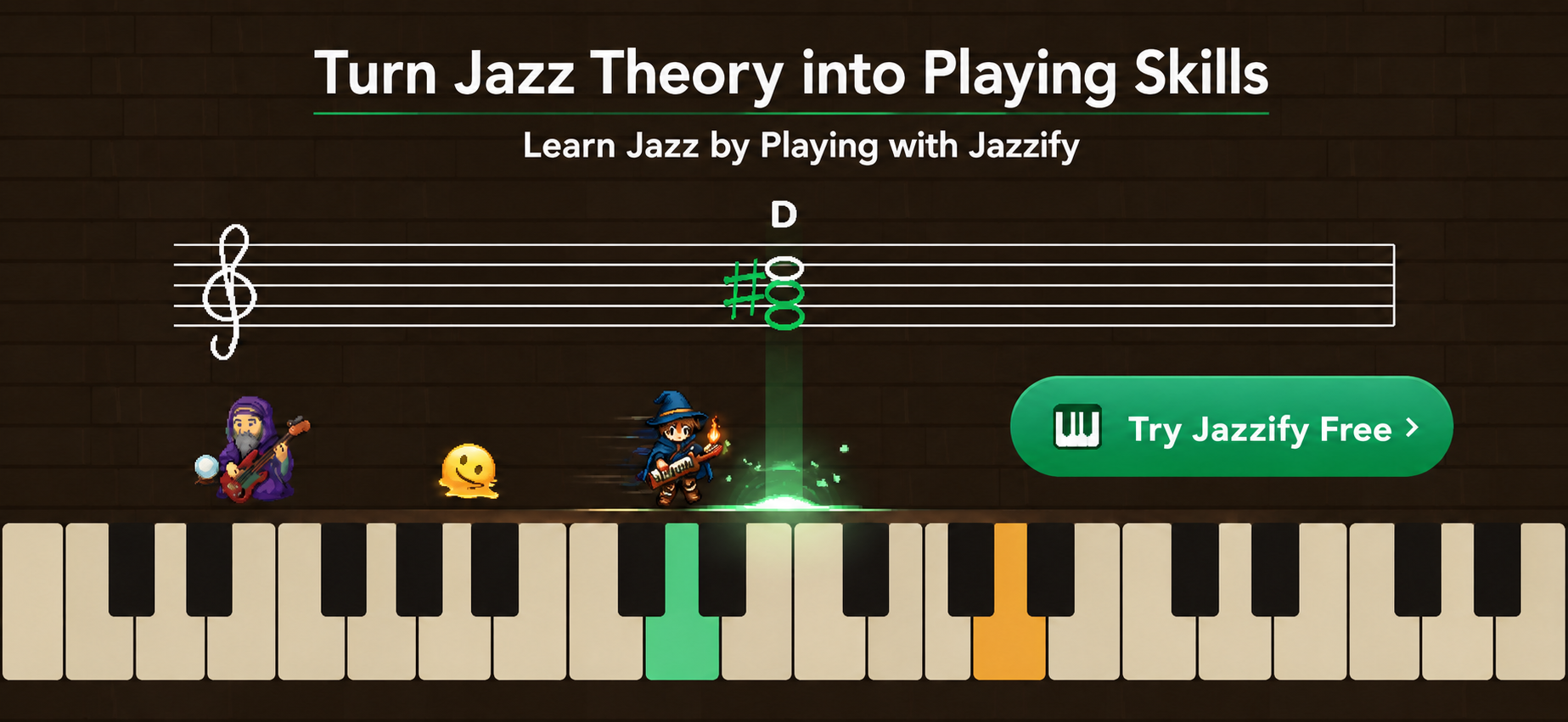
Apps like Jazzify integrate ear-training modules — interval recognition, chord quality, call-and-response phrases — into the same session as keyboard exercises. You hear a chord, identify it, then play it back. Consistency builds faster than occasional ear tests in a lesson.
Lower cost per practice hour
A $20/month app subscription provides unlimited daily sessions. A single $60 lesson provides one hour. If you practice 30 minutes daily, the app costs roughly $1.30 per practice hour; the teacher costs $60 per practice hour (one session per week).
No scheduling friction
Open the browser, connect your MIDI keyboard, start a quest. At 11 PM on a Tuesday, no booking required. For students with irregular schedules, this accessibility matters.
When to Choose a Teacher First
- You are a complete beginner and do not know where to start.
- You are a classical crossover and need help unlearning rigid rhythm habits.
- You have been self-studying for months and feel stuck despite daily practice.
- Your goal is gigging or professional work and you need repertoire coaching.
- You lack self-motivation and need external accountability.
Classical pianists transitioning to jazz face specific challenges covered in jazz piano lessons for classical pianists.
When to Choose an App First
- You know what to practice but need structured daily exercises.
- Your budget is under $30/month and weekly lessons are not affordable yet.
- You want to build chord vocabulary and ear training before investing in a teacher.
- Your schedule is irregular and you cannot commit to weekly lesson times.
- You already have a teacher and need feedback between sessions.
For app options, see best apps for jazz practice and MIDI piano learning software.
The Hybrid Model Most Students Should Use
Combine both formats with clear roles:
| Role | Tool | Frequency |
|---|---|---|
| Daily technical practice | Interactive app (Jazzify) | 5–6 days/week, 20–30 min |
| Musical coaching and repertoire | Live teacher | Biweekly or monthly, 45–60 min |
| Listening and transcription | Recordings + self-study | Daily, 10–15 min |
| Repertoire application | Both (app for drills, teacher for tune selection) | Ongoing |
This model costs $20–$30/month for the app plus $60–$120 every two to four weeks for a teacher — typically $50–$80/month total, less than weekly lessons alone.
What Neither a Teacher Nor an App Replaces
- Listening to recordings — the primary source of jazz language.
- Transcription — copying a master's phrasing by ear.
- Playing with other musicians — jam sessions, duo practice, ensemble work.
- Self-recording and review — hearing yourself as others hear you.
Our self-study roadmap in how to learn jazz piano by yourself integrates all of these elements.
Sample Weekly Schedule: Hybrid Model
Here is a concrete week combining Jazzify and a biweekly teacher:
| Day | Activity | Duration |
|---|---|---|
| Mon | App: voicing quest + ear training | 25 min |
| Tue | Repertoire: comp through one standard | 25 min |
| Wed | App: ii-V-I voice leading drills | 25 min |
| Thu | Listen + transcribe 4 bars | 25 min |
| Fri | App: improvisation quest | 25 min |
| Sat | Live teacher session (every 2 weeks) | 45 min |
| Sun | Free play: review teacher notes | 25 min |
Adjust durations to fit your schedule. The pattern — app on weekdays, repertoire and listening mixed in, teacher every two weeks — keeps cost manageable while maintaining daily momentum.
Red Flags: When Your Current Setup Is Not Working
Teacher only, no daily practice
One lesson per week with no structured practice between sessions produces slow progress regardless of teacher quality. Add an app or written assignment list.
App only, plateau for months
You can spell every voicing but your playing still sounds mechanical. You need a teacher (or jam session) to develop phrasing and time feel.
Both, but no listening or repertoire
Exercises without tunes produce exercisers, not musicians. Allocate at least 20 minutes daily to a real standard.
Making the Decision: Three Questions
- Can I practice without someone telling me what to do today? No → start with a teacher or structured app. Yes → app may suffice initially.
- Am I making technical mistakes I cannot hear myself? Yes → app for instant correction. No → teacher for musical refinement.
- What is my monthly budget? Under $30 → app. $30–$100 → app + biweekly teacher. $100+ → weekly teacher + app.
For detailed pricing, see online jazz piano lessons cost.
How to Evaluate Whether Your Hybrid Setup Is Working
After six weeks of app-plus-teacher study, check these indicators:
- You practice at least five days per week without forcing motivation.
- Your teacher's corrections decrease — fewer voicing errors, better time feel.
- App quest stages that once failed now pass on the first or second attempt.
- You can comp through at least one standard without stopping.
If none of these are true, adjust the ratio: more app time if execution is weak, more teacher time if theory understanding is strong but playing sounds stiff.
Summary
- Teachers excel at time feel, phrasing, diagnosis, and repertoire coaching; apps excel at daily repetition, instant feedback, and ear training.
- Neither replaces listening, transcription, or playing with others.
- The hybrid model — app for weekdays, teacher for monthly coaching — offers the best value for most hobbyists.
- Choose based on your current bottleneck: structure, technical feedback, or musical coaching.
- Re-evaluate every three months as your weaknesses shift.
Play the Jazzify demo right now
Connect a MIDI keyboard and play this interactive demo in your browser.
On iPhone and iPad, browsers cannot use a MIDI keyboard. Please use the Jazzify app instead.