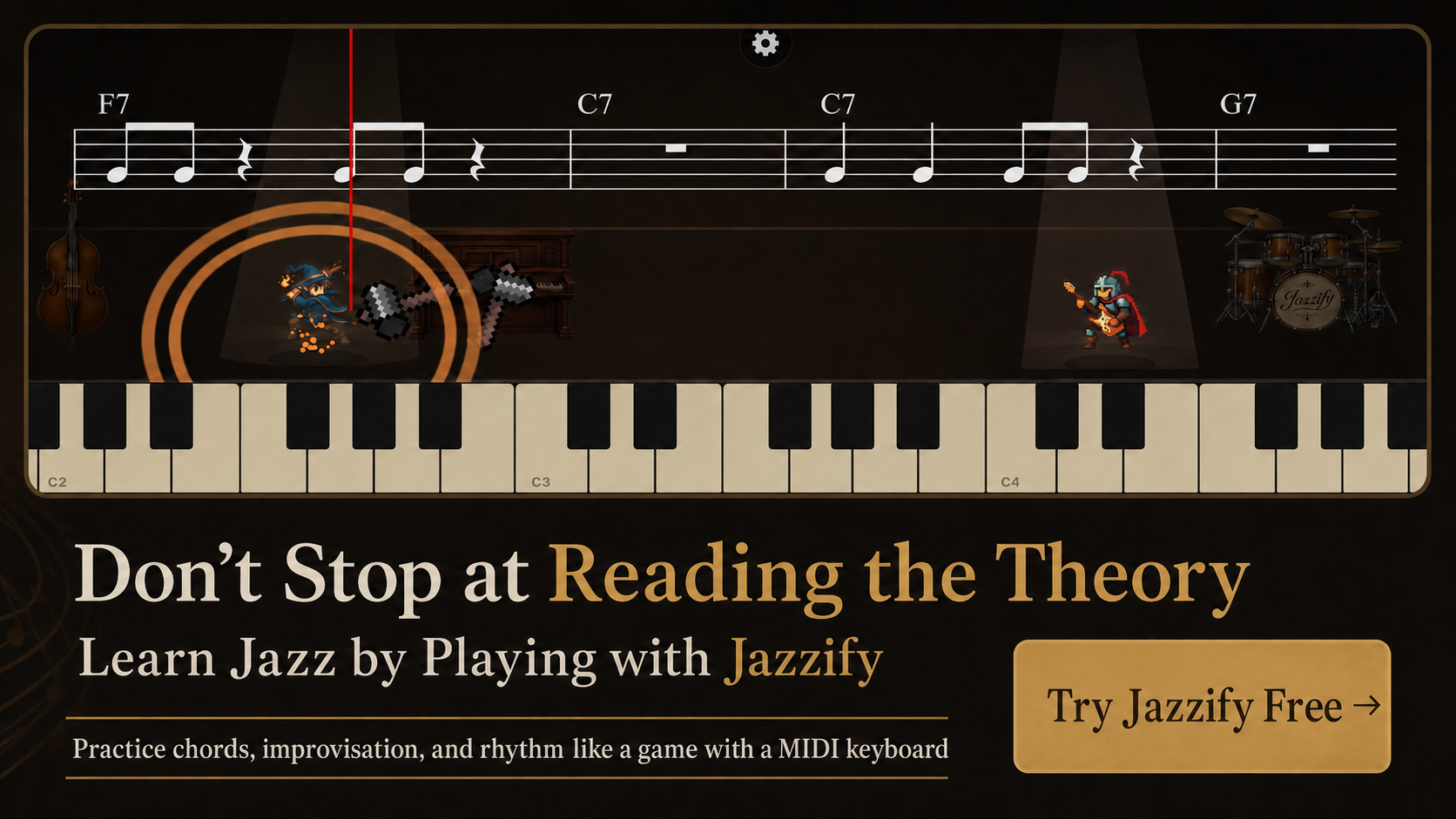
Walking bass lines on jazz piano fill the harmonic and rhythmic foundation when no bassist is present — or when you want left-hand independence in trio-style comping. Quarter notes on beats 1–4 outline chord changes, connect roots by step or fifth, and drive swing at medium and up tempos.
This guide covers basic walking principles, note choice on ii–V–I progressions, blues bass lines, and coordination with right-hand voicings.

What Makes a Bass Line "Walk"
Walking means continuous quarter notes — four per 4/4 bar — with notes chosen to define harmony and forward motion. Unlike root-only patterns (half notes on beat 1), walking fills the bar and implies chord changes before they arrive.
Register: typically C2–C3 for acoustic bass feel on piano. Keep right hand above C4 to avoid mud.
Chord Tone Priority
On each beat, prefer in order:
- Root of current chord
- Fifth or third of current chord
- Root of approaching chord ( anticipation on beat 4)
- Chromatic passing tone between chord tones
On Cmaj7 for one bar, a simple walk: C2 (root) – E2 (3rd) – G2 (5th) – A2 (6th or step toward next chord).
Walking Through ii–V–I in C
Progression: Dm7 | G7 | Cmaj7 | Cmaj7 (one bar each)
Sample bass line (note names, quarter notes):
- Bar 1 (Dm7): D – F – A – C
- Bar 2 (G7): B – D – F – E (E approaches D or leads to Cmaj7)
- Bar 3 (Cmaj7): C – E – G – B
- Bar 4 (Cmaj7): A – D – G – C (turnaround setup)
Bar 2 beat 1 on B emphasizes G7's third — strong harmonic definition. Chromatic E on beat 4 approaches D or C depending on next bar spelling.
Functional harmony review: ii–V–I progression.
Approach Tones and Chromaticism
Approach the root of the next chord from a half step above or below:
- Approaching Cmaj7 root C: play B on beat 4 of previous bar (below) or Db (above, less common in major)
- Approaching G7 root G: play Ab or F# on beat 4
Chromatic passing fills gaps between chord tones: D to F on Dm7 bar can walk D – Eb – E – F if rhythm needs fill — use passing tones on weak beats (2 and 4) when possible.
12-Bar Blues in F: Sample Bass Line
Standard blues changes: F7 | Bb7 | F7 | F7 | Bb7 | Bb7 | F7 | D7 | Gm7 | C7 | F7 | C7 (last bar turnaround varies)
Simplified first four bars (quarter notes):
- F7: F – A – C – Eb
- Bb7: Bb – D – F – Ab
- F7: F – Eb – D – C (descending approach)
- F7: F – A – Ab – G (chromatic toward Gm7)
Practice blues walking alone at quarter = 100 before adding right-hand comping.
Left Hand Alone vs. Stride
Walking only: Left hand quarters; right hand silent or later. Builds bass independence.
Stride hybrid: Bass note on 1 and 3, chord on 2 and 4 — earlier jazz style, not continuous walk but related skill.
Walk + comp: Left hand walk entire bar; right hand stabs voicings on 2 and 4 or and-of-2. Hardest coordination — master walk alone first.
Coordinating with Right-Hand Voicings
Rules for walk + comp:
- Right hand avoids doubling bass note in same octave
- Comp short — do not sustain through every bass note or harmony muddies
- Start with two-handed rhythm: LH quarters, RH one voicing on beat 2 only
- Add beat-4 RH hit when LH walk is automatic
Rootless voicings in right hand while left walks roots — classic trio simulation. Voicing guide: jazz piano left-hand voicings.
Triton Substitution in the Bass
On G7 bar walking to Cmaj7, substitute Db7 bass motion:
Db – F – Cb – B (Cb/B resolves to C)
Chromatic bass descent D – Db – C on bars Dm7–G7–Cmaj7 when substituting. See tritone substitution.
Tempo and Feel
- 60–90 BPM: Learning zone — say note names aloud while playing
- 100–130 BPM: Performance range for medium swing standards
- 130+ BPM: Simplify lines — roots and fifths dominate; fewer chromatic fills
Swing eighths in right hand while left walks quarters — left hand straight quarters, right hand triplet feel. Do not swing the bass line heavily unless stylistically intentional (some Latin-jazz walks excepted).
Common Mistakes
- Roots only on beat 1 with three beats rest — not walking
- Jumping octaves randomly — keep smooth stepwise motion when possible
- Wrong register — too high (above C3) loses bass character
- Adding right-hand melody before bass is solid — coordination collapse
Practice Routine
- Walk ii–V–I in C, F, Bb — 5 min each key, LH only, 80 BPM.
- 12-bar blues in F — LH only, 100 BPM, 10 min.
- Add RH shell on beat 2 — same blues, 10 min.
- Walk + rootless comp on one chorus of active standard.
- Transpose blues walk to B-flat and E-flat.
Two-Feel and Latin Bass Alternatives
Not every jazz tune walks quarter notes throughout. Bossa nova often uses roots on 1 and 3 with chord tones on 2 and 4. Samba patterns repeat syncopated cells. Learn walking first, then adapt — the note-choice logic (roots, chord tones, approach tones) still applies; only rhythmic grid changes.
On medium swing standards at 140+ BPM, left-hand walking plus right-hand single-note lines is rare in solo piano — consider stride or root-on-one patterns instead to keep texture manageable.
Practice With Backing Tracks Minus Bass
Some play-along tracks offer mix-minus-bass stems. Walking over those files tests whether your line defines changes without hiding behind a recorded bassist. If minus-bass tracks are unavailable, mute low frequencies mentally and ask whether another musician could infer the chord progression from your line alone — the standard test for audible walking.
Physical Endurance
Walking bass at quarter = 120 for full choruses fatigues the left hand before the right. Build endurance gradually: two choruses daily for one week, then three, then four. Stretch forearms between sets. Tension in the wrist produces uneven quarter notes audible to bassists and drummers.
Summary
- Walking bass uses continuous quarter notes in C2–C3 register.
- Prioritize roots, chord tones, approach tones, chromatic passing.
- Master ii–V–I and blues bass lines before adding right-hand comp.
- Triton subs create chromatic bass descent — D–Db–C.
- Build tempo gradually; simplify lines above 130 BPM.
Play the Jazzify demo right now
Connect a MIDI keyboard and play this interactive demo in your browser.
On iPhone and iPad, browsers cannot use a MIDI keyboard. Please use the Jazzify app instead.