Jazz piano lessons online now span live one-on-one teaching, pre-recorded video courses, community cohorts, and interactive apps that listen to your playing through a MIDI keyboard. Each format solves a different problem. Choosing the wrong one wastes money and months of practice time on material that does not match how you actually learn.
This guide compares the four main formats, outlines what to look for in each, and helps you decide when a teacher, a course, or a practice app is the right next step for your level and schedule.
The Four Formats Compared
| Format | Best for | Typical cost | Feedback speed |
|---|---|---|---|
| Live one-on-one teacher | Personalized correction, accountability, career-track students | $40–$120/hour | Immediate |
| Pre-recorded video course | Structured curriculum, theory depth, self-paced learners | $50–$300 one-time or subscription | None (unless community included) |
| Interactive practice app | Daily repetition, ear training, chord recognition, game-like progress | Free tier + $10–$30/month | Instant (automated) |
| Group cohort / masterclass | Motivation, peer feedback, specific topics (voicings, transcription) | $100–$500 per program | Weekly or biweekly |
Most serious jazz students eventually combine at least two formats. A teacher for monthly check-ins plus a daily practice app covers both direction and repetition.
When Live Online Lessons Make Sense
A live teacher is worth the cost when you need someone to hear your time feel, voicing choices, and phrasing in context. Written feedback on a video submission cannot catch a rushed beat 2 or a voicing that covers the melody register.
Look for a teacher who:
- Plays the style you want to learn (bebop, modal, contemporary, solo piano).
- Assigns specific tunes and gives measurable goals between sessions.
- Records lessons or provides written summaries so you can review.
- Uses a platform with low-latency audio (Zoom with original sound, or specialized music platforms).
If you are a classical pianist transitioning to jazz, seek a teacher experienced with that crossover. Our guide on jazz piano lessons for classical pianists covers the specific skills that transfer and those that do not.
When a Video Course Is Enough
Pre-recorded courses work well when you already know what to practice but lack a structured path. Strong courses typically cover:
- Seventh-chord construction and diatonic harmony.
- Shell voicings and rootless voicings in Type A and Type B shapes.
- ii-V-I voice leading in major and minor keys.
- Scale choices over common chord types (major, dominant, half-diminished).
- Repertoire application — at least three standards with comping and solo examples.
Evaluate a course by watching the free preview lesson and checking whether the instructor plays examples at multiple tempos with clear voice leading. Avoid courses that list dozens of topics but never apply them to a complete tune.
When an Interactive App Fits Best
Apps excel at the daily repetition that jazz demands: recognizing chord qualities by ear, playing shell voicings through a blues form, and improvising over a ii-V-I with immediate note-by-note feedback. This is the gap that one lesson per week cannot fill.
Effective jazz practice apps should offer:
- MIDI keyboard input so you play real voicings, not tap buttons.
- Ear-training modules that test interval, chord quality, and short phrase recognition.
- Progressive curriculum from triads through rootless voicings and improvisation.
- Immediate feedback on pitch, timing, and chord spelling.
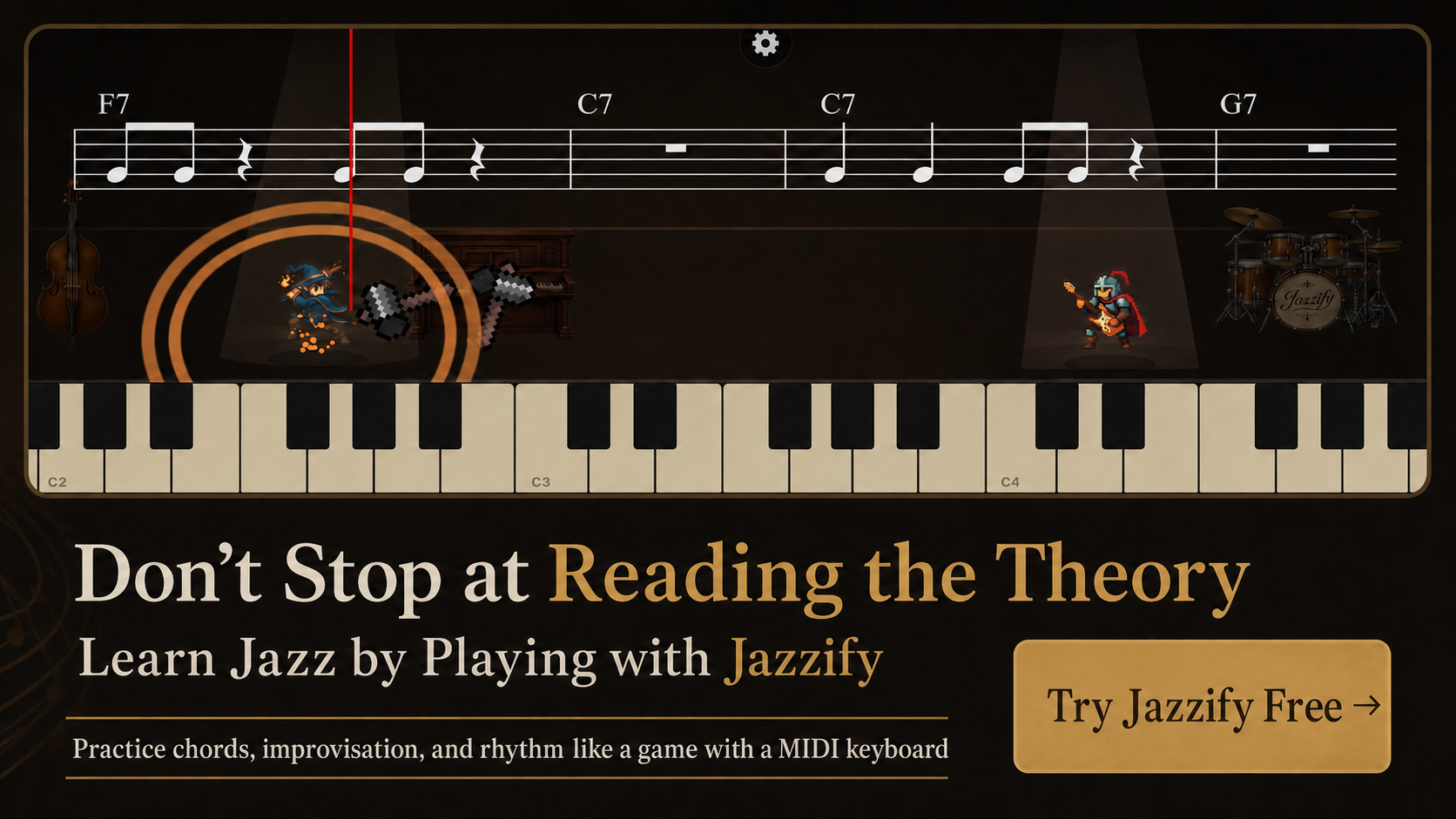
Jazzify is built around this model: connect a MIDI keyboard, work through guided quests covering harmony and improvisation, and get real-time feedback without scheduling a lesson. For a detailed comparison of apps and other tools, see best apps for jazz practice.
How to Match Format to Your Level
Complete beginner (little or no piano experience)
Start with an app or course that covers keyboard geography, basic rhythm, and triads before introducing seventh chords. A live teacher is helpful but expensive at this stage unless you need strong accountability.
Classically trained pianist
Skip note-reading mechanics. Focus on chord symbols, swing rhythm, and ear-based learning. A teacher who understands the crossover saves months. Supplement with an app for daily chord and ear training.
Intermediate (can read lead sheets, know basic voicings)
A teacher helps most with time feel, comping interaction, and solo language. An app keeps voicings and ear skills sharp between lessons. Consider a cohort program for a focused topic like reharmonization or transcription.
Advanced (regular gigging or jamming)
Lessons become coaching: repertoire selection, arrangement decisions, and stylistic depth. Apps remain useful for ear training and maintenance, but the teacher relationship drives growth.
Red Flags When Choosing Online Lessons
- No audio or video of the instructor playing. Jazz is learned by ear and example, not text alone.
- Curriculum jumps from triads to Coltrane substitutions. Missing steps mean missing foundations.
- No mention of time or rhythm. Harmony without swing is not jazz piano.
- Subscription with no clear progression path. Random content libraries feel productive but lack cumulative skill building.
- Teacher cannot explain voice leading in plain language. If they only demonstrate without showing why notes move, you will copy shapes without understanding them.
Building a Hybrid Weekly Schedule
A practical weekly plan combining formats:
| Day | Activity | Format | Duration |
|---|---|---|---|
| Mon–Fri | Guided exercises (chords, ear training, improvisation) | Interactive app | 20–30 min |
| Tue, Thu | Repertoire: learn one standard section | Self-study with lead sheet | 20 min |
| Saturday | Live lesson or course video | Teacher or course | 45–60 min |
| Sunday | Free play: comp and solo over week's tune | Self-study | 30 min |
This structure gives you daily feedback from an app, weekly depth from a teacher or course, and repertoire application every week. Adjust the ratio based on budget — if you cannot afford weekly lessons, biweekly teacher sessions plus daily app practice still works.
What Online Lessons Cannot Replace
No format substitutes for:
- Listening to recordings — apps and courses teach technique; records teach language.
- Playing with other musicians — even a simple duo with a bassist or drummer changes your comping priorities.
- Transcription — copying a player's phrasing and articulation by ear builds vocabulary that no exercise generates.
Use online lessons to build skills. Use listening, transcription, and jam sessions to become a musician. Our guide on how to learn jazz piano by yourself ties these elements into a complete self-study roadmap.
Summary
- Live teachers provide the best feedback on time feel and musical decisions; apps provide the best daily repetition.
- Video courses work when you need structure and can self-motivate without immediate correction.
- Most students benefit from combining two formats rather than relying on one.
- Evaluate any option by checking whether it applies concepts to real tunes with audible voice leading.
- Match the format to your current level: beginners need foundations, classical crossovers need rhythm and ear training, advanced players need coaching.
- Online lessons build skills; listening and playing with others build musicianship.
Play the Jazzify demo right now
Connect a MIDI keyboard and play this interactive demo in your browser.
On iPhone and iPad, browsers cannot use a MIDI keyboard. Please use the Jazzify app instead.