Choosing the best online jazz piano course is less about finding a single winner and more about matching a program to how you learn, what you already know, and how much feedback you need between sessions. A course that works beautifully for a classical crossover student may frustrate a complete beginner, and a video-only syllabus cannot fix a rushed ii-V-I voice lead no matter how well it is filmed.
This 2026 guide breaks down what separates strong jazz piano courses from generic piano content, compares the main delivery formats, and gives you a practical checklist to evaluate any program before you pay.
What Makes a Jazz Piano Course Different From General Piano Lessons
General piano courses teach reading, technique, and repertoire from the classical or pop tradition. A serious jazz course must go further:
- Seventh-chord fluency — building maj7, m7, dom7, and half-diminished shapes in every inversion.
- Functional harmony — understanding why a chord resolves where it does, not just what letter name to play.
- Repertoire application — applying voicings and scales to complete standards, not isolated exercises.
- Ear training — recognizing chord quality, guide tones, and short melodic fragments by sound.
- Rhythm and time feel — practicing with swing subdivision, not just straight eighth notes.
If a course lists "jazz piano" in the title but never comping through a blues or a ii-V-I in a real tune, treat it as introductory material at best.
The Three Course Formats You Will Encounter
| Format | Strengths | Weaknesses | Typical price range |
|---|---|---|---|
| Pre-recorded video library | Deep theory, replayable, self-paced | No feedback on your playing | $50–$300 one-time or subscription |
| Live cohort / masterclass | Accountability, Q&A, peer motivation | Fixed schedule, higher cost | $150–$600 per program |
| Interactive app with curriculum | Instant feedback, daily repetition, MIDI input | Less personalized musical coaching | Free tier + $10–$30/month |
Many working students combine a video course for conceptual depth with an interactive tool for daily practice. Our overview of online jazz piano lessons compares all major formats side by side.
Curriculum Checklist: Eight Topics a Strong Course Must Cover
Before purchasing, scan the syllabus for these milestones. Missing more than two is a red flag.
- Triads and seventh chords in root position and inversions.
- Shell voicings (3-7 or 7-3) and rootless Type A / Type B shapes.
- Major and minor ii-V-I voice leading in multiple keys.
- Blues form comping and a simple blues scale solo approach.
- At least one modal tune (e.g., So What or Impressions).
- Scale choices over maj7, dom7, m7, and half-diminished chords.
- Basic reharmonization or chord-substitution concepts.
- Three or more complete standards with comping and solo demonstrations.
A course that jumps to "advanced voicings" without establishing shell voicings and voice leading usually produces students who know many shapes but cannot navigate a tune.
How to Evaluate Video Quality and Teaching Style
Watch the free preview lesson with these questions in mind:
- Does the instructor play examples at multiple tempos, or only demonstrate once at performance speed?
- Are voicings shown on a keyboard diagram and heard in context with a bass line?
- Does the instructor explain why a note choice works, or only which notes to press?
- Is there a downloadable lead sheet or practice backing track included?
Prefer instructors who reference recordings. A teacher who says "listen to Red Garland comp behind Miles on So What" is grounding theory in the tradition, not just textbook harmony.
Feedback: The Feature Most Courses Lack
Video courses teach concepts well but cannot tell you that your G7 voicing is missing the third or that your left hand rushes beat 2. That gap matters because jazz progress depends on repetition with correction.
Options for getting feedback without a weekly private teacher:
- Community forums attached to the course — useful but slow.
- Monthly group coaching calls — better, but spots are limited.
- Interactive apps with MIDI input — instant pitch and chord-spelling feedback on every attempt.
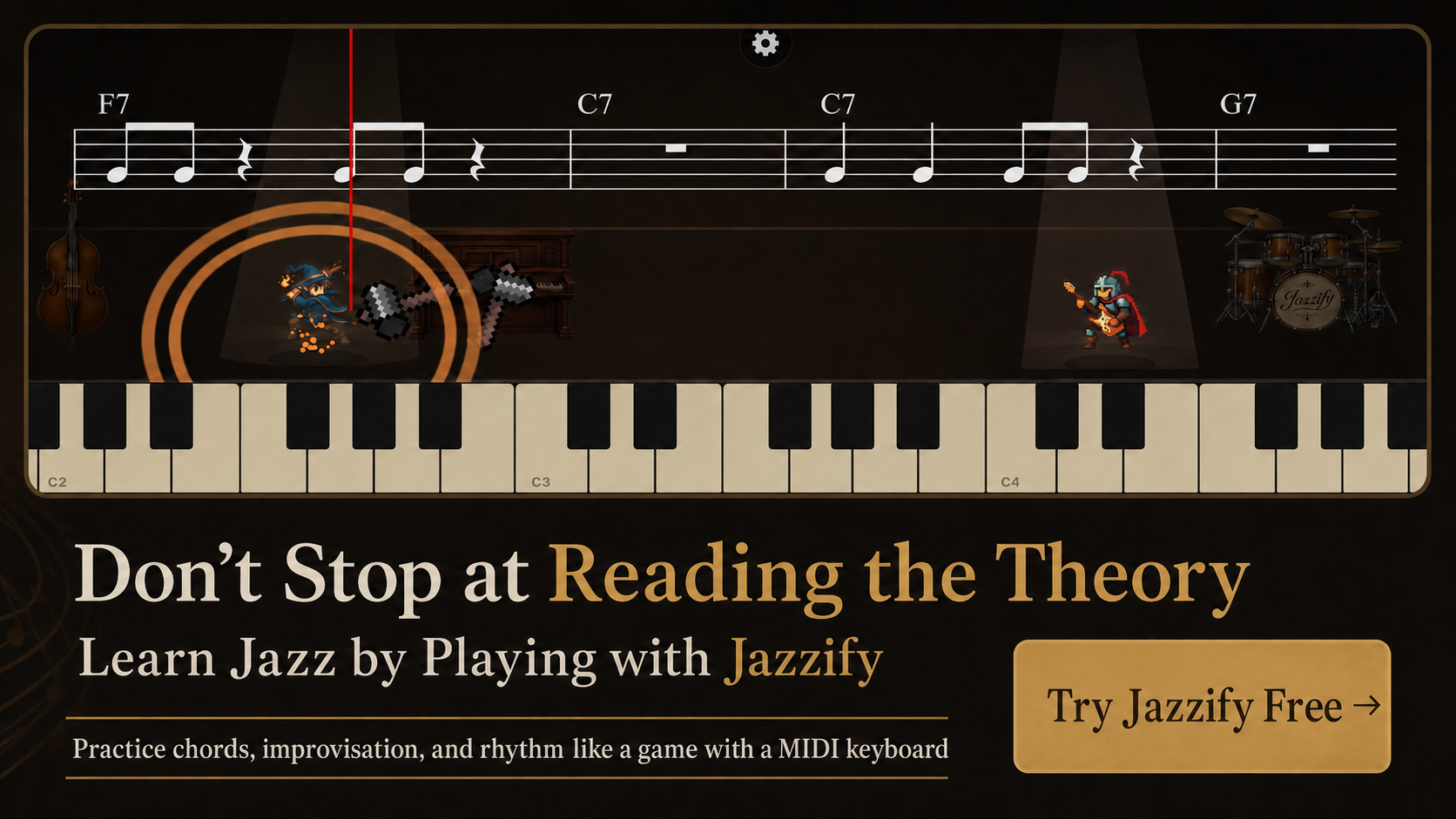
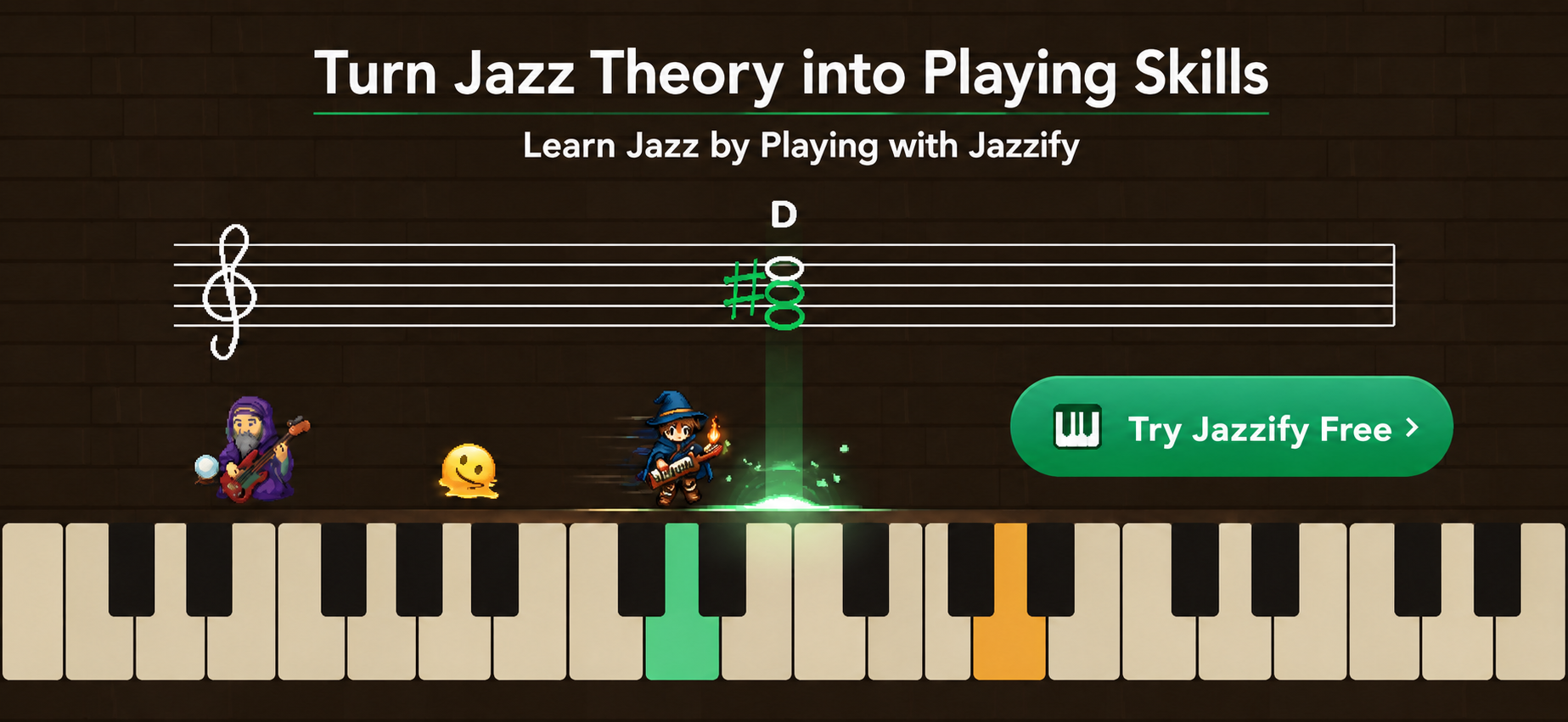
Jazzify fills this gap with browser-based guided quests: connect a MIDI keyboard, play voicings and improvisation exercises, and receive real-time evaluation. It is not a replacement for a human teacher's comments on phrasing, but it covers the daily repetition that video alone cannot provide. See best apps for jazz practice for how interactive tools fit into a full routine.
Matching a Course to Your Starting Point
Complete beginner
Look for a course that spends the first modules on keyboard geography, note names, and basic rhythm before introducing seventh chords. Avoid programs that assume you can already read treble and bass clef fluently unless you genuinely can.
Classical pianist crossover
You likely read well and have hand independence. You need rhythm, chord spelling by ear, and comping — not more Hanon. Seek courses with dedicated crossover modules or teachers who address swing feel explicitly.
Self-taught hobbyist with gaps
Choose a course with a diagnostic quiz or a clear level map so you do not replay material you already know. Focus on voice leading and repertoire application rather than re-learning triads.
Price vs. Value: What You Should Expect to Pay
One-time video courses between $80 and $200 are common for 20–40 hours of content. Subscription platforms run $15–$40 per month. Live cohort programs cost more but include direct access to the instructor.
Calculate value by cost per guided practice hour, not just total video length. A 30-hour library with no exercises is worth less than a 10-hour course that assigns daily drills tied to each lesson. For a detailed price breakdown across formats, read our guide on online jazz piano lessons cost.
Red Flags When Shopping for a Course
- No audio examples — PDF-only content cannot teach jazz time feel.
- Every lesson uses the key of C; no transposition practice.
- "100 voicings" lists without connecting them to functional progressions.
- No mention of listening, transcription, or repertoire.
- Refund policy shorter than 14 days with no preview lesson.
Questions to Ask Before You Buy
Email the instructor or check the FAQ for straight answers:
- Does the course include backing tracks at multiple tempos?
- Can I access content after my subscription ends?
- Is there a community or forum for posting practice recordings?
- Does the syllabus show which standards are covered by name?
- Is MIDI keyboard practice integrated, or is it video-only?
Vague answers to these questions usually mean the course was adapted from generic piano content rather than designed for jazz.
Building a Course Into a Complete Practice Plan
A course provides structure. You still need daily habits outside the videos:
- 15 minutes — technique and voicing drills from the current module.
- 15 minutes — ear training (intervals, chord quality, short phrases).
- 20 minutes — repertoire: learn one standard per month, comp and solo.
- 10 minutes — listen actively to one recording of a tune you are studying.
Our self-study roadmap in how to learn jazz piano by yourself expands this into a weekly schedule.
Summary
- The best online jazz piano course matches your level, includes repertoire application, and covers voice leading — not just chord lists.
- Video libraries teach concepts; interactive apps and teachers provide feedback. Most students need at least two of these.
- Evaluate any course with the eight-topic curriculum checklist before purchasing.
- Watch the preview lesson for tempo variety, voice-leading demonstrations, and recording references.
- Combine course material with daily ear training, listening, and standard repertoire work.
Play the Jazzify demo right now
Connect a MIDI keyboard and play this interactive demo in your browser.
On iPhone and iPad, browsers cannot use a MIDI keyboard. Please use the Jazzify app instead.